

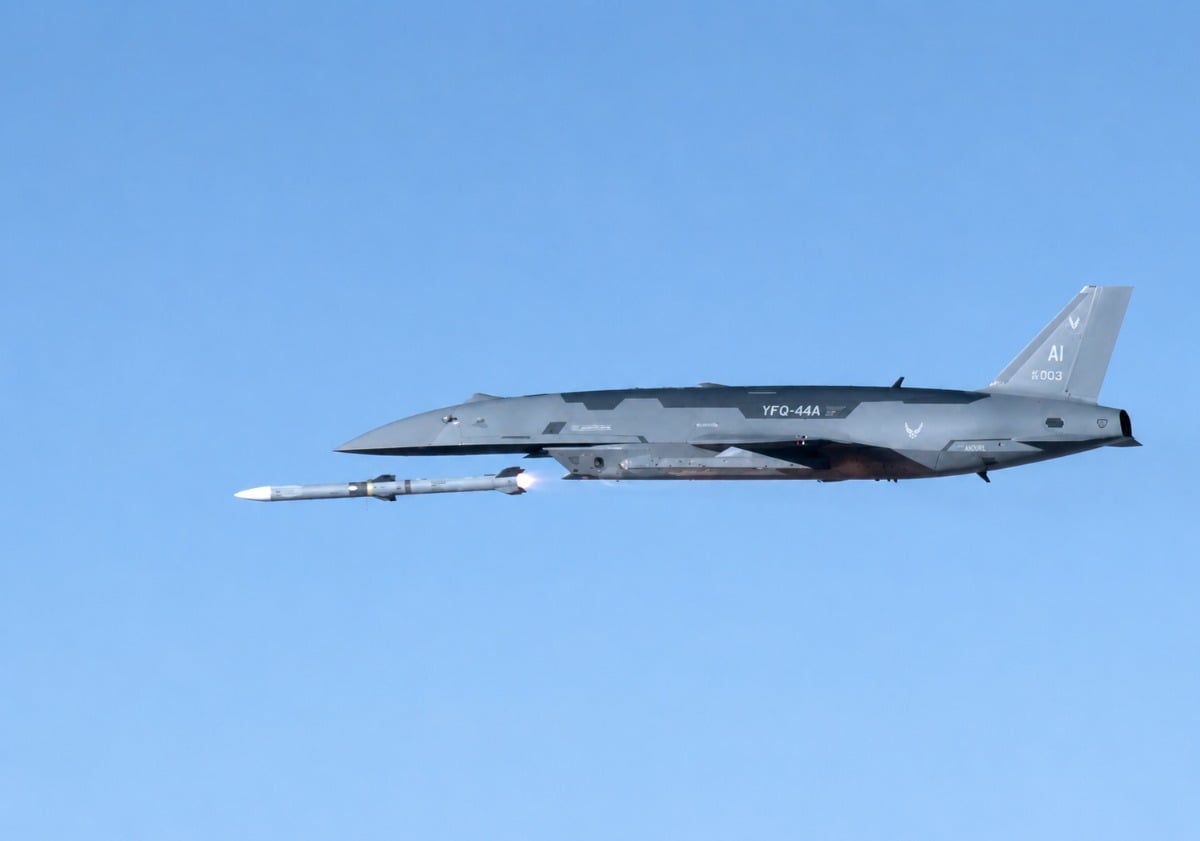
- The Air Force fired an AIM-120 AMRAAM missile from an Anduril YFQ-44A Collaborative Combat Aircraft at a digital target over the Mojave Desert.
- The test marks the first live-fire weapons employment for a Collaborative Combat Aircraft, following earlier inert carriage and data link testing phases.
An unmanned fighter jet just fired a live air-to-air missile at a target over the California desert, and a human sitting somewhere else gave the order to pull the trigger.
The Department of the Air Force confirmed that a YFQ-44A Collaborative Combat Aircraft, the service’s designation for a new class of autonomous fighter drones built to fly alongside crewed jets, successfully fired an AIM-120 AMRAAM missile at a digital target in restricted airspace over the Mojave Desert, marking the first time one of these drones has actually shot a live weapon rather than just carrying one.
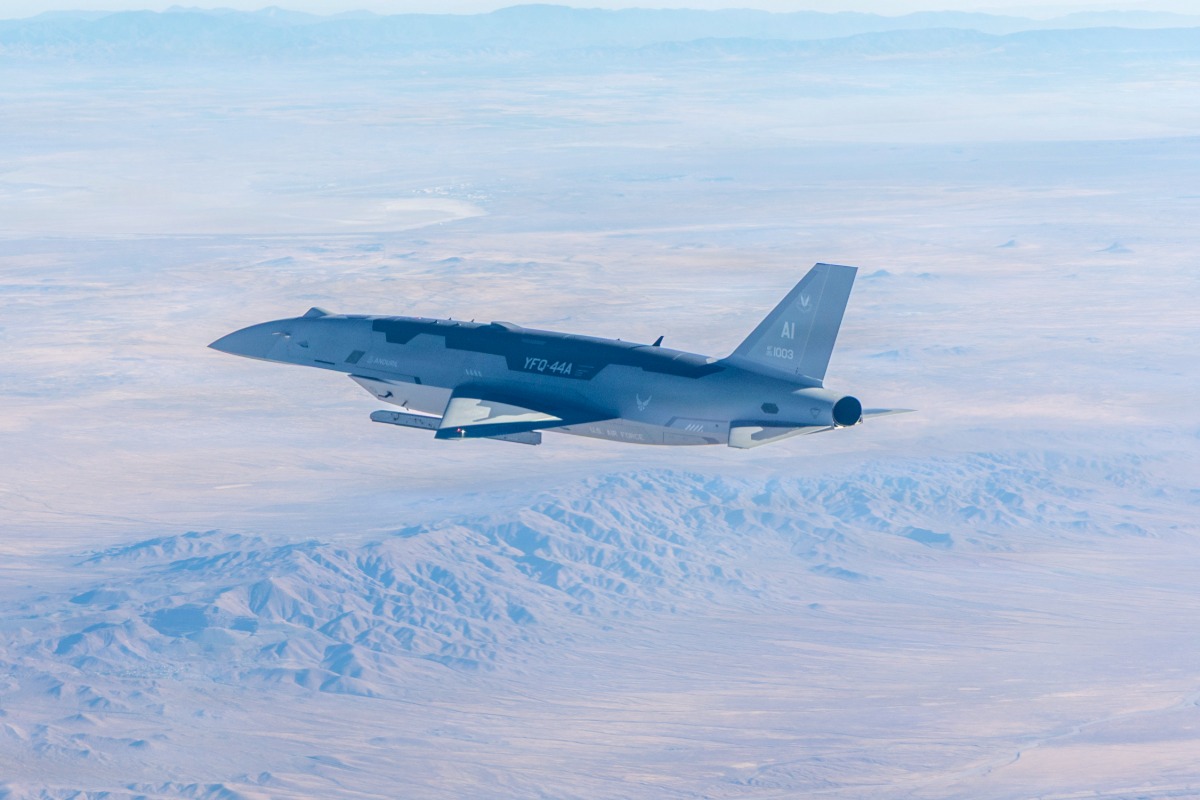
The aircraft involved is built by Anduril Industries and known internally as Fury, and it belongs to a small and closely watched category of drones the Air Force calls Collaborative Combat Aircraft, or CCA, designed to operate as a kind of robotic wingman for pilots flying jets like the F-35 or F-22. Rather than replacing crewed fighters, the concept behind CCA is to multiply what a single pilot can accomplish, giving that pilot extra sets of eyes, extra sensors, and extra weapons spread across multiple unmanned aircraft that can absorb risk a human pilot would otherwise have to shoulder alone. The YFQ-44A first flew under its own power on October 31, 2025, and the Air Force selected it alongside a competing design from General Atomics, the YFQ-42A, nicknamed Dark Merlin, as the two prototypes moving through the program’s initial phase, known as Increment 1.
Engineers first flew the YFQ-44A carrying an inert, non-explosive version of the AIM-120 AMRAAM, a radar-guided air-to-air missile the Air Force has used on crewed fighters for decades, purely to confirm the drone could physically carry the weapon without affecting its handling or aerodynamics in flight. From there, testers moved to validating the data link connecting the aircraft to the weapon itself, essentially confirming that when a human operator sent a command through that link, the drone executed it precisely and without delay in a simulated engagement. Only after both of those steps checked out did the program move to an actual live-fire shot, a sequence the Air Force describes as mirroring the same testing methodology it has long used for crewed combat aircraft.
Air Force Chief of Staff Gen. Ken Wilsbach framed the test as a meaningful step forward for a program that has moved unusually fast by Pentagon standards.
“This live-fire test is an important next step in the development of Collaborative Combat Aircraft,” Wilsbach said. “We’re one step closer to delivering capabilities to the warfighter.”
Despite the drone’s ability to fly and maneuver with a significant degree of autonomy, the Air Force has repeatedly stressed that firing a weapon is not a decision the aircraft ever makes on its own. A human operator retains exclusive command and control over the platform at all times, and CCA is explicitly designed so that the decision to release any weapon requires that operator’s direct authorization rather than an autonomous judgment call by the aircraft’s onboard systems, a distinction the service has built into the program from the start given the legal and ethical weight attached to any system capable of using lethal force.
Gen. Dale White, who serves as the Department of War’s direct reporting portfolio manager for Critical Major Weapon Systems, described the test as proof the program has matured well beyond its early prototype stage.
“Moving from inert carriage earlier this year to today’s weapon release demonstrates program maturity, allowing us to validate our digital integration models with actual data,” White said. “These tests provide operational validation that Collaborative Combat Aircraft can execute the weapon employment sequence autonomously within pilot-defined parameters, accelerating capability delivery to the warfighter.”
Anduril offered additional detail on exactly how the engagement unfolded, describing it as considerably more involved than a simple weapons release. Mark Shushnar, the company’s vice president of autonomous airpower, said the YFQ-44A took off from Edwards Air Force Base in California, received a target track through the company’s Lattice software platform, and fired the AIM-120 only after a human operator formally tasked the aircraft to engage, a sequence he characterized as an end-to-end, beyond-line-of-sight strike against a simulated target rather than a scripted demonstration.
The test came together through the 412th Test Wing’s Air Dominance Combined Test Force, a mixed team of active-duty service members, government civilians, and contractors who spent months refining and validating the technical models needed to safely execute a live-fire event of this kind, work that carries real stakes given that a mistake during weapons testing on an experimental aircraft can ground an entire program for months.