

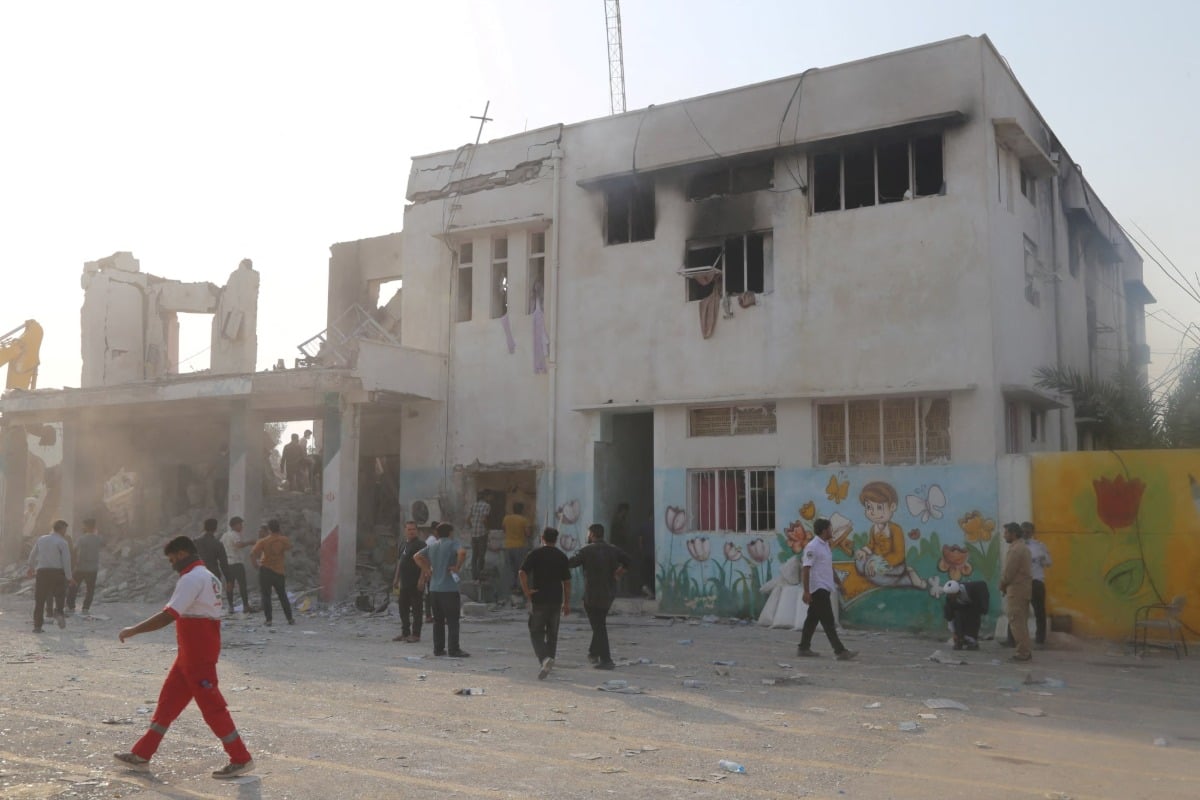
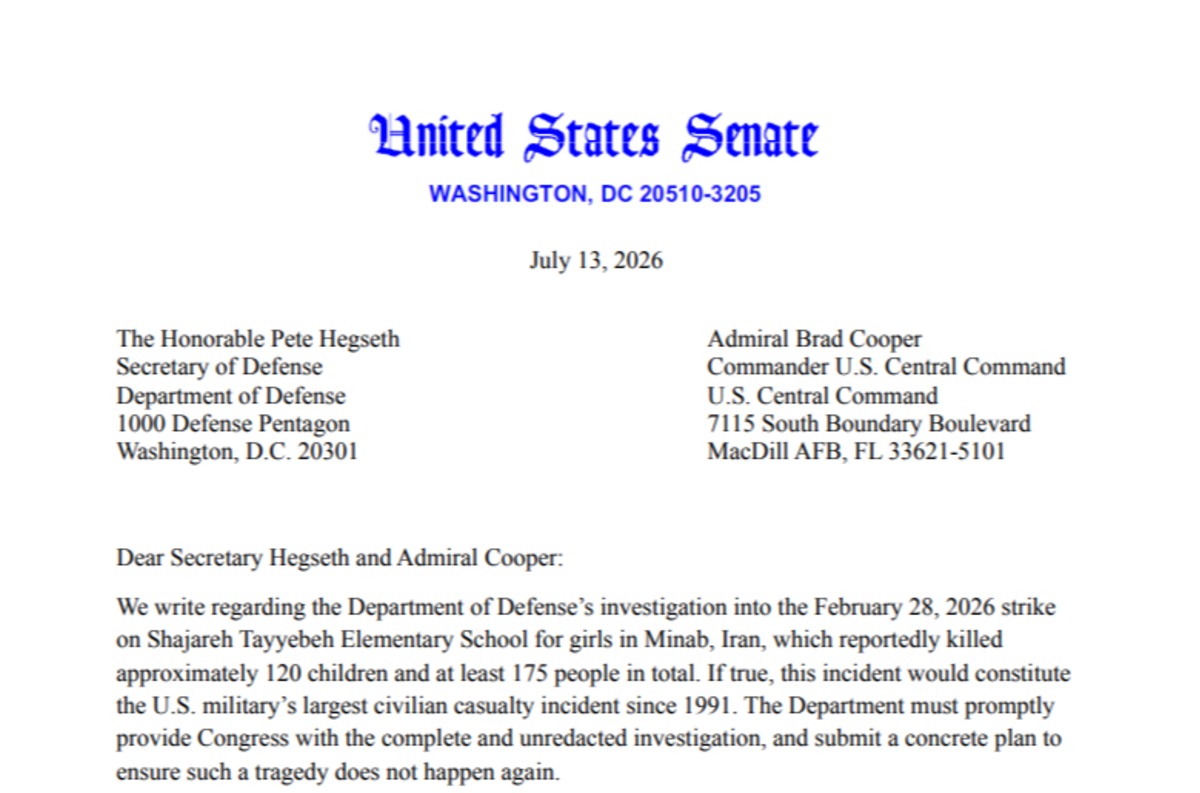
- Twenty-five Democratic senators sent a letter July 13 demanding the Pentagon release its investigation into the February 28 strike on a girls' school in Minab, Iran.
- The senators asked Defense Secretary Pete Hegseth and CENTCOM Commander Admiral Brad Cooper to provide findings and a prevention plan to Congress by July 20, 2026.
Twenty-five U.S. senators want to know why the Pentagon is still sitting on an investigation into one of the deadliest strikes involving American forces in more than three decades, and they’re giving the Department of War exactly one week to start answering.
Senators Elissa Slotkin of Michigan and Kirsten Gillibrand of New York, joined by 23 Democratic colleagues, sent a letter Monday to Defense Secretary Pete Hegseth and Admiral Brad Cooper, the four-star officer who leads U.S. Central Command, the military command responsible for American operations across the Middle East, demanding the release of findings from an investigation into the February 28 strike on Shajareh Tayyebeh Elementary School, a girls’ school in the southern Iranian city of Minab. The strike happened on the opening day of the 2026 war between the United States, Israel, and Iran, and it quickly became the conflict’s deadliest single incident for civilians, with death toll estimates from Iranian authorities and international investigators ranging from roughly 156 to more than 170 people, most of them schoolgirls between the ages of 7 and 12. The senators’ letter cites figures of approximately 120 children killed and about 175 people in total, numbers that, if accurate, would make the strike the U.S. military’s largest civilian casualty incident since 1991.
Neither the United States nor Israel has formally claimed responsibility for the strike, but the evidence pointing toward American involvement has piled up steadily in the months since. Amnesty International’s analysis of missile fragments and video footage concluded that a U.S.-manufactured Tomahawk cruise missile, a precision-guided weapon fired exclusively by American forces during the conflict, likely struck the school, and independent munitions experts who reviewed footage of the attack for Time magazine reached the same conclusion. Satellite imagery reviewed by Human Rights Watch and other researchers shows the school building had been physically separated by its own walls and entrances from an adjacent Islamic Revolutionary Guard Corps naval compound since at least 2016, meaning the site had functioned as a civilian school, unconnected to the military facility next door, for roughly a decade before the strike occurred.
That gap between what satellite imagery showed and what apparently guided the strike sits at the center of the senators’ concern. Their letter cites press reporting indicating that an intelligence analyst flagged as early as 2019 that the site appeared to have changed from a naval facility into a school, but that observation was entered into what the senators describe as a digital intelligence tool that was never connected to the authoritative targeting database, the master system military planners rely on when selecting and verifying strike targets. According to the reporting the senators cite, the site was reviewed multiple additional times in the years that followed without anyone updating that targeting database to reflect the change, meaning outdated information about the location may have remained in the system used to plan strikes even as the building’s civilian status became increasingly well documented elsewhere.
The senators’ letter goes further, citing reporting from this past week alleging that warnings appeared within the targeting system itself, flagging that intelligence about the site was outdated, but that those warnings were dismissed for what the reporting describes as reasons of “expediency,” despite the Trump administration having spent weeks planning the operation before it began. If accurate, that detail would suggest the failure was not simply a case of stale data slipping through unnoticed, but a warning that surfaced and was overridden anyway.
“These reported issues, if accurate, raise deeply troubling questions about the integrity of U.S. target development, the adequacy of target validation and vetting procedures, the interoperability of intelligence and targeting databases, the timeliness and reliability of intelligence used for lethal targeting, and the Department’s implementation of civilian harm mitigation policies,” the senators wrote.
According to the senators, Admiral Cooper’s investigation was submitted for review back in April, meaning senior Defense Department leadership has now had the findings in hand for roughly three months without releasing them publicly or, according to the letter, briefing Congress on the results.
“More than four months after the strike, and after the reported submission of the investigation in April, Congress and the American people still have not received the Department’s investigation and findings,” the senators wrote. “There is no justification for withholding an unclassified accounting of what happened, what went wrong, and what the Department is doing to prevent recurrence.”
The letter lays out four specific demands the senators want met by July 20: a complete, unredacted version of the investigation delivered to Congress, a separate unclassified version suitable for public release, a written prevention and remediation plan spelling out concrete corrective steps, and a formal congressional briefing covering both the investigation and the Department’s plans to prevent similar failures. All 25 signatories are Democrats, including Senators Elizabeth Warren, Tim Kaine, Mark Kelly, Adam Schiff, and Jack Reed, the Rhode Island senator who serves as the top Democrat on the Senate Armed Services Committee, and no Republican senators joined the letter.
“The United States military has a legal and moral obligation to take all feasible precautions to prevent civilian harm,” the senators wrote. “When a U.S. strike kills civilians, the Department owes Congress, the American people, and the victims’ families a clear accounting of what happened and a credible plan to prevent future failures.”
Whether the Pentagon meets that July 20 deadline remains to be seen, and the letter itself carries no legal force to compel a response. What it does carry is a bipartisan reminder written by only one party that oversight of American military power does not end when the missiles stop falling, and that for the families of more than a hundred children buried in Minab, an unclassified accounting is the smallest possible answer a government can owe.