

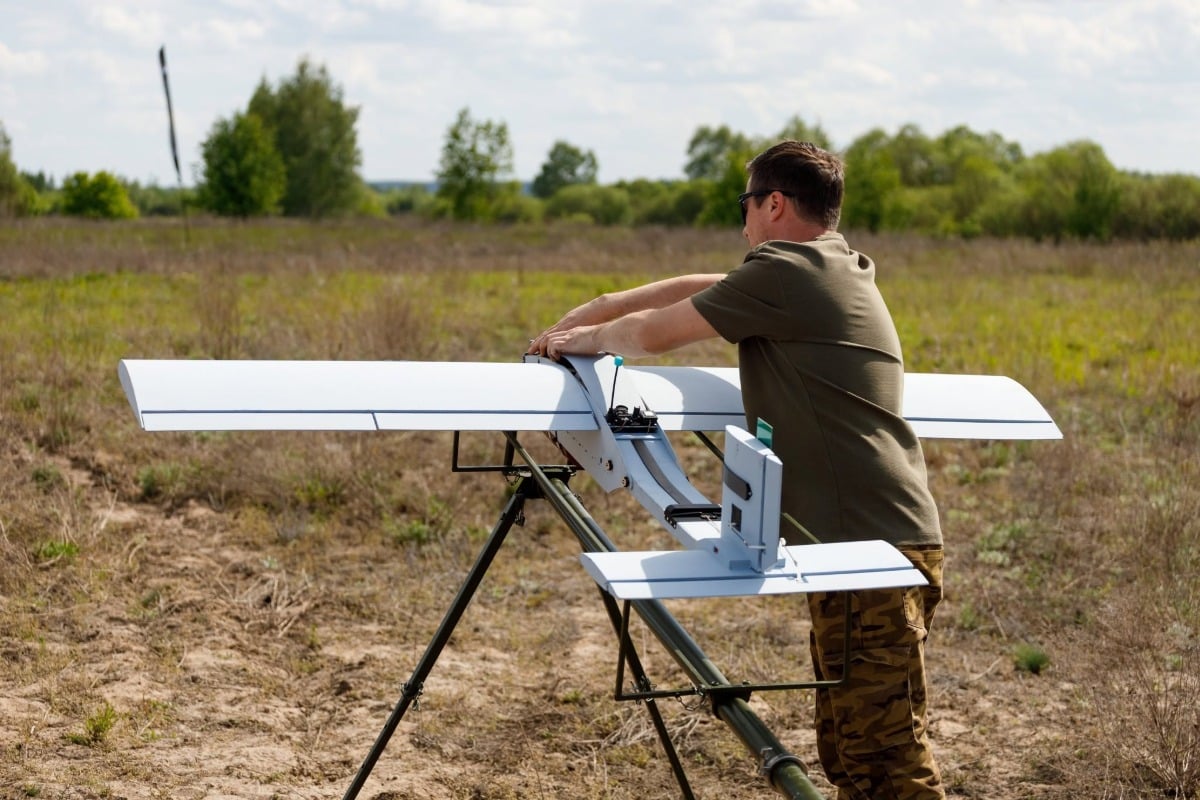
- President Volodymyr Zelenskyy said Ukraine now produces about 10 million drones a year, up from a 1 million target set in 2023.
- Zelenskyy said Ukraine is developing its own ballistic missile capability for the first time and wants to help build a unified European anti-ballistic missile system.
Ukraine now builds roughly 10 million drones a year, a tenfold jump from the target President Volodymyr Zelenskyy first announced just three years ago, Radio Svoboda, the Ukrainian service of Radio Free Europe/Radio Liberty, reported. Zelenskyy delivered the figure during a ceremony in Kyiv marking Ukrainian Statehood Day, framing it as proof that a goal many dismissed as unrealistic when he first floated it has since been surpassed by a wide margin.
“I remember when I first publicly announced the state’s plan: a million drones a year. There was a lot of skepticism everywhere, both inside and outside the country. And now we can state: we are making 10 million drones a year. 10, and it will be 20,” he said.
That original million-drone target dates back to December 2023, when Zelenskyy unveiled it as an ambitious goal for the following year, with Ukraine’s then-Minister for Strategic Industries, Oleksandr Kamyshin, noting at the time that the country was already producing more than 50,000 first-person-view drones a month. The gap between that early figure and Wednesday’s claim illustrates how dramatically Ukraine’s drone industry has scaled since then, growing from a handful of workshops and volunteer-driven manufacturers into what officials now describe as a decentralized network of more than 200 companies building everything from cheap, disposable frontline strike drones to long-range aircraft capable of hitting targets deep inside Russia.
Zelenskyy’s new figure sits notably higher than recent independent estimates of Ukraine’s drone output. The Council on Foreign Relations, a U.S.-based foreign policy think tank, estimated that Ukraine produced roughly four million robotic and autonomous systems in 2025, with output tracking toward five to six million for 2026, and separate reporting has cited a Ukrainian government target of around seven million units by the end of this year. Neither of those figures, nor Wednesday’s remarks, specify exactly which categories of unmanned systems count toward the total, whether that includes small first-person-view drones, ground robots, naval drones, and long-range strike aircraft all combined, or which portion comes from state-run defense enterprises versus the private manufacturers that have proliferated since the war began. That distinction matters because Ukraine’s drone ecosystem spans wildly different price points and capabilities, from first-person-view quadcopters that reportedly cost around $400 apiece to deep-strike aircraft like the Fire Point FP-1, which has demonstrated a range of up to 1,600 kilometers (994 miles), so a single combined production number can obscure as much as it reveals about where that capacity is actually going.
Zelenskyy said Ukraine is developing its own ballistic missile capability for the first time, a category of weapon distinct from the cruise missiles and drone-missiles the country has already fielded, such as the Peklo and the jet-powered Flamingo, also known as the FP-5. Where a cruise missile flies a relatively flat, airplane-like trajectory powered by a jet or rocket engine throughout its flight, a ballistic missile launches on a steep, rocket-powered climb before arcing back down toward its target at extremely high speed, a flight profile that gives air defense systems dramatically less time to detect, track, and intercept it. Russia has used ballistic missiles extensively against Ukrainian cities throughout the war, and until now Kyiv has had to rely entirely on donated Western air defense systems like the Patriot to counter that threat rather than fielding any ballistic capability of its own.
Zelenskyy tied that development directly to a broader push for a continent-wide missile shield.
“We will do everything to build Europe’s anti-ballistic missile system, uniting all European anti-ballistic missile capabilities. So that the sky over our peoples is protected, so that dictators cannot dictate how free people in Europe should live. So that the lives of people in Ukraine and in every European country do not depend on whether Putin and those like him have ballistic missiles or not,” he said.
The framing reflects a shift in how Ukrainian officials describe the war’s endpoint, moving away from talk of crippling Russia’s economy toward a longer-term vision centered on separating Ukraine’s future from Russian influence entirely. Zelenskyy said Ukraine’s central objective is not, in his words, “Russia without gasoline,” a reference to the Ukrainian drone campaign that has knocked out a significant share of Russian oil refining capacity over the past year, but rather “Ukraine without Russia.”
“Ukraine with Europe. And Ukraine and Europe without the Moscow threat,” he said, thanking what he called “every leader who is doing everything possible for our common security.”