

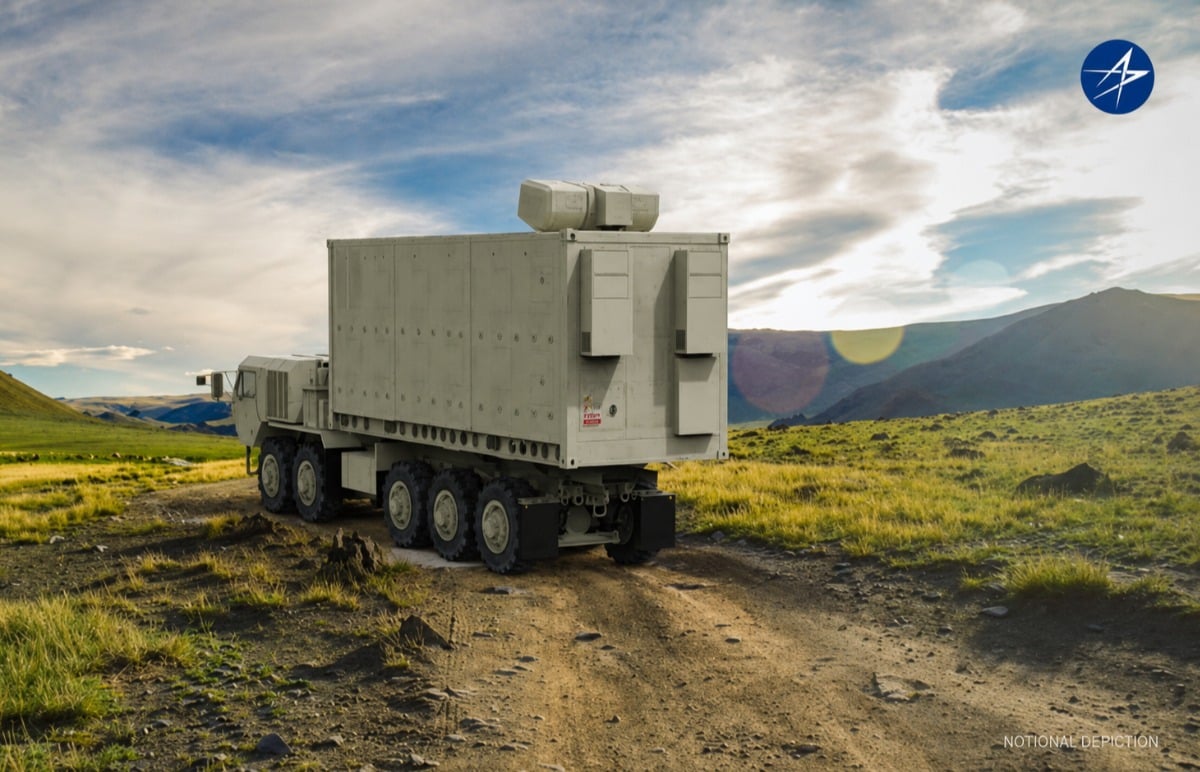
- The U.S. Department of War awarded Lockheed Martin a Joint Laser Weapon System contract on July 9, 2026, to build a containerized 500 kW laser weapon.
- The combined JLWS agreements with Lockheed Martin and nLight Defense carry an initial value of $86 million and a program ceiling of $847 million.
Lockheed Martin has been tapped by the U.S. Department of War to build the most powerful laser weapon ever packed into a shipping container, a 500-kilowatt system designed to knock cruise missiles and drone swarms out of the sky before they reach American forces or the homeland.
The Bethesda, Maryland-based defense giant announced the award on July 9, 2026, under the Joint Laser Weapon System (JLWS) program, a Department of War effort to give combatant commanders a cheaper, faster way to intercept aerial threats than firing missiles at them. Lockheed Martin will develop the system through its collaboration with Scaled Directed Energy, one of six Critical Technology Areas the Department has designated under the Office of the Under Secretary of War for Research and Engineering.
The Department did not disclose Lockheed Martin’s specific award amount in its announcement, but independent reporting from Military.com put the combined initial value of the JLWS agreements, split between Lockheed Martin Aculight and a second contractor, nLight Defense, at $86 million, with a total program ceiling of $847 million if all options are exercised. That structure, known as an Other Transaction Authority agreement, lets the Pentagon skip some of the slower steps of traditional defense contracting to get prototypes into the field faster.
Cheap, mass-produced drones have swarmed battlefields from Ukraine to the Middle East, and traditional air defense, which fires missiles costing hundreds of thousands of dollars apiece at targets that sometimes cost a few thousand dollars to build, is a losing financial trade. A laser weapon fires at the speed of light, never runs out of ammunition as long as it has power, and costs only a few dollars per shot once it is operating. That combination is why the Department of War is racing to move directed energy weapons out of testing labs and into actual units.
“We are honored to field this operational-tactical prototype – the highest-power laser ever packaged in a transportable container,” said Paul Lemmo, vice president and general manager of Lockheed Martin Sensors, Effectors, and Mission Systems.
Lemmo’s team is drawing on more than 15 years of laser weapons work at Lockheed Martin, much of it built around a persistent engineering problem: high-energy lasers need enormous amounts of power and cooling, and cramming that into something small enough to move to a battlefield has been the industry’s central challenge. Lockheed Martin says its approach to lowering the size, weight, and power requirements of its systems is what lets it build containerized weapons on a compressed timeline rather than waiting years for a purpose-built platform.
According to reporting on Pentagon budget documents by Defense News, the JLWS effort will unfold in stages. Initial prototypes will start at around 150 kW, a power level suited to shooting down individual drones and smaller threats, before scaling into the 300 to 500 kW range the Department considers necessary for reliable cruise missile defense, since missiles fly faster, lower, and with hardened bodies that take far more sustained energy to destroy than a drone’s exposed frame. In parallel, Lockheed Martin’s 500 kW integrated system will draw on a laser source developed under the Department’s High Energy Laser Scaling Initiative, a separate research effort aimed at pushing laser output past the megawatt threshold.
Both the scalable and integrated systems are being built in containerized form, meaning they can be shipped like standard cargo and bolted onto ground vehicles or ships rather than requiring a dedicated hull or chassis. That modularity is meant to let the military move a laser weapon to whichever combatant command needs it most without a lengthy integration process.
The company is the prime contractor on two systems that JLWS is meant to build on: the Navy’s 60 kW High Energy Laser with Integrated Optical-Dazzler and Surveillance, currently installed aboard the USS Preble, an Arleigh Burke-class guided-missile destroyer (505 ft, roughly 154 m), and the Army’s 300 kW Indirect Fire Protection Capability-High Energy Laser prototype. Those two programs have spent years working through the thermal management and beam control problems that any high-power laser weapon has to solve before it can reliably track and destroy a fast-moving target.
The newsletter Laser Wars reported that Lockheed Martin and nLight participated in a directed energy demonstration for Secretary of War Pete Hegseth and Under Secretary Emil Michael at White Sands Missile Range in New Mexico on June 23, 2026, where laser weapons stopped incoming drones and simulated cruise missiles during testing.
“We must actively defend the homeland against emerging threats,” said Emil Michael, Under Secretary of War for Research and Engineering.
“We are partnering with industry to rapidly deliver deep magazine directed energy capabilities to the Joint Force that can be seamlessly deployed across multiple domains.”
The JLWS award also feeds into the broader Golden Dome for America initiative, the administration’s push for a layered homeland missile shield that combines space-based sensors, interceptors, and directed energy weapons.