

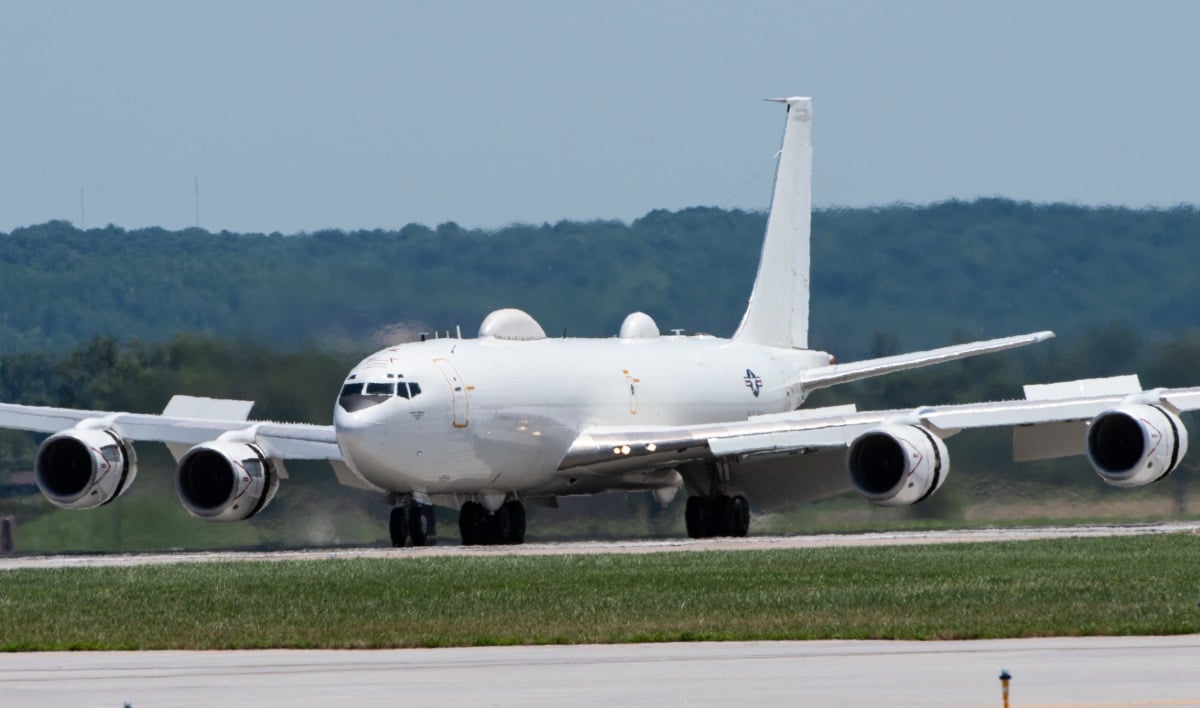
- The U.S. Navy posted a draft Request for Proposal on July 9, 2026, for a maintenance and repair contract covering the E-6B Mercury fleet.
- The contract would run for five years with an option for five more, covering fiscal years 2027 through 2036, with industry comments due July 24.
If nuclear war ever broke out and every ground-based command center went dark, a fleet of aging jets built on a 1960s airliner design would still be able to relay the launch order, and the U.S. Navy just opened bidding on a decade-long contract to keep those planes flying. The Naval Air Systems Command posted a draft solicitation on July 9 for maintenance, repair, and overhaul services on the E-6B Mercury, the Navy’s airborne nuclear command post, with industry comments due by July 24 ahead of a final contract award expected in the third quarter of fiscal year 2027.
The E-6B Mercury carries a job description most aircraft never have to think about: staying survivable enough to keep America’s nuclear chain of command intact even if the ground-based system that normally handles it gets destroyed. Built by Boeing on a modified 707 airliner airframe, the E-6B performs what the military calls the TACAMO mission, short for “Take Charge and Move Out,” transmitting very low frequency radio signals through a trailing wire antenna that can extend roughly five miles behind the aircraft, a signal capable of reaching Navy ballistic missile submarines even while they remain fully submerged deep underwater.
The same aircraft doubles as an airborne backup command post known as Looking Glass, equipped with an Airborne Launch Control System that lets military leaders remotely transmit launch orders to the nation’s land-based Minuteman III intercontinental ballistic missiles if ground control facilities become inoperable during a crisis.
That dual mission makes the E-6B one of a small handful of aircraft the U.S. military genuinely cannot afford to have grounded, a status the Navy has historically shorthanded with the nickname “doomsday plane.” The current fleet consists of just 16 aircraft, all originally delivered between 1989 and 2006, and split between two operational squadrons based at Tinker Air Force Base in Oklahoma, the “Ironmen” of Fleet Air Reconnaissance Squadron VQ-3 and the “Shadows” of VQ-4, supported by a training squadron called the “Roughnecks” of VQ-7. Those aircraft rotate through 15-day deployment cycles maintaining round-the-clock alert coverage over the Atlantic and Pacific, a demanding operational tempo that has left the fleet averaging nearly 35 years of age even as it remains one of the most heavily relied-upon links in America’s entire nuclear command structure.
The Navy intends to award a single-source Indefinite Delivery Indefinite Quantity contract structured around a five-year base ordering period running from fiscal years 2027 through 2031, with an option for an additional five-year period extending coverage through 2036, giving whichever contractor ultimately wins the award a full decade of guaranteed depot maintenance work on a fleet the Navy has openly acknowledged is approaching the end of its useful service life.
The service has already begun transitioning the TACAMO mission to a new aircraft called the E-130J Phoenix II, a heavily modified version of Lockheed Martin’s C-130J-30 Super Hercules military transport, following a formal naming decision the Navy announced in October 2024. Northrop Grumman won a $3.5 billion development contract in December 2024 to integrate mission systems onto the E-130J airframes, and the first converted aircraft emerged from modification work in September 2025, with the Navy’s budget documents indicating the replacement process is set to begin in fiscal year 2028. Notably, current planning indicates the E-130J will take over only the TACAMO submarine communication mission, not the Looking Glass airborne launch control function, leaving an open question about which platform will eventually assume that second, equally critical role once the E-6B finally retires.
Given how long that transition is expected to take, the Navy has made clear it is not simply letting the E-6B coast toward retirement while waiting for its replacement to arrive. The service awarded Collins Aerospace a $20 million contract in late 2025 specifically to produce three high-power transmit set modernization kits for the E-6B, upgrading key communications equipment on an aircraft the Navy has said will likely remain in active service into the early to mid-2030s even as the E-130J gradually enters the fleet. This week’s maintenance contract solicitation fits that same pattern, treating the E-6B as an aircraft requiring sustained, serious investment through the next decade rather than one being allowed to run down its remaining service life on minimal upkeep.