

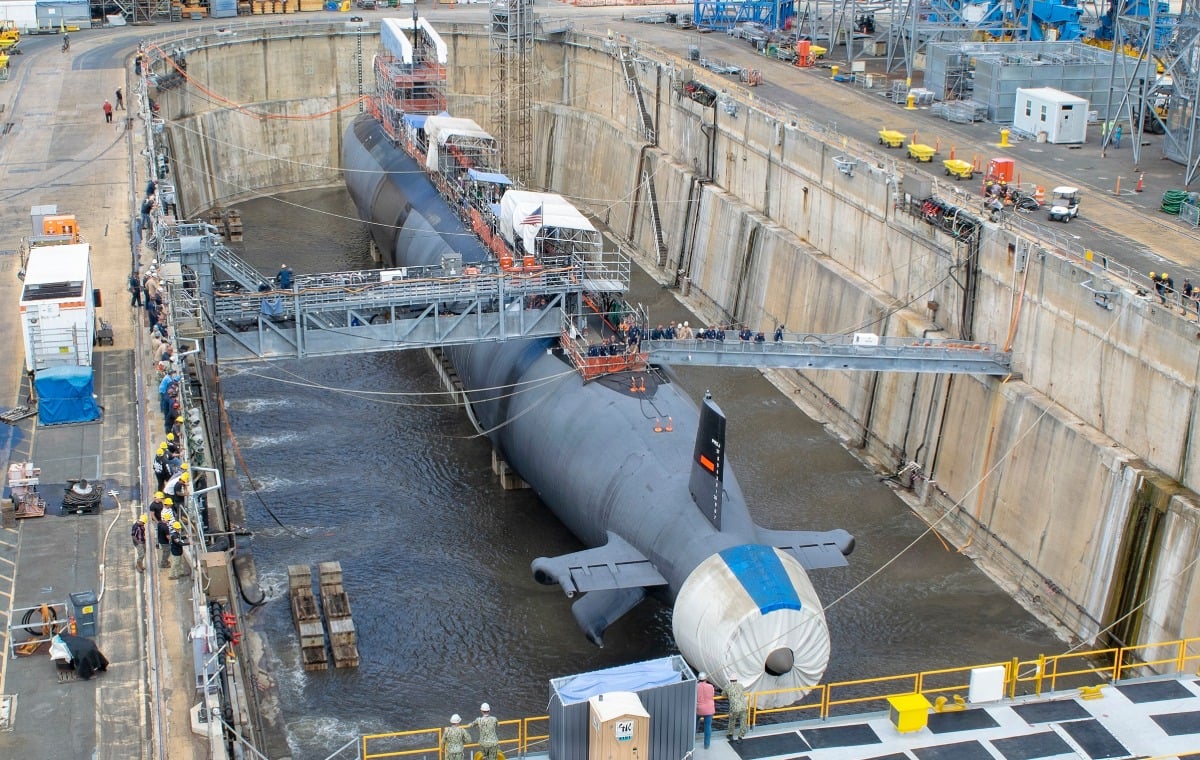
- USS Illinois (SSN-786) completed a scheduled maintenance period at Pearl Harbor Naval Shipyard, undocking on June 24, 2026.
- Illinois is identified by open-source trackers as the second Virginia-class submarine confirmed to carry the Large Vertical Array sonar system.
The U.S. Navy released photos showing divers entering Dry Dock 2 as the attack submarine USS Illinois (SSN-786) prepared to undock at Pearl Harbor Naval Shipyard and Intermediate Maintenance Facility on June 24, 2026, marking the completion of a scheduled maintenance period for one of the fleet’s most closely watched Virginia-class boats.
Open-source trackers monitoring the Navy’s ongoing submarine acoustic upgrade program have identified Illinois as the second Virginia-class submarine confirmed to carry the Large Vertical Array, a next-generation sonar system the Navy has spent nearly two decades developing to keep its attack submarines ahead of increasingly capable Russian and Chinese undersea threats.
The Large Vertical Array, commonly shortened to LVA, is a hull-mounted acoustic sensor built to give a submarine sharper, longer-range detection of other vessels moving through the water around it. Unlike the six Light Weight Wide Aperture Arrays already running along the flanks of every Virginia-class hull, the LVA sits as a distinct addition specifically engineered to sharpen the submarine’s ability to build what naval officials call a tactical picture, the composite understanding of every contact nearby that lets a crew decide whether to close distance, evade, or engage. United Technologies Aerospace Systems, now part of RTX, began manufacturing the first production LVA units at its Jacksonville, Florida facility in 2017, following nearly a decade of prototype development work conducted jointly with the Navy and prime submarine builder General Dynamics Electric Boat.
Publicly available Navy briefing material, some of it circulating online in unclassified-marked slide decks detailing the service’s Acoustic Superiority program, frames the LVA as part of a broader package of quieting improvements the Navy first proved out on USS South Dakota (SSN-790) under an effort called the South Dakota Insertion Program. That program combined the LVA with enhanced hull treatment and internal machinery quieting upgrades, all aimed at making the submarine both harder to detect and better able to detect others, and the slides indicate South Dakota underwent a one-year post-shakedown availability in 2018 before completing at-sea demonstration testing of the new systems in 2019. According to the Navy’s own documentation, the effort represented the service’s first significant investment in Virginia-class sonar arrays and hull coatings since the class’s original design, driven by what officials described in the same briefing materials as the Chief of Naval Operations’ mandate to maintain undersea dominance through the middle of this century.
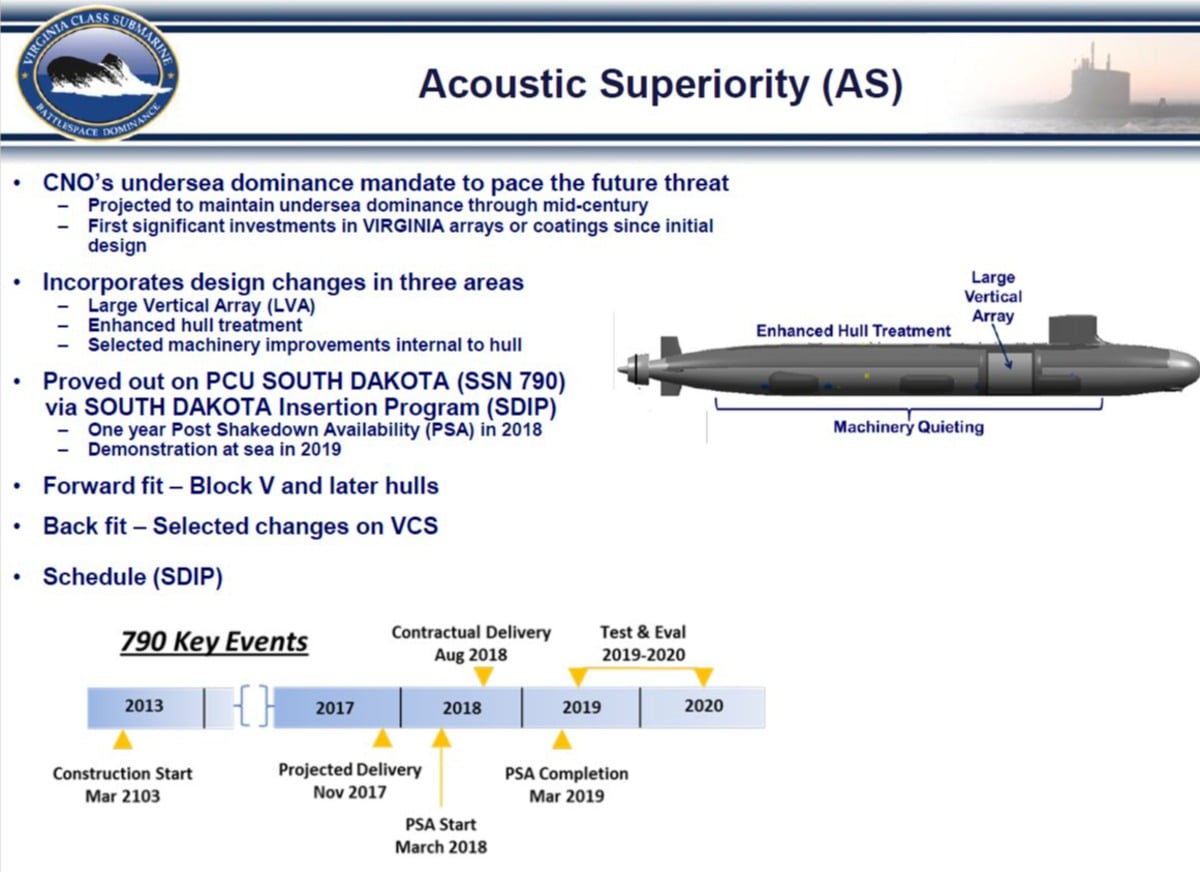
That upgrade path was never meant to stop with a single demonstration hull. According to reporting from naval analyst H I Sutton, published through Naval News, the Navy’s plans call for the LVA to become standard equipment on the newest Block V Virginia-class submarines going forward, installed as a forward fit during construction, while earlier Block III and IV boats already in the fleet are eligible for the array as a back fit retrofit during scheduled maintenance periods, the same kind of extended overhaul Illinois has just completed at Pearl Harbor. Sutton’s reporting also noted indications that an LVA had been fitted to at least one Ohio-class ballistic missile submarine, USS Tennessee (SSBN-734), suggesting the Navy’s acoustic upgrade ambitions extend beyond the Virginia-class fleet into the country’s nuclear deterrent boats as well, though that broader rollout across submarine classes remains only partially documented in open sources.
Commissioned on October 29, 2016, as the 13th submarine of its class, Illinois belongs to the Block III variant, a design that introduced a redesigned bow section carrying two large-diameter Virginia Payload Tubes in place of the class’s original individual vertical launch tubes, a change that reduced construction costs by an estimated $400 million per hull while preserving the submarine’s Tomahawk land-attack missile capacity. The boat is capable of anti-submarine warfare, anti-surface ship warfare, strike missions, special operations forces support, and intelligence, surveillance, and reconnaissance, a mission set that benefits directly from any improvement to how effectively its crew can detect and track other vessels operating nearby.
Pearl Harbor Naval Shipyard and Intermediate Maintenance Facility, where Illinois just completed its overhaul, holds a strategic position in the Navy’s broader Pacific posture that extends well beyond routine ship repair. Positioned roughly halfway between the U.S. West Coast and the western Pacific, the facility functions as the Navy’s most comprehensive fleet repair and maintenance hub in that stretch of ocean, giving forward-deployed submarines and surface ships a place to undergo major upgrades without needing to sail all the way back to the continental United States, a logistics advantage that becomes increasingly valuable as the Navy positions more of its most capable submarines to respond quickly to potential contingencies involving China.
The identification of Illinois as an LVA recipient rests on open-source analysis connecting this maintenance timeline to the Navy’s previously documented Acoustic Superiority rollout schedule rather than on any explicit Navy confirmation naming the array by name in connection with this particular boat, a distinction that matters given how closely the Navy typically guards specifics about submarine sensor upgrades even when the broader program itself has been publicly discussed for years.
If the identification holds, Illinois joins South Dakota as one of only a small number of Virginia-class hulls confirmed to carry a technology the Navy has spent the better part of two decades developing specifically to keep pace with rival submarine fleets that have themselves grown quieter and more capable.