

- MITS Capital invested in Dropla Tech, a Danish-Ukrainian defense technology company, on July 9, 2026, with the deal size undisclosed.
- Dropla Tech's Blue Eyes system has recorded more than 5,000 confirmed explosive threat detections in Ukraine with accuracy above 90 percent.
MITS Capital, an American-Ukrainian investment group, announced on July 9 that it has invested in Dropla Tech, a Danish-Ukrainian defense technology company whose flagship system detects landmines, improvised explosive devices, and ambush drones in real time, though neither company disclosed the deal size or Dropla Tech’s current valuation.
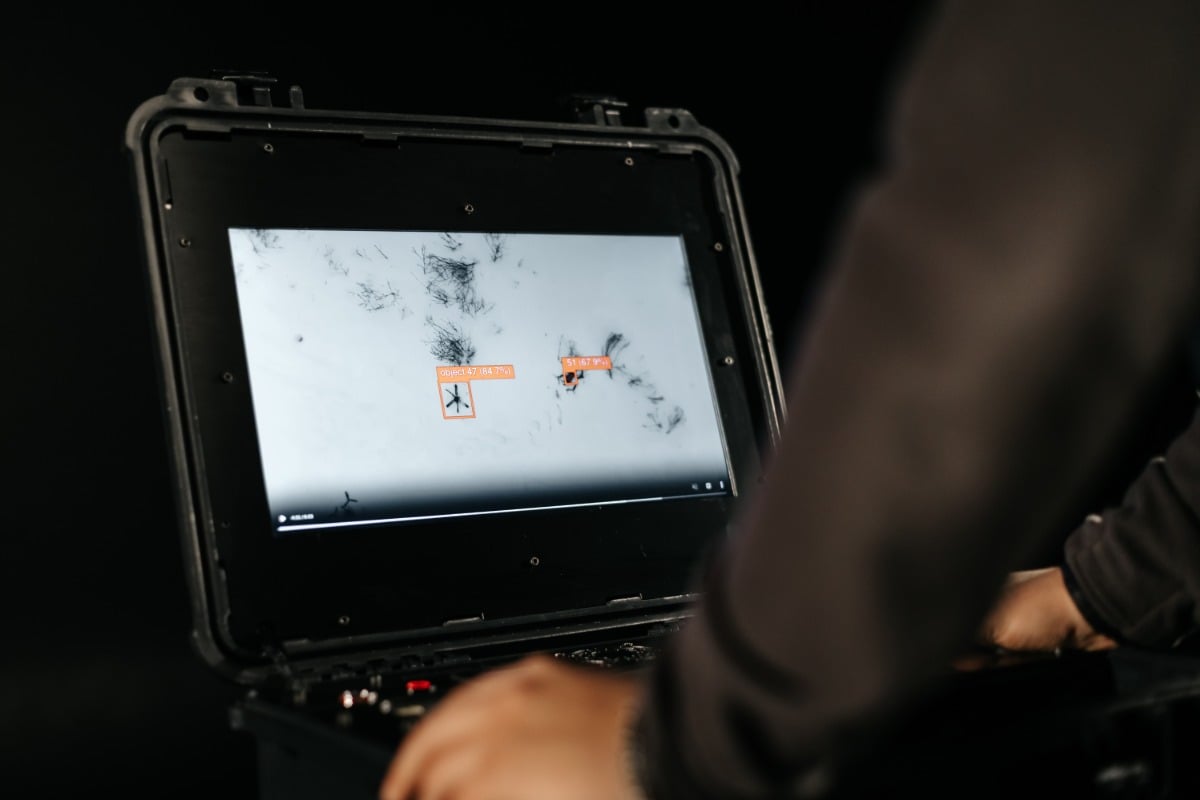
Dropla Tech’s core technology, called Blue Eyes Warbox, works as what the industry calls edge-AI, meaning the system processes threat detection directly on a small onboard computer rather than sending data to a remote server or cloud platform for analysis. That distinction matters enormously on a modern battlefield where Russian electronic warfare routinely jams or severs communications links, since a cloud-dependent system goes blind the moment its connection drops, while Blue Eyes keeps analyzing footage from aerial sensors in real time regardless of whether it has any outside connectivity at all. The system attaches to reconnaissance drones already flying over frontline routes, scanning footage as the drone moves rather than requiring troops to land the aircraft and manually review recordings afterward, a workflow that used to introduce delays of thirty minutes or longer before intelligence on a potential ambush actually reached the people who needed it.
Dropla Tech’s co-founder and CEO, Viacheslav Shvaidak, framed MITS Capital’s investment as answering a need the company valued more than the money itself.
“We were not looking for capital,” Shvaidak said. “We were looking for infrastructure.”
Shvaidak elaborated on what that infrastructure actually provides beyond straightforward funding, pointing specifically to the operational network MITS Capital brings across two countries where Dropla Tech now maintains staff and manufacturing.
“MITS Capital brings an operating back office across jurisdictions, a portfolio of Ukrainian defense companies we can build with on joint R&D, sub-integration, and interoperability,” Shvaidak said. “For a company scaling between Denmark and Ukraine, that is worth more than any check.”
The system carries an official NATO Stock Number, 7010-61-019-5238, assigned through Ukraine’s National Codification Bureau, a designation that confirms a piece of military equipment meets alliance technical and logistics standards and lets any NATO member purchase it through standard procurement channels rather than negotiating a separate bespoke arrangement. Blue Eyes is currently deployed with Ukrainian Armed Forces units and several Ukrainian security services, and according to the company, it has grown from confirming several hundred explosive threat detections to more than 5,000 in under a year, with detection accuracy above 90 percent, a scaling curve that reflects both growing frontline adoption and continuous retraining of the underlying AI models against real combat data rather than laboratory test conditions.
Dropla 4×4 and Dropla 6×6 are modular unmanned ground vehicles designed to work directly with Blue Eyes, supporting configurations for casualty evacuation, logistics resupply, intelligence and reconnaissance missions, remote weapon stations, and counter-drone operations, all built specifically for European series production rather than one-off prototype runs. A third product, Dropla Seer, combines aerial and ground sensors with Blue Eyes AI processing into a mobile, multi-sensor reconnaissance system aimed at humanitarian mine action once active combat eventually ends, a forward-looking bet on the reality that Ukraine’s landscape will remain contaminated with unexploded ordnance for years after any ceasefire, requiring exactly the kind of detection technology Dropla Tech has spent the war refining under live combat conditions.
MITS Capital’s founder and CEO, Perry Boyle, described the investment as advancing goals that extend well beyond a single company’s growth trajectory.
“We are excited to welcome Dropla Tech to the MITS family,” Boyle said. “Viacheslav has achieved an important feat of creating a truly transnational Danish-Ukrainian defense company. We look forward to working with Dropla Tech’s team as a key pillar of MITS Capital’s mission: to defeat Russia in Ukraine and integrate Ukraine into Europe’s defense architecture.”
Dropla Tech now becomes the first publicly disclosed company from MITS Accelerator’s third cohort, a batch of eight companies participating in a program built around scaling operations, entering NATO markets, and drawing on expertise across MITS Capital’s broader platform, which as of July 2026 includes 20 defense technology companies spanning sensing, electronic warfare, communications, and unmanned systems. That portfolio gives Dropla Tech a built-in network of potential technical partners it would otherwise need years to cultivate independently, and the company has already started acting on that kind of cross-industry collaboration outside the accelerator itself, announcing in July 2026 that it began integrating its unmanned ground vehicles into MOSAIC UXS, an AI-powered mission software platform developed by German company Quantum Systems. Dropla Tech also signed a memorandum of cooperation with fellow Ukrainian robotics developer Frontline Robotics at the Eurosatory defense exhibition earlier in 2026, adding another integration partner to a growing web of companies working to make Ukrainian-developed detection and robotics technology interoperable across different manufacturers’ hardware rather than locked into single-vendor ecosystems.
Shvaidak said the company’s next major goal involves joining the Build with Ukraine program, a German government initiative that subsidizes Ukrainian defense manufacturing, while simultaneously scaling production capacity toward 3,000 unmanned ground vehicles annually, a target that would represent a dramatic expansion from the company’s current output and would require the kind of manufacturing infrastructure and cross-border coordination MITS Capital’s investment is specifically meant to support.