

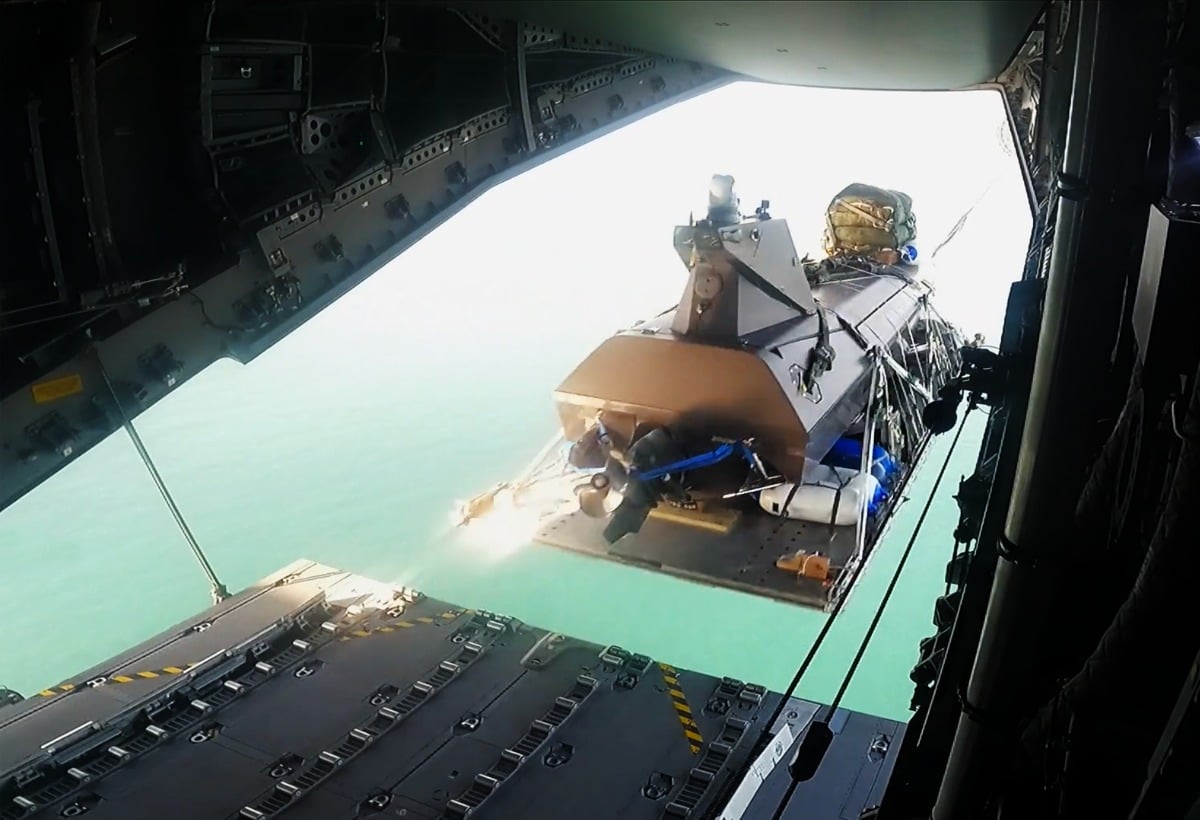
An uncrewed patrol boat just fell out of an airplane at 1,300 feet and splashed down ready to go to work, and the company behind it says nobody has ever pulled that off before.
Kraken Technology Group and Capewell announced on July 8 that they completed the world’s first extracted-load airdrop of an uncrewed surface vessel, or USV, from a military transport aircraft, backed by the UK’s Royal Navy under a program called Project Beehive that is reshaping how Britain thinks about naval power.
The vessel dropped was Kraken’s K3 SCOUT, a roughly 8.4-meter (28-foot) composite-hulled boat built for high-speed, crewless missions ranging from surveillance to casualty evacuation. Trials saw the SCOUT deployed multiple times from an Airbus A400M military transport aircraft, a four-engine turboprop that serves as the backbone of Royal Air Force heavy airlift and can carry loads of up to roughly 37 tonnes (81,500 lb), dropping the boat into water conditions as rough as Sea State 4, a scale that describes waves running roughly 1.25 to 2.5 meters (4 to 8 feet) high, choppy enough to make a routine boat launch difficult even for a crewed vessel let alone one arriving by parachute.
Getting a boat out of a moving aircraft and into open water intact required specialized hardware most people have never heard of. The SCOUT rode down attached to Capewell’s Universal Maritime Craft Aerial Delivery System, known as UMCADS, a reconfigurable Type V parachute platform built specifically to airdrop various maritime vessels directly into military zones rather than requiring a ship or helicopter to physically lower a boat into the water. The trial campaign also validated something Capewell calls the IN-Release system, an electro-mechanical release mechanism designed to disconnect the load reliably and in sync across a wide range of aerial and maritime delivery scenarios, the kind of technical detail that sounds mundane until you consider that a poorly timed release at 1,300 feet could mean the difference between a boat landing safely and one tumbling into the sea in pieces.
“Working in partnership with Capewell and the Royal Navy, we have demonstrated that K3 SCOUT can be rapidly deployed directly from a military transport aircraft into contested or difficult-to-access waters ready for operation,” said Mal Crease, Founder and CEO of Kraken Technology Group. “Kraken, alongside its partners and the Royal Navy, will continue to push boundaries to deliver novel and enhanced operational capabilities with our resilient, modular platforms.”
Capewell’s own account of the trials emphasized not just that the system worked, but how quickly it could be repeated, a detail that matters enormously for any military capability meant to be used under real operational pressure rather than as a one-off demonstration stunt.
“In collaboration with Kraken we were able to validate the integration of a complex payload with our UMCADS platform while demonstrating the ease with which the system can be reconfigured for alternative mission essential equipment be they maritime or land applications,” said Mark Lavender, Director of Business Development and Training at Capewell. “This was further validated in that we conducted 4 live airdrops in 6 working days with the same boat and platform during this campaign.”
The K3 SCOUT belongs to a fleet of 20 boats the Royal Navy ordered from Kraken in March 2026 under a roughly $16.5 million contract, part of Project Beehive, a Royal Navy initiative designed to build what officials are calling a “Hybrid Navy,” a fleet structure that pairs large, conventional crewed warships like the Type 26 and Type 31 frigates with smaller, disaggregated, autonomous vessels that can be deployed faster and in greater numbers than traditional shipbuilding allows. Captain Adam Ballard of the Royal Navy described Project Beehive at the time of the original contract as taking experimentation from the service’s Disruptive Capabilities team and immediately proving the Navy’s ability to rapidly adopt new technology into actual operations, a philosophy this airdrop trial appears designed to validate in dramatic fashion.
The Beehive fleet is assigned to the Royal Navy’s Coastal Forces Squadron and 47 Commando Royal Marines, giving both fast-craft specialists and amphibious raiding units direct hands-on experience with uncrewed boats capable of speeds up to 55 knots, or roughly 63 mph, and endurance stretching to 30 days at sea depending on configuration. Defense trade publication Janes reported in June 2026 that the Royal Navy and defense contractor QinetiQ are actively preparing K3 SCOUT vessels for potential deployment to the Strait of Hormuz, a narrow and frequently tense waterway between Iran and the Arabian Peninsula, underscoring that this is not simply an experimental toy for training exercises but a system the Royal Navy is actively positioning for use in one of the world’s most strategically sensitive and contested maritime chokepoints.
Airdropping a boat solves a specific operational problem that has quietly limited how fast uncrewed maritime systems can actually reach where they are needed. Under normal circumstances, deploying a USV means physically transporting it by ship, a process that can take days or weeks depending on distance and requires a vessel already positioned nearby, or launching it from a helicopter, which limits payload size and range compared to a large transport aircraft. An airdrop capability compresses that timeline dramatically, letting military planners insert an uncrewed vessel into contested or hard-to-reach waters directly from an aircraft already flying long distances at altitude, without needing a ship to already be in position or exposing a crewed vessel to the same risk the USV itself is meant to absorb.