

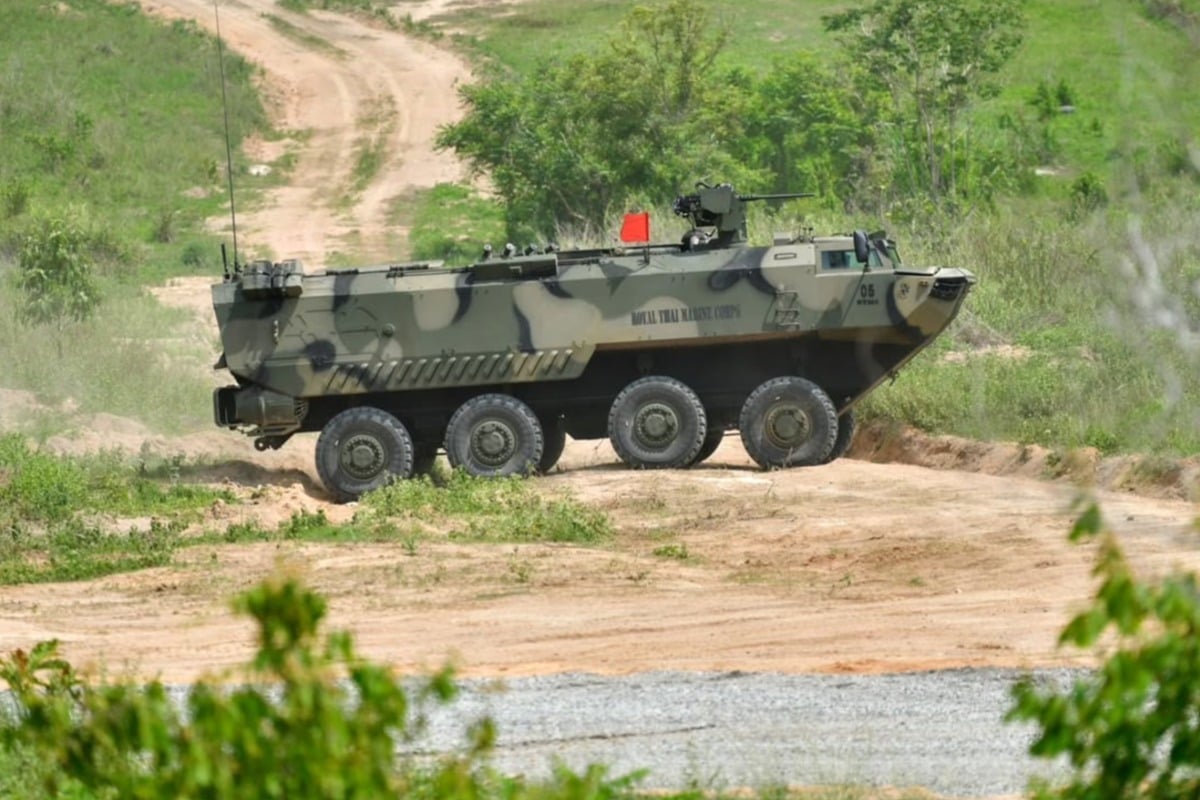
- The Philippine Navy selected Chaiseri's AWAV 8x8 amphibious vehicle for the Philippine Marine Corps, Chaiseri's first export sale.
- An initial order covers five vehicles with delivery expected by 2027, beating South Korean, Turkish, and Czech competitors.
A Thai company has beaten out South Korean, Turkish, and Czech defense giants to win its first-ever export contract, and the prize is a vehicle built to carry Philippine Marines across water and onto beaches in one of the world’s most scattered island nations.
The Philippine Navy has selected the AWAV 8×8, an armored amphibious vehicle built by Thai manufacturer Chaiseri Metal and Rubber, to equip the Philippine Marine Corps, with an initial order covering five vehicles expected for delivery by 2027, according to reports of the selection. The deal marks the first time Chaiseri has sold the AWAV outside Thailand, a milestone for a company that until now had supplied the vehicle only to its own country’s military.
The Philippine Navy opened bidding for five new 8×8 armored personnel carriers earlier this year specifically for peacekeeping operations, setting a budget of roughly $8 million and requiring only a baseline level of protection under NATO’s STANAG 4569 standard, a classification system that rates armored vehicles by how much small-arms fire, artillery fragmentation, and mine blasts they can withstand, with the Philippine requirement set at STANAG level 2, a relatively modest protection tier compared to the heavier armor found on frontline combat vehicles. Notably, the specification did not call for a full remote-controlled weapon turret, only a mounted 12.7mm heavy machine gun, keeping the estimated cost per vehicle to roughly $1.6 million and putting the competition within reach of manufacturers that might not compete for a more heavily armed contract.
That relatively narrow requirement still drew a crowded field of established international competitors before Chaiseri’s AWAV came out on top. South Korea’s Hyundai Rotem entered its K808 White Tiger, Hanwha Aerospace offered its Tigon platform, Turkish manufacturers FNSS and Otokar put forward vehicles from the PARS family and the Arma respectively, Czech firm Excalibur Army proposed its Pandur 2, and Thai rival Panus Assembly competed with its own R600, meaning Chaiseri’s vehicle beat out companies from four different countries with far longer track records in international arms exports before ever landing its first sale abroad.
The AWAV 8×8 itself is purpose-built for exactly the kind of mixed land-and-sea operations that define military logistics across the Philippine archipelago, a nation of more than 7,000 islands where moving troops and equipment often means crossing open water rather than driving between bases. The vehicle measures 9.2 meters (30 feet) in length, 3.1 meters (10 feet) in width, and roughly 3 meters (10 feet) in height, weighing in around 23 to 26 tonnes depending on configuration, and its 711-horsepower diesel engine pushes it to a top road speed of 105 kilometers per hour (65 mph) while twin waterjets propel it through water at 10 kilometers per hour (6 mph). With a combat range of 600 kilometers (373 miles) and room for 11 troops plus a three-person crew of driver, gunner, and commander, the AWAV is designed to drive off a ship’s ramp, swim ashore under its own power, and continue operating on land without switching modes, a capability that matters enormously for an archipelagic military that cannot count on paved roads connecting every point it needs to defend.
Chaiseri has already proven the design in service with its own country’s military, having delivered a total of 14 AWAV 8×8 vehicles to the Royal Thai Navy for use by the Royal Thai Marine Corps, where the vehicles operate from Thai landing platform docks alongside older AAV7-series amphibious assault vehicles that Chaiseri has also helped modernize. Before entering Thai service, the AWAV underwent testing that included hundreds of kilometers of continuous road driving, multiple hours of uninterrupted operation at sea, and obstacle courses designed to simulate difficult terrain, with the vehicle demonstrating the ability to climb slopes as steep as 60 degrees during evaluation. That operational track record, built through actual fleet use rather than trade show demonstrations alone, likely helped the company’s pitch to Philippine evaluators who needed a design already proven to work in the kind of amphibious role their own Marines require rather than a vehicle still working through its first real-world deployment.
The win lands at a moment when the Philippines has been steadily rebuilding its military capacity to operate across its own contested waters, a modernization push driven in large part by ongoing tension with China over disputed features in the South China Sea and the broader strategic reality that a scattered island nation needs mobile, water-capable forces far more than it needs vehicles designed purely for continental land warfare.