


- Green Berets used unmanned surface vessels to deliver shaped charges that sank a target vessel during Balikatan 2026 near Itbayat, Philippines.
- The USVs show close similarity to Magura-type drones built by UFORCE in Portugal, while similar platforms have also been developed by U.S. companies such as Red Cat, with no confirmed link to the systems used.
Green Berets from 1st Special Forces Group (Airborne) remotely launched and controlled unmanned surface vessels during Exercise Balikatan 2026, using them to deliver shaped charges against a target vessel off the western coast of Itbayat, Philippines, on April 24 — and the drone boats they operated bear a close visual resemblance to systems associated with the Magura family of naval drones.
The event, designated Maritime Strike-North, was a combined live-fire training operation conducted by U.S. and Philippine special operations forces in the Batanes archipelago, a chain of islands in the Luzon Strait roughly 100 miles south of Taiwan.
According to the DVIDS official release, combined air and maritime assets engaged and sank a designated target vessel in a complex, multi-domain operation. The unmanned surface vessels, operated by U.S. special operations forces, delivered shaped charges against the target vessel, puncturing its hull and degrading its structural integrity. The exercise also incorporated other emerging technologies designed to enhance maritime awareness and precision strike capability, per the same release.
Images released by the U.S. Department of Defense show the USVs fitted with a forward-mounted shaped charge warhead. Open-source analysis indicates the configuration includes a single large forward-facing explosively formed penetrator (EFP) surrounded by seven smaller EFP elements angled slightly outward — a configuration that likely increases warhead effectiveness particularly when the vessel strikes its target at an angle. Notably, the vessels feature three impact fuses arranged on the forward hull, a detail consistent with documented Ukrainian Magura examples and a potentially significant identifying characteristic.
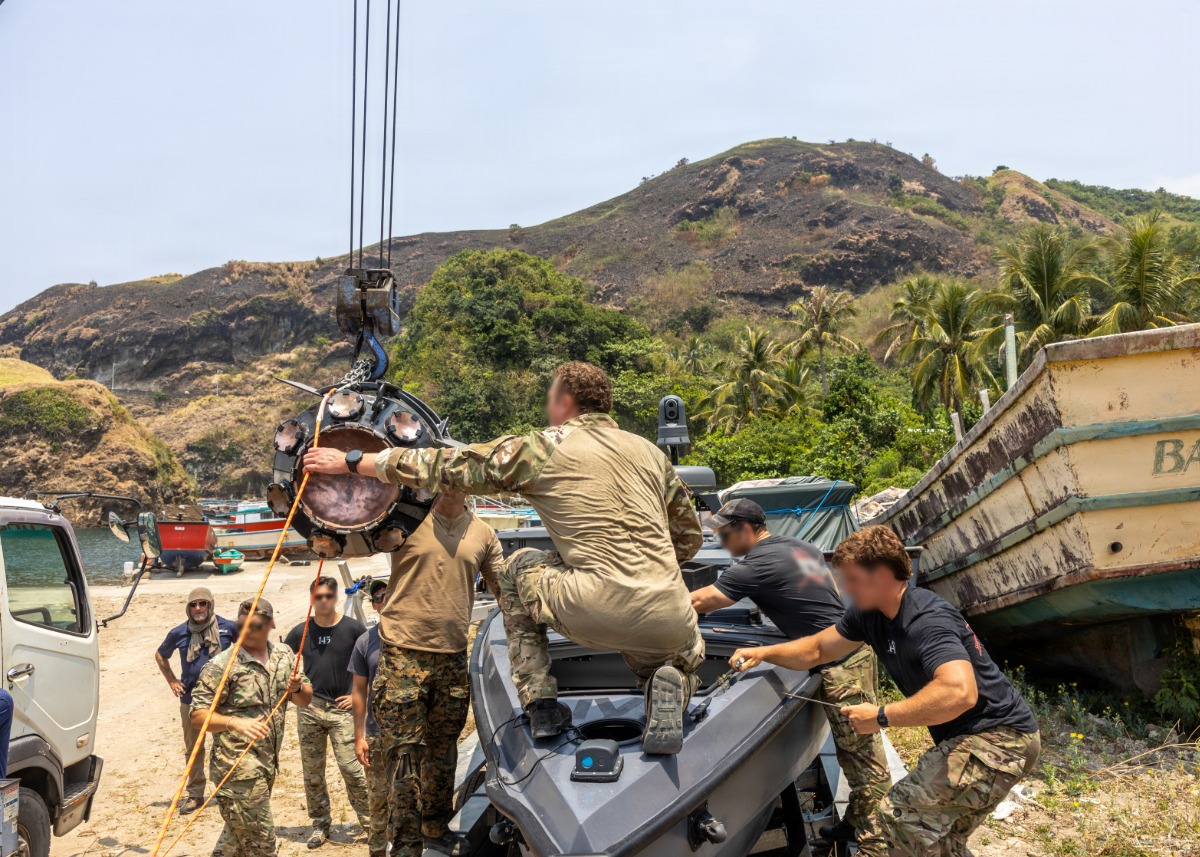
The USVs observed during the exercise share multiple external features with later variants of the Magura series, including hull geometry and forward impact fusing elements. The Magura V7.2 is built in Portugal by UFORCE and broadly represents the third generation of Ukrainian naval surface drones — larger than the combat-proven Magura V5 used against the Russian Navy in the Black Sea. The V7.2 has previously been demonstrated at NATO exercises, including REPMUS 25 in Portugal in September 2025. However, no official confirmation has been provided that the systems used in Balikatan 2026 are Magura-produced platforms.

At the same time, similar unmanned surface vessels are being developed by other manufacturers. In the United States, Red Cat Holdings has presented a 7-meter-class platform under its Blue Ops division with comparable dimensions and mission profile. However, no official connection between Red Cat’s systems and the vessels used in Balikatan 2026 has been confirmed.

Red Cat’s Variant 7 platform is described by the company as a high-speed, long-range unmanned surface vessel designed for kinetic maritime operations, supporting payloads of up to 650 kilograms and extended endurance. While these characteristics broadly align with the class of systems seen in Balikatan, their use in the exercise has not been confirmed.
The Magura lineage has gained attention due to its combat use in the Black Sea, including strike operations against Russian naval targets. Later variants have also demonstrated expanded roles, including integration of the Sea Dragon ‘FrankenSAM’ air-defense system, capable of carrying two rails for either AIM-9M Sidewinder or Soviet-type AA-11 ARCHER missiles.
UFORCE, which identifies itself as the exclusive producer and manufacturer of Magura USVs, disputed any authorized connection to the vessels used in the exercise, stating that no third party is licensed or authorized to produce Magura USVs in any country, worldwide. The company acknowledged awareness of “third-party produced USVs that share visual similarities” to its platform — a formulation that stops short of denying the visual and technical resemblance itself. UFORCE offered no statement on Balikatan specifically.
As a result, while the systems used in Balikatan 2026 display characteristics consistent with modern Ukrainian naval drone designs — including hull geometry, impact fuse arrangement, and warhead configuration matching documented Magura examples — their exact origin, configuration, and manufacturer remain unconfirmed based on publicly available information.