

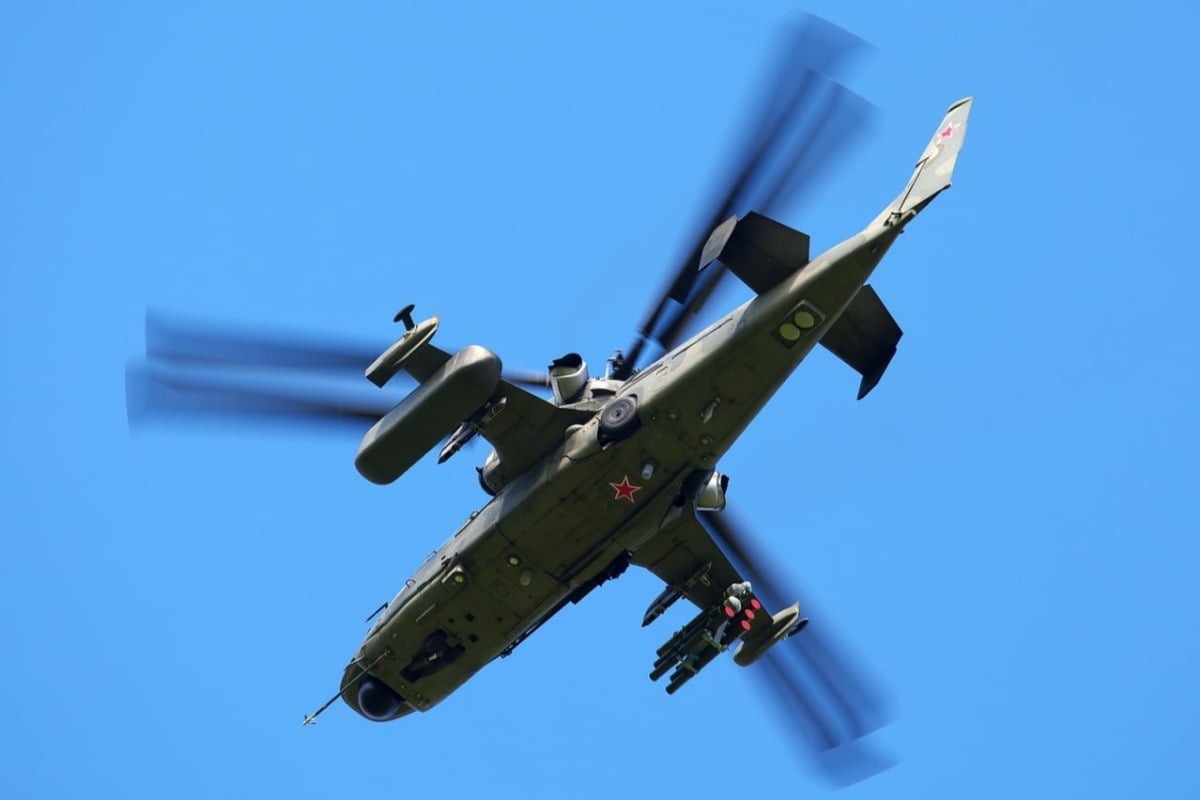
- Russian military-linked bloggers claimed the loss of a Ka-52 attack helicopter, with no location, date, or cause disclosed.
- Oryx had confirmed at least 66 Ka-52 losses as of December 2025, with Ukrainian reporting citing a toll as high as 68 by mid-2026.
Russian military bloggers with close ties to the country’s armed forces are reporting the loss of another Ka-52 “Alligator” attack helicopter, a claim that, if confirmed, would add one more airframe to what is already the single heaviest helicopter loss count of Russia’s war in Ukraine.
The bloggers offered no details on where or when the incident occurred, no cause, and no unit information, a level of vagueness that is common in early loss reports circulating on Russian military Telegram channels before any wreckage footage or geolocated evidence surfaces. As of publication, Russian officials have made no statement confirming or denying the loss.
What is being reported, according to the same military-linked bloggers, is that the one of the died in the incident, a detail that would be consistent with how a number of previous Ka-52 losses have played out over the course of the war, since the aircraft’s coaxial rotor design and heavy weapons load leave little margin for survival when it takes a direct hit rather than sustaining damage it can limp home with. A separate set of sources cited in Russian reporting claims the helicopter was flying in support of an operation to intercept Ukrainian strike drones when it went down, a detail that would mark a notable shift if accurate, since Ka-52s were originally fielded and employed for anti-armor and close air support missions rather than air defense against small unmanned aircraft.
The Ka-52, NATO reporting name Hokum-B, is a two-seat, coaxial-rotor attack helicopter built by Russian manufacturer Kamov and fielded by the Russian Aerospace Forces as one of the military’s primary anti-armor and close air support platforms. It carries a side-by-side cockpit rather than the tandem seating found on most Western attack helicopters, a design choice intended to improve coordination between the pilot and weapons operator, and it is one of the only helicopters in the world equipped with ejection seats, a feature meant to give the crew a chance to escape a stricken aircraft that most rotary-wing crews in other militaries simply do not have. Despite that safety feature, Ukrainian and open-source reporting has repeatedly documented cases where Ka-52 crews did not survive being shot down.
Since Russia’s full-scale invasion began in February 2022, the Ka-52 has suffered losses at a rate that stands out even against the broader attrition of Russia’s helicopter fleet. Open-source investigators at the Oryx blog, who compile a running tally of visually confirmed Russian equipment losses using photo and video evidence, had documented at least 68 Ka-52s destroyed, damaged, or captured. For comparison, Oryx’s tracking shows Russia’s other primary attack helicopter, the Mi-28, has lost fewer than a third as many airframes over the same period, a gap that reflects how heavily Russian commanders have relied on the Ka-52 for missions that repeatedly exposed it to Ukrainian man-portable air defense systems, first-person-view drones, and more recently fiber-optic-guided FPV drones that are largely immune to the electronic jamming Russian aircraft depend on for protection.
Pavel Luzin, a Russian political analyst and visiting scholar at the Fletcher School of Law and Diplomacy, told Newsweek in 2023 that despite the mounting losses, Moscow had few alternatives to keep using the aircraft.
“The Ka-52 is the most advanced and the most reliable Russian combat helicopter,” Luzin said.
That assessment helps explain why Russian forces have continued flying Ka-52 missions even as loss rates climbed year after year, since the alternatives, including the aging Mi-24 and the less capable Mi-28, offer commanders fewer options for the kind of precision anti-armor strikes the Ka-52 was designed to deliver. If the unverified claim about this helicopter supporting a drone-intercept mission holds up under further scrutiny, it would suggest Russian commanders have begun tasking their most valuable attack helicopter with a mission set it was never built for, a sign of how badly Ukraine’s growing fleet of long-range strike drones has strained Russia’s existing air defense network rather than evidence of a deliberate doctrinal shift.