

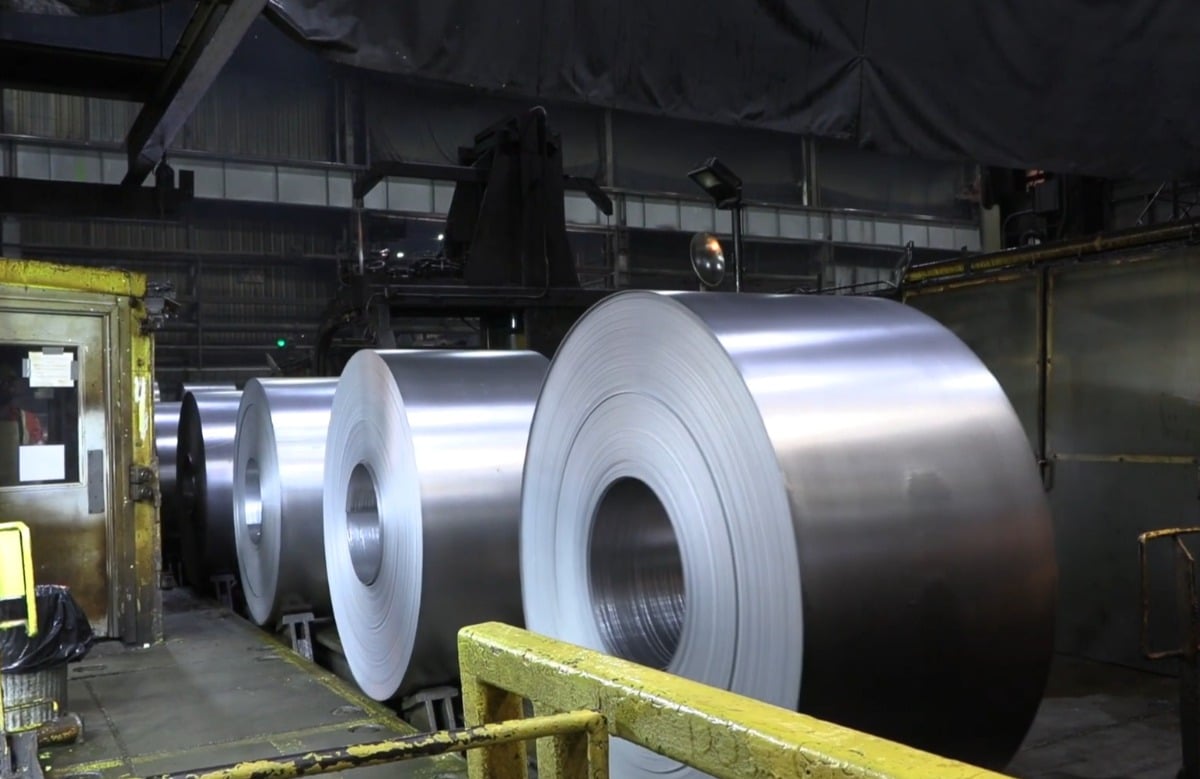
- The Defense Logistics Agency awarded Cleveland-Cliffs a $400 million sole-source contract for grain oriented electrical steel on September 9, 2025.
- Cleveland-Cliffs is the only U.S. producer of this steel, used in transformers for the Army, Navy, Air Force, Marine Corps, and Space Force.
The Pentagon has locked in its only domestic source of a specialized steel that keeps America’s power grid, its military bases, and its warships running, awarding a $400 million contract to a company that happens to be the sole American producer capable of making it. The Defense Logistics Agency, the Department of War’s supply chain arm responsible for keeping the military stocked with everything from fuel to spare parts, granted Cleveland-Cliffs Steel Corp an indefinite-delivery, indefinite-quantity contract worth up to $400 million for grain oriented electrical steel, a specialized metal engineered to lose minimal energy when magnetized and demagnetized by alternating current, which makes it essential for building the cores of transformers and generators.
The contract runs five years with no option periods and a performance completion date of September 8, 2030, according to the Defense Logistics Agency’s Contracting Services Office in Ohio, which manages the deal under contract number SP8000-25-D-0008.
The Pentagon’s public notice lists the award date as September 9, 2025, meaning this contract has been in effect for close to a year even though its formal disclosure appeared in the Department of War’s list of contracts for July 1, 2026, and Cleveland-Cliffs itself had already confirmed the deal publicly months earlier. Chairman, president and chief executive Lourenco Goncalves told investors about it during the company’s third quarter 2025 earnings call in October, describing a five-year, $400 million contract to supply up to 53,000 short tons of the specialized steel for government stockpiling.
“The US government continues to grow as our partner,” Goncalves said.
That relationship matters because Cleveland-Cliffs holds a position few American manufacturers can claim, standing as the only company in the United States capable of producing grain oriented electrical steel at the scale the country’s power grid and military infrastructure require. The company makes the material at its mill in Butler, Pennsylvania, and for years American utilities and defense contractors have had to rely heavily on imports of this steel from countries including Japan and South Korea, a dependency that has drawn growing concern in Washington as officials warn that a foreign supply disruption could leave the United States unable to repair or replace critical transformers during a grid emergency or a national security crisis. Grid security has become a bipartisan worry in recent years, with federal officials and utility operators repeatedly flagging that large power transformers can take a year or more to manufacture and deliver even under normal conditions, a lead time that would be catastrophic if a significant number of transformers were damaged or destroyed during a natural disaster, a cyberattack, or an act of war targeting the electrical grid.
The Defense Logistics Agency justified skipping a competitive bidding process for this contract by citing 10 U.S. Code 3204(a)(3)(A), as implemented in Federal Acquisition Regulation 6.103-3(b)(1), a legal provision that allows federal agencies to award a sole-source contract when only one company can reasonably meet the government’s requirements rather than opening the work to multiple bidders. In plain terms, the government determined that Cleveland-Cliffs was effectively the only viable supplier for this specific need, a designation that reflects both the company’s unique manufacturing capability and the strategic importance Washington now places on securing a domestic source for this material rather than continuing to depend on imports.
Grain oriented electrical steel does not sound like a typical defense procurement story, and it is worth explaining why five branches of the U.S. military, the Army, Marine Corps, Navy, Air Force, and Space Force, are all listed as users of a contract for what is essentially transformer steel rather than weapons or ammunition. Military bases, shipyards, and defense industrial facilities all depend on electrical infrastructure built around transformers and generators just as civilian utilities do, and the steel purchased under this contract is expected to be stockpiled for national security purposes rather than installed immediately, giving the government a strategic reserve it can draw on if a crisis disrupts normal supply chains. The funding for the deal comes from fiscal 2025 through 2029 transaction funds, a detail that signals the government intends to spread purchases and deliveries across multiple years rather than taking the full $400 million worth of steel in one shipment.
Cleveland-Cliffs has leaned into this role as a strategic domestic supplier well beyond this single contract, positioning itself in recent public statements as a company central to what it describes as America’s push for industrial independence, including exploration into rare earth mineral deposits in Michigan and Minnesota that could reduce U.S. reliance on foreign sources for other critical materials. The company has faced real financial strain in the same period it secured this defense deal, reporting a net loss of $234 million in the third quarter of 2025 alone, its fifth consecutive quarterly loss, even as steel shipment volumes climbed and automotive steel demand showed its strongest quarter since early 2024.