

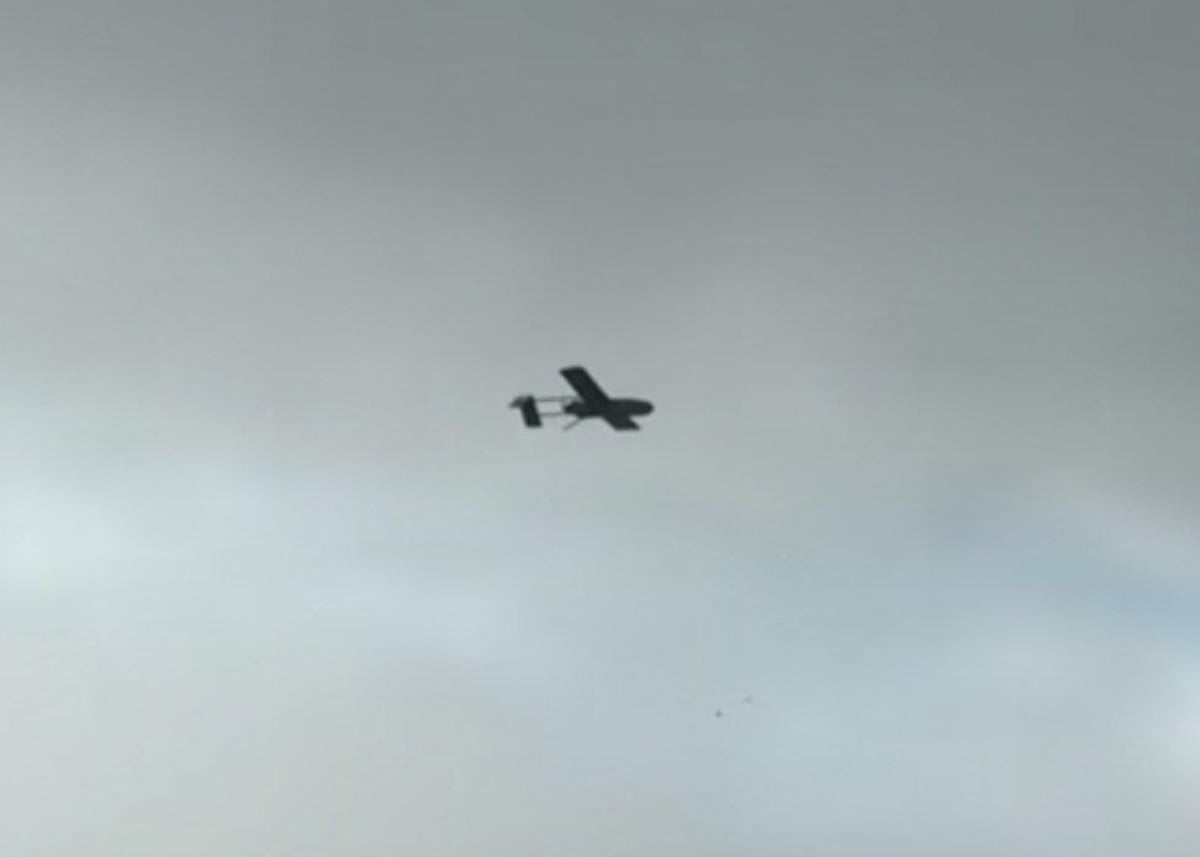
- RIA Novosti reported Russia's Defense Ministry claims 63,993 Ukrainian fixed-wing drones were destroyed over Russian territory in the first half of 2026.
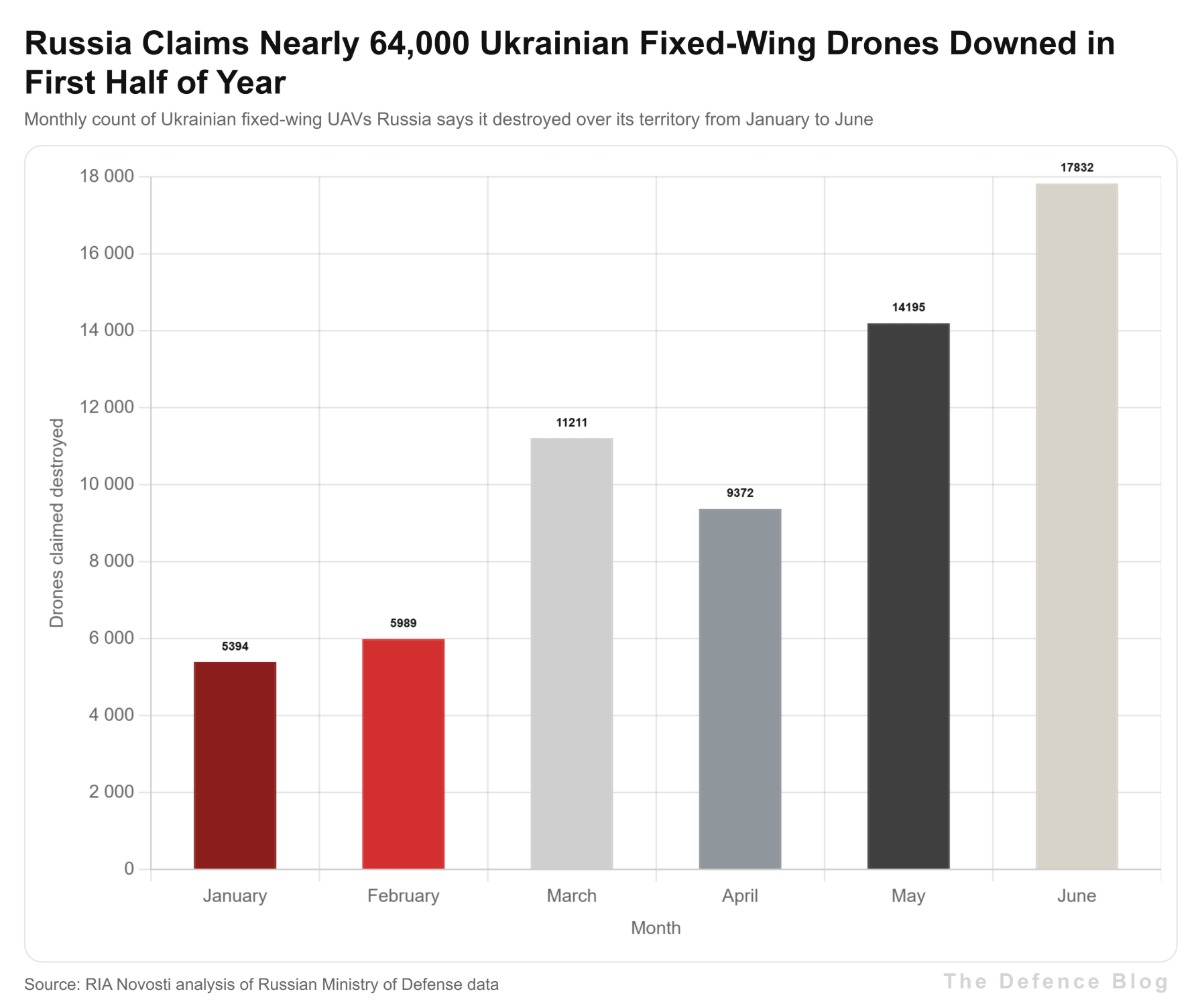
- The figures show a monthly acceleration from 5,394 in January to 17,832 in June, though the numbers have not been independently verified.
Russian state news agency RIA Novosti, tabulating figures from Russia’s Defense Ministry daily briefings, reported that Russian air defense forces destroyed at least 63,993 fixed-wing unmanned aircraft over Russian territory between January 1 and June 30, 2026.
The figures break down month by month: 5,394 in January, 5,989 in February, 11,211 in March, 9,372 in April, 14,195 in May, and a single-month peak of 17,832 in June. Russia’s Defense Ministry, which releases the individual daily counts that RIA Novosti aggregated, has never been independently audited for accuracy, and the figures warrant examination before being accepted as a factual baseline.
Several methodological questions surround Russia’s drone interception statistics that have been noted by Western defense analysts and open-source researchers throughout the war. The Ministry of Defense counts differ structurally from the figures Ukraine’s Air Force publishes, which separately categorize attack drones by type, including Shahed variants, FPV drones, reconnaissance platforms, and loitering munitions, without aggregating all unmanned aircraft into a single figure. Russia’s count specifically covers “fixed-wing unmanned aircraft of airplane type” over Russian territory, a definition that excludes the vast majority of FPV drones, which Russia itself fires in far greater numbers and which Ukraine also uses extensively near the contact line rather than on deep strikes into Russian territory. The June figure of 17,832 drones in a single month equates to roughly 594 fixed-wing unmanned aircraft intercepted per day, every day of the month, a rate that Ukrainian OSINT analysts and independent researchers tracking drone launch operations have not independently confirmed through visual or signals intelligence.
The trajectory of the monthly figures raises additional questions that RIA Novosti’s summary does not address. The jump from 5,394 in January to 11,211 in March, followed by a slight decline to 9,372 in April before a sustained surge to 14,195 in May and 17,832 in June, does not match any publicly documented expansion of Ukraine’s drone production capacity on a comparable timeline, though Ukraine has significantly increased domestic production and launch operations throughout 2026. Ukrainian officials, including President Volodymyr Zelensky, have publicly confirmed deep-strike drone campaigns targeting Russian refineries, military-industrial facilities, and infrastructure across multiple regions, but Ukraine does not publish its own strike counts that would allow independent verification of the Russian intercept claims.
The significance of the June figure extends beyond the raw number. If 17,832 fixed-wing drones were genuinely destroyed over Russian territory in June 2026, that would indicate Ukraine launched somewhere between 20,000 and 25,000 fixed-wing platforms during the month, accounting for attrition rates, making it the most intensive sustained unmanned aircraft campaign conducted by any military in history. By comparison, the Lancet loitering munition, which Russia has used extensively against Ukrainian armored vehicles and artillery, was estimated by open-source tracking projects to have been produced at a rate of several hundred per month at its peak before recent production expansions, and even the lower-cost Shahed-136 derivative variants Russia has employed in mass saturation attacks against Ukrainian cities were estimated to have been launched at rates of several hundred per week at peak campaign tempo. A sustained Ukrainian deep-strike capability at 17,832 fixed-wing interceptions per month would require a production and launch infrastructure operating at a scale that neither Ukraine’s publicly known drone manufacturers nor the Ukrainian Air Force’s published operational disclosures have confirmed.
The Russian Defense Ministry’s incentive structure for publishing these numbers is worth considering. Inflated interception statistics serve multiple internal and external functions: they demonstrate the effectiveness of Russian air defense investments to a domestic audience skeptical about military performance after early setbacks, they justify continued procurement of expensive air defense missiles to intercept cheap drones, and they present a picture of Russia successfully managing Ukrainian deep-strike pressure that contradicts the visible damage to refineries, ammunition depots, and defense industrial facilities that Ukrainian sources and OSINT analysts have documented repeatedly throughout 2026. The Conflict Intelligence Team and Molfar, two Ukrainian OSINT organizations that track confirmed Russian military losses and damage assessments, have not published aggregate figures consistent with Russia’s claimed intercept rates, though neither organization specifically focuses on compiling total drone campaign statistics.
What the figures do clearly confirm, even if their precise accuracy remains questionable, is that Ukraine has been conducting a sustained and intensifying long-range drone campaign against Russian territory across the entire first half of 2026, a trend consistent with everything known about Ukrainian deep-strike strategy and confirmed by multiple independent visual records. Major facilities hit during this period include the NIIFI research institute in Penza, which manufactures sensors for Iskander ballistic missiles and Kh-101 cruise missiles, confirmed by President Zelensky on July 1, oil refineries in Ufa struck at least twice, the Promsyntez explosive production facility in Chapayevsk, and the Votkinsk Plant in Udmurtia, which manufactures rocket engines for both conventional and strategic missile programs. Each of those strikes generated satellite imagery, Russian emergency services reports, and social media documentation that independently confirmed significant physical damage regardless of what Russia’s Defense Ministry claims about interception rates.
The monthly acceleration pattern, from roughly 5,000 per month in the winter to nearly 18,000 in June, is itself a data point worth noting regardless of whether the specific numbers are accurate, because it suggests Russia is observing a genuine trend of increasing Ukrainian strike intensity and has documented that trend in its own official reporting, even if the specific figures have been inflated to serve the narrative that Russian air defense is successfully managing the threat. The gap between Russia’s claimed interception rates and the visible damage to Russian territory suggests that either a significant number of the claimed intercepts are manufactured, or that Russia’s air defense systems are genuinely intercepting a very large number of platforms while a much smaller fraction reaches its targets and causes the confirmed damage that independent sources have documented.
What is certain is that 2026 has seen Ukrainian deep-strike drone operations against Russian territory reach a scale and tempo that was not contemplated when either side began this war, and that Russia’s own military bureaucracy is now generating six-figure annual tallies to account for what is happening in its airspace.