

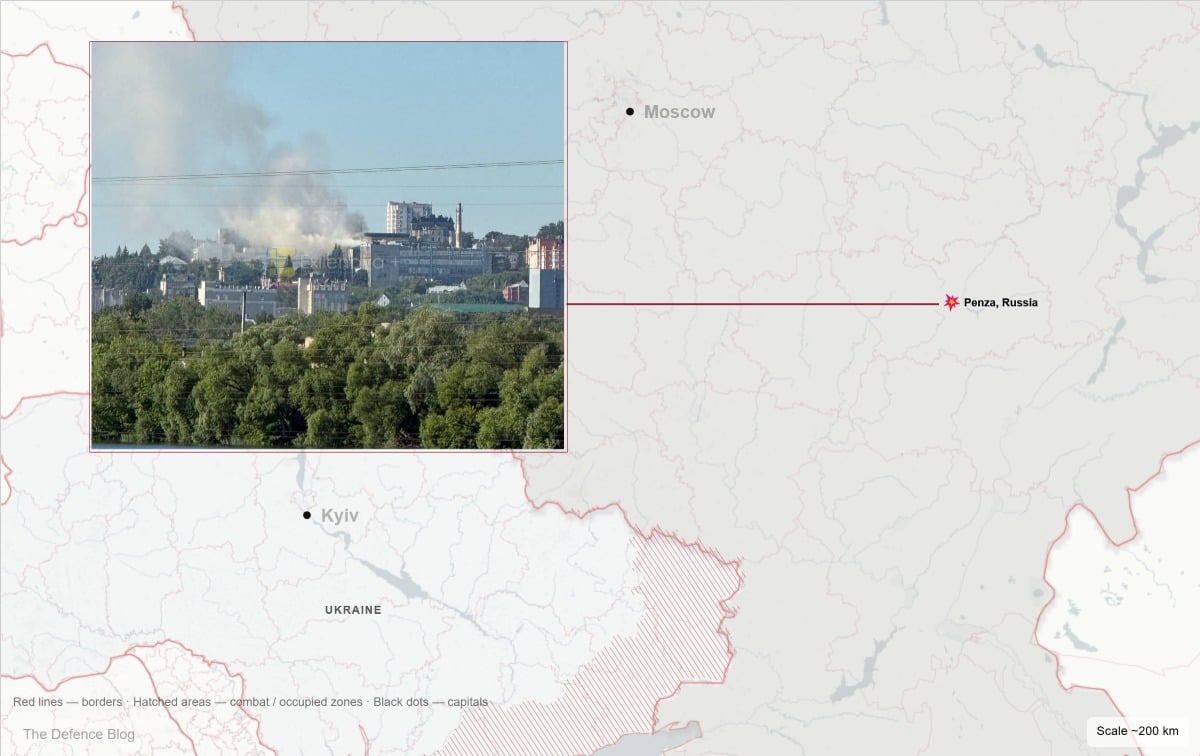
- Zelenskyy confirmed on July 1, 2026, that Ukraine struck NIIFI in Penza, a Roscosmos enterprise producing sensor components for Iskander, Bulava, Topol-M, and Kh-101 missiles.
- A simultaneous strike hit an oil refinery in Ufa, approximately 1,300 km from the front line, marking the second Ukrainian attack on that facility.
Ukrainian weapons struck a strategic defense research institute in Penza, Russia, that develops and manufactures critical sensor technology for Russia’s Iskander ballistic missiles, Bulava submarine-launched ballistic missiles, Topol-M intercontinental missiles, Su-34 and Su-57 fighter aircraft, and Kh-101 and Kh-59 cruise missiles, Ukrainian President Volodymyr Zelenskyy confirmed on July 1, 2026.
The facility struck is the Scientific Research Institute of Physical Measurements, known by its Russian acronym NIIFI, a state enterprise operating under the Roscosmos state corporation that supplies precision sensor systems across virtually every major class of Russian offensive weapon. Zelenskyy also confirmed a second simultaneous strike on an oil refinery in Ufa, capital of the Russian republic of Bashkortostan, located approximately 1,300 km (808 miles) from the front line, marking the second time Ukrainian weapons have reached that specific facility.
The attack on the Penza institute represents a qualitatively different kind of strike from Ukraine’s ongoing campaign against Russian oil infrastructure. NIIFI is not a fuel depot or a refinery that can be rebuilt with steel and pipes. It is a research and production enterprise whose output is specialized, high-precision sensor apparatus that Russia cannot simply import or improvise a substitute for, given that it operates under Western sanctions blocking most advanced sensor technology from reaching the Russian defense industrial base. The institute develops what Russian defense documentation describes as measuring instruments and sensor apparatus used in guidance and control systems across ballistic and cruise missile programs, meaning a strike that disrupts its production capacity ripples through every weapons system it supplies, potentially delaying or degrading missile output at a moment when Russia is already straining to maintain its wartime production pace.
The Iskander-M short-range ballistic missile, which NIIFI supplies with sensor components, is the weapon Russia has used more broadly than any other against Ukrainian cities, military bases, and infrastructure throughout the full-scale invasion. Its guidance system uses an inertial navigation package updated by optical scene-matching terminal guidance, and the precision instruments NIIFI manufactures feed into that guidance chain’s accuracy, which Russia advertises at approximately 5 to 7 m (16 to 23 ft) circular error probable. Ukraine has also confirmed that the Scientific Research Institute of Physical Measurements supplies pressure sensors for the engines of Kh-101 cruise missiles, the air-launched weapon fired by Tu-95MS and Tu-160 strategic bombers that has become Russia’s primary tool for attacking Ukrainian power infrastructure in overnight missile barrages.
The Bulava submarine-launched ballistic missile, the third system NIIFI reportedly supplies, is Russia’s primary sea-based nuclear deterrent, a three-stage solid-fuel missile carried by Borei-class nuclear submarines that entered service in 2013 and has a reported range of 8,000 km (4,971 miles). Its inclusion in the list of systems served by the Penza institute gives the strike a dimension extending beyond conventional warfighting into the Russian nuclear arsenal’s maintenance pipeline, though this does not indicate Ukraine was targeting nuclear capability specifically, rather that NIIFI serves as a cross-cutting supplier whose products reach multiple Russian weapons families including both conventional and strategic systems. The Topol-M, the fourth system listed in Zelenskyy’s announcement, is Russia’s land-based intercontinental ballistic missile deployed since the late 1990s as part of Russia’s nuclear triad, with a range of approximately 10,000 km (6,214 miles), and similarly appears on NIIFI’s client list as a precision measurement customer.
Ukraine has not officially stated which weapon system delivered the Penza strike, and the distance from Ukrainian territory, approximately 1,000 km (621 miles) for Penza specifically, places the attack within the range envelope of several Ukrainian long-range systems currently in service, including the FP-5 Flamingo cruise missile manufactured by Fire Point, which has a stated range of up to 3,000 km (1,864 miles) and has been used in multiple confirmed strikes against Russian defense industrial targets in 2026. The Ufa refinery, the second confirmed target in Zelenskyy’s July 1 statement, sits at 1,300 km (808 miles) from Ukrainian lines, pushing closer to the outer edge of most Ukrainian cruise missile systems’ effective range but well within the Flamingo’s published specifications. Ukraine’s General Staff confirmed the Ufa strike was the second Ukrainian attack on the same facility, a pattern consistent with Ukraine’s stated strategy of repeatedly targeting the same Russian oil processing infrastructure to compound damage and prevent restoration between strikes.
The Penza institute’s structural position inside Roscosmos is significant for understanding why it makes a strategically attractive target beyond its direct weapons output. Roscosmos serves as the Russian state corporation overseeing not just space activities but a broad portfolio of dual-use aerospace enterprises whose manufacturing capabilities bridge civilian and military programs. NIIFI’s membership in that structure means it operates under Russia’s military-space industrial complex rather than purely commercial management, giving it access to classified technical requirements, specialized materials, and a supply chain that is now severely constrained by the technology restrictions imposed on Russia since 2022. Disrupting the institute’s physical production capacity strikes not just current missile inventories but Russia’s ability to reproduce and replenish precision guidance components, the most difficult part of a modern missile to manufacture without access to Western semiconductor and precision manufacturing technology.
Hitting the factory that builds the guidance sensors for the missiles hitting your cities is a different kind of retaliation from hitting the factories that fuel the planes carrying them. It is an attempt to work upstream in the kill chain, to make the next salvo less accurate, or to prevent it from being assembled at all.