

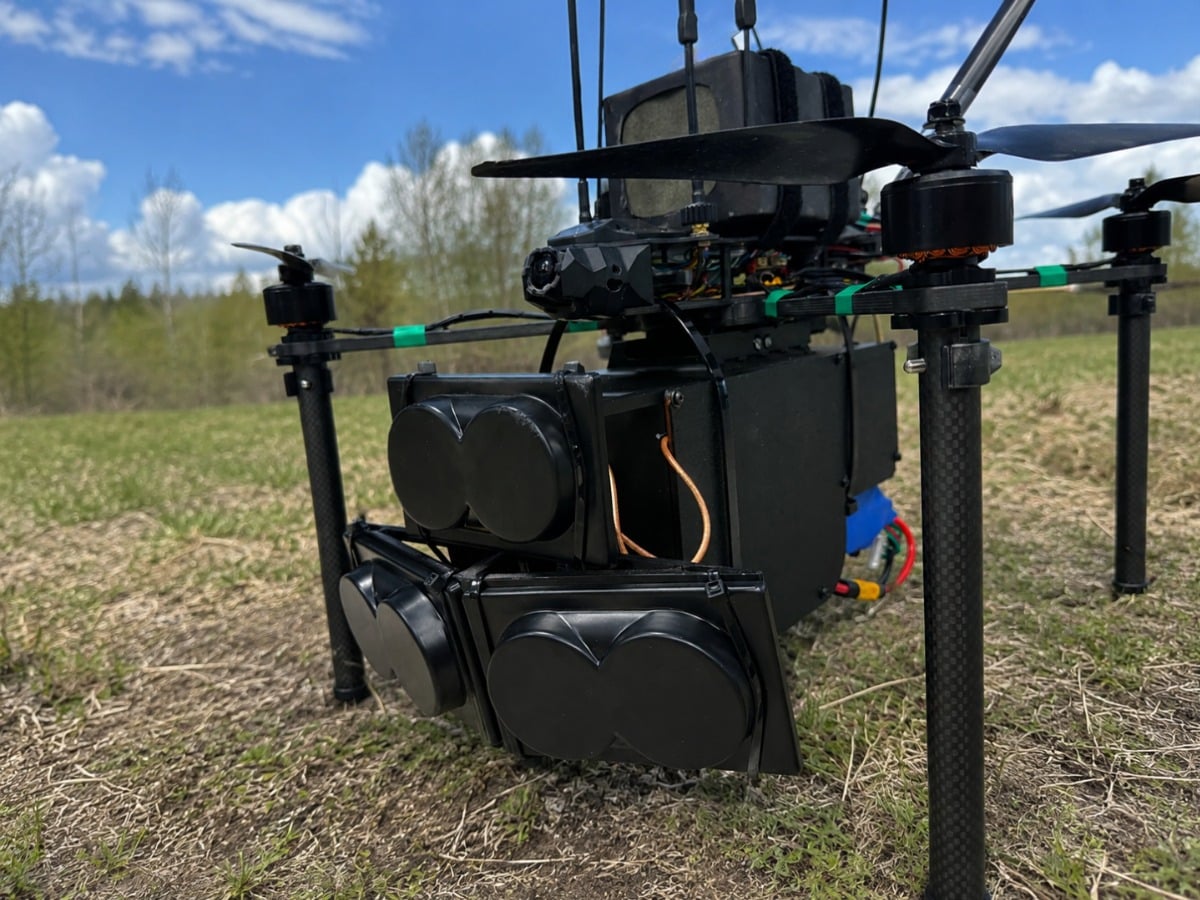
- Sky Spy and Orqa demonstrated a UAV-mounted SIGINT system with Estonia's 131st Infantry Battalion during Exercise Spring Storm on June 29, 2026, involving over 12,000 NATO personnel from 20 nations.
- The SkyAgent 001 sensor mounted on Orqa's MRM2-10 FPV drone successfully detected hostile electronic emitters beyond the range of ground-based sensors in a simulated electromagnetic attack scenario.
Estonian soldiers successfully tested a signals intelligence system mounted on a lightweight FPV racing drone during Exercise Spring Storm, the country’s largest annual military exercise, detecting hostile electronic emitters at ranges that ground-based sensors could not reach, the companies behind the system announced June 29.
The technology pairing combines Sky Spy’s SkyAgent 001 autonomous passive radio frequency sensor with Orqa’s MRM2-10 FPV drone platform, creating a portable, airborne electronic intelligence capability that a single soldier can carry into the field and launch in minutes. The test, conducted with Estonia’s 131st Infantry Battalion in a simulated electromagnetic attack scenario, marks the first confirmed operational demonstration of the combined system with NATO forces.
To understand why putting a radio frequency sensor on a drone matters, it helps to understand the problem it solves. Every piece of electronic equipment on a modern battlefield, from a radar to a jammer to the control station of an enemy drone, emits radio frequency energy that can be detected by a sensor tuned to the right frequencies. Signals intelligence, which the military abbreviates as SIGINT, is the discipline of finding and analyzing those emissions to build a picture of where enemy electronic systems are operating and what they are doing. Knowing where an enemy’s drone control station is located, for example, tells a commander where to aim a countermeasure, whether an electronic jammer, a mortar round, or an anti-drone system. The problem is that terrain gets in the way. A ground-based sensor sitting at the same elevation as the emitter it is trying to detect has to contend with hills, buildings, forests, and every other physical feature that blocks the signal path. Put that sensor in the air, even at a modest altitude, and the line-of-sight obstruction largely disappears.
The Orqa MRM2-10 platform that carries the Sky Spy sensor is not a large military drone. Orqa, founded in Croatia and described in the press release as the largest drone manufacturer in the European Union to build both integrated systems and components, built the MRM2-10 as a lightweight, deployable FPV platform with military applications in mind. FPV, which stands for first-person view, refers to the category of small racing-style drones that have become the defining weapon of low-level combat in Ukraine, typically flown at high speed into targets by an operator watching through video goggles. The MRM2-10 adapts that agility and portability to a different mission: instead of carrying a warhead, it carries a passive radio frequency receiver that listens for electronic emissions without broadcasting any signal of its own, making it difficult for adversaries to detect that the sensor is operating.
The Sky Spy SkyAgent 001 system that rides on the MRM2-10 is described by the company as autonomous, meaning it can process and classify the radio frequency signals it detects onboard without requiring a human analyst to evaluate raw data in real time. The system identifies the type of emitter, characterizes its signal parameters, and flags it as a radar, jammer, drone control station, or other category of electronic equipment, giving soldiers actionable intelligence about the electromagnetic threat environment around them rather than a stream of raw data that requires specialized expertise to interpret. Sky Spy CEO Arsenii Hurtavtsov, who founded the company in Estonia, described the operational concept with characteristic directness.
“Sky Spy was established to identify the archer, before the arrow is fired,” Hurtavtsov said in the company’s announcement.
The exercise that hosted the demonstration, Exercise Spring Storm, is Estonia’s largest annual military event and one of the most significant NATO training exercises in the Baltic region, involving more than 12,000 NATO personnel from over 20 nations. Estonia, a country of approximately 1.3 million people that shares a 330 km (205 mile) land border with Russia and joined NATO in 2004, takes its military exercises more seriously than most alliance members, partly because it spent decades under Soviet occupation and has no illusions about what Russian aggression looks like in practice. The Force Transformation Command of the Estonian Defence Forces, which hosted the Sky Spy and Orqa demonstration, is specifically tasked with identifying and integrating new military technologies through combat-realistic training events, which is why it organized the electromagnetic attack scenario with the 131st Infantry Battalion rather than a purely academic evaluation.
The lessons from Ukraine shaped the specific scenario the Estonian forces used to test the system, and the press release is unusually direct about what those lessons are. Sky Spy’s release states that drone-related causes now account for 85 percent of casualties on the modern battlefield, a figure reflecting the extent to which FPV drones and loitering munitions have shifted how casualties are generated in high-intensity conflict. The ability to locate the control stations and electronic signatures that enable those drones before they can guide an attack has therefore become a first-order tactical problem rather than a specialized intelligence task. A squad-portable system that can rapidly detect and geolocate those signatures from the air, even in terrain that would block ground-based sensors, addresses that problem at the level where it actually needs to be solved, in the hands of frontline infantry units rather than in a dedicated electronic warfare battalion operating from a protected position kilometers behind the line of contact.
Srdjan Kovacevic, co-founder and CEO of Orqa, described the partnership’s value in terms that reflect both the technical accomplishment and the broader alliance objective.
“Working in partnership with Sky Spy, we’ve shown that combining passive RF sensing with our lightweight UAVs is a practical solution to the challenge of gathering intelligence in hostile electromagnetic environments,” Kovacevic said. “As the largest drone manufacturer in the EU to build both integrated systems and components, we are proud to support the Estonian Defence Forces.”
The modular architecture Sky Spy used in the Spring Storm demonstration is specifically designed to avoid the platform dependency that has limited previous airborne SIGINT systems. Because the SkyAgent 001 integrates with any drone through a standardized interface rather than being built into a specific airframe, the same sensor package can migrate to different platforms as better drones become available, and can be rapidly adopted by allied forces operating different drone types. Sky Spy states the company is “rapidly integrating with world-leading UAV manufacturers” through this approach, though which manufacturers beyond Orqa have joined the integration program was not specified in the announcement.