

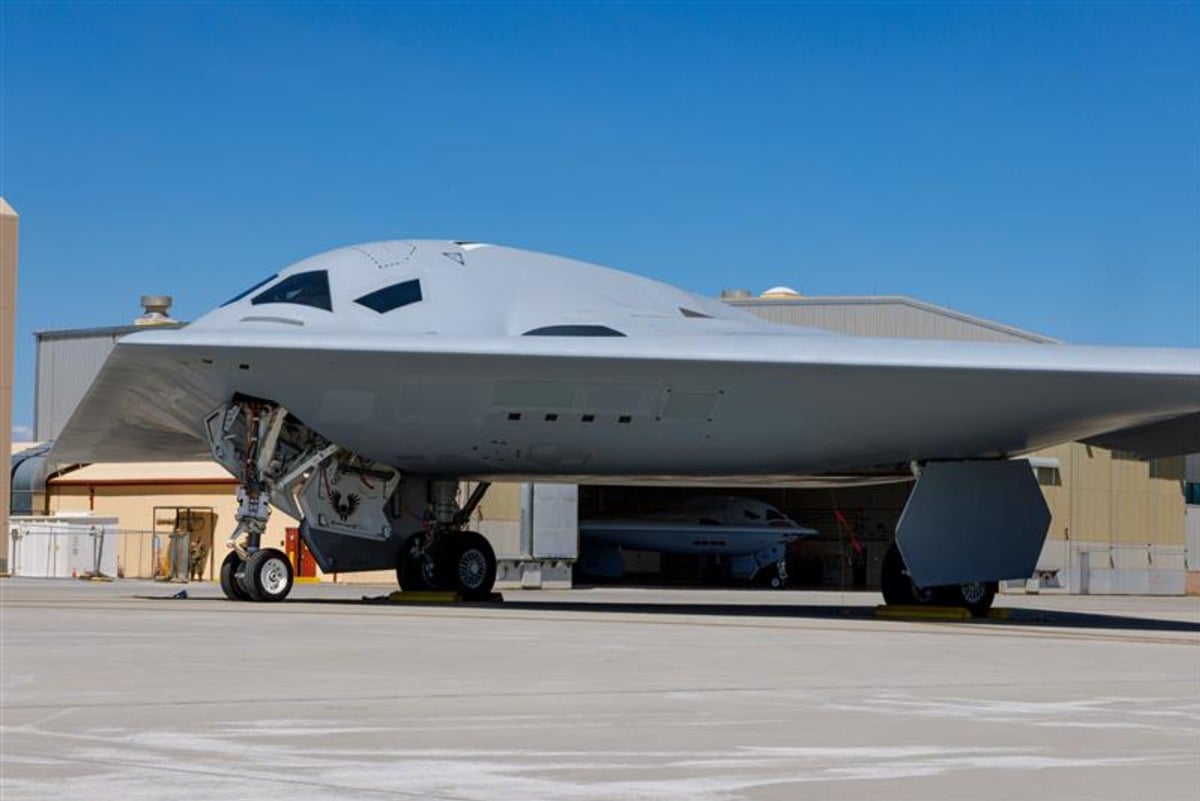
- The Army Corps of Engineers awarded Conti Federal Services a $44 million contract to build B-21 environmental protection shelters at Ellsworth Air Force Base, South Dakota.
- Work is scheduled to complete by October 3, 2028, using fiscal year 2026 military construction funds obligated at award.
With the first operational B-21 Raiders scheduled to arrive at Ellsworth Air Force Base in 2027, the U.S. Army Corps of Engineers has awarded a $44 million construction contract to build the permanent outdoor shelters that will protect America’s most advanced stealth bomber from the harsh South Dakota winters, extending its service life and keeping it ready to fly with minimal downtime between missions.
The U.S. Army Corps of Engineers’ Omaha District awarded the contract to Conti Federal Services LLC, an Orlando, Florida construction firm that has become one of the most active builders in the B-21 beddown program at Ellsworth, on a competitive basis after receiving six bids. Work will take place entirely at Ellsworth Air Force Base in South Dakota, with completion required by October 3, 2028. The full $44 million in fiscal year 2026 military construction funds was obligated at award.
The structures being built are called Environmental Protection Shelters, and understanding what they are requires a brief look at what they are not. They are not the kind of sealed, climate-controlled hangars that the B-2 Spirit stealth bomber, the B-21’s predecessor, requires at Whiteman Air Force Base in Missouri to survive between missions. The B-2, designed in the 1980s, uses radar-absorbent coatings that degrade when exposed to moisture, ultraviolet radiation, and temperature swings, forcing the Air Force to house each bomber in purpose-built climate hangars between sorties. That maintenance burden became one of the most persistent operational problems in the B-2 program, contributing to the aircraft’s historically low mission-capable rate, which ran between 50 and 60 percent over much of its service life.
The B-21 Raider was designed from the outset to break that cycle, using next-generation stealth coatings durable enough to survive outdoor storage in the most demanding weather conditions the continental United States can produce. Col. Derek Oakley, Air Force Global Strike Command’s B-21 Integration and System Management Office director, explained the purpose in a statement during early prototype testing: “Environmental Protection Shelters help extend the life of the aircraft and reduce required maintenance by limiting UV exposure, limiting snow accumulation and melt, and limiting icing/de-icing operations experienced by the aircraft over time. These shelters also help us generate sorties more quickly by eliminating the need to always have to move aircraft in and out of hangars.”
The Air Force has publicly projected the B-21 will achieve a mission-capable rate exceeding 80 percent, a figure that would represent a dramatic improvement over the B-2 and fundamentally change how the Air Force plans strategic bomber operations. A bomber that can be serviced on the flight line under a shelter, rather than moved into and out of a specialized indoor hangar for every maintenance task, requires less ground time between missions and fewer specialized facilities to support routine operations. The Environmental Protection Shelters are a physical embodiment of that design philosophy, translating the B-21’s more maintainable stealth coatings into operational readiness at the flightline level.
Ellsworth Air Force Base, located near Rapid City, South Dakota, was selected as the first B-21 basing location ahead of Whiteman Air Force Base in Missouri and Dyess Air Force Base in Texas, which the Air Force designated as the second and third B-21 bases in September 2024. Ellsworth currently operates the Rockwell B-1B Lancer, the supersonic swing-wing bomber that the B-21 will eventually replace, and the installation has been undergoing a multi-year, multi-billion-dollar reconstruction to replace Cold War-era facilities originally built for the B-52 fleet. The total investment in Ellsworth’s B-21 infrastructure is estimated at roughly $1.5 billion, encompassing more than 60 facilities across the base, some up to 70 years old. The Army Corps of Engineers has already overseen construction of a $135.5 million Phase Maintenance Hangar at the base, a 95,000-square-foot dual-dock facility for heavy maintenance on the B-21’s radar-absorbent materials, as well as a flight simulator facility, a radio frequency hub, a fuel cell maintenance hangar, and a weapons loader training facility, all awarded to Conti Federal Services.
The B-21 Raider itself is a next-generation stealth strategic bomber built by Northrop Grumman, designed to penetrate the most sophisticated air defense networks on earth and strike targets anywhere in the world with both conventional and nuclear weapons, including the B61-12 nuclear gravity bomb and the Long Range Stand-Off nuclear cruise missile currently in development. The aircraft’s flying wing design, visible in imagery from test flights at Edwards Air Force Base in California, gives it an extremely low radar cross-section. Northrop Grumman has characterized its fuel efficiency as the best of any bomber ever built, a claim with significant operational implications given that aerial tankers, which bombers rely on for intercontinental range, would themselves be priority targets in a conflict with a peer adversary. The Air Force currently plans to acquire at least 100 B-21s, with U.S. Strategic Command having pushed for a fleet of 145 or more, and a $4.5 billion production acceleration deal signed in 2026 is increasing the production rate at Northrop’s Plant 42 facility in Palmdale, California.
The contract awarded to Conti Federal Services for the Row South shelters covers what the Air Force describes as “B-21: 60 Row South Environmental Shelters,” a designation indicating a specific parking row configuration on Ellsworth’s flight line. The quantity of individual shelter structures within that row configuration is not specified in the contract announcement, and the Air Force has not publicly disclosed the planned aircraft count for Ellsworth’s initial operating complement.