

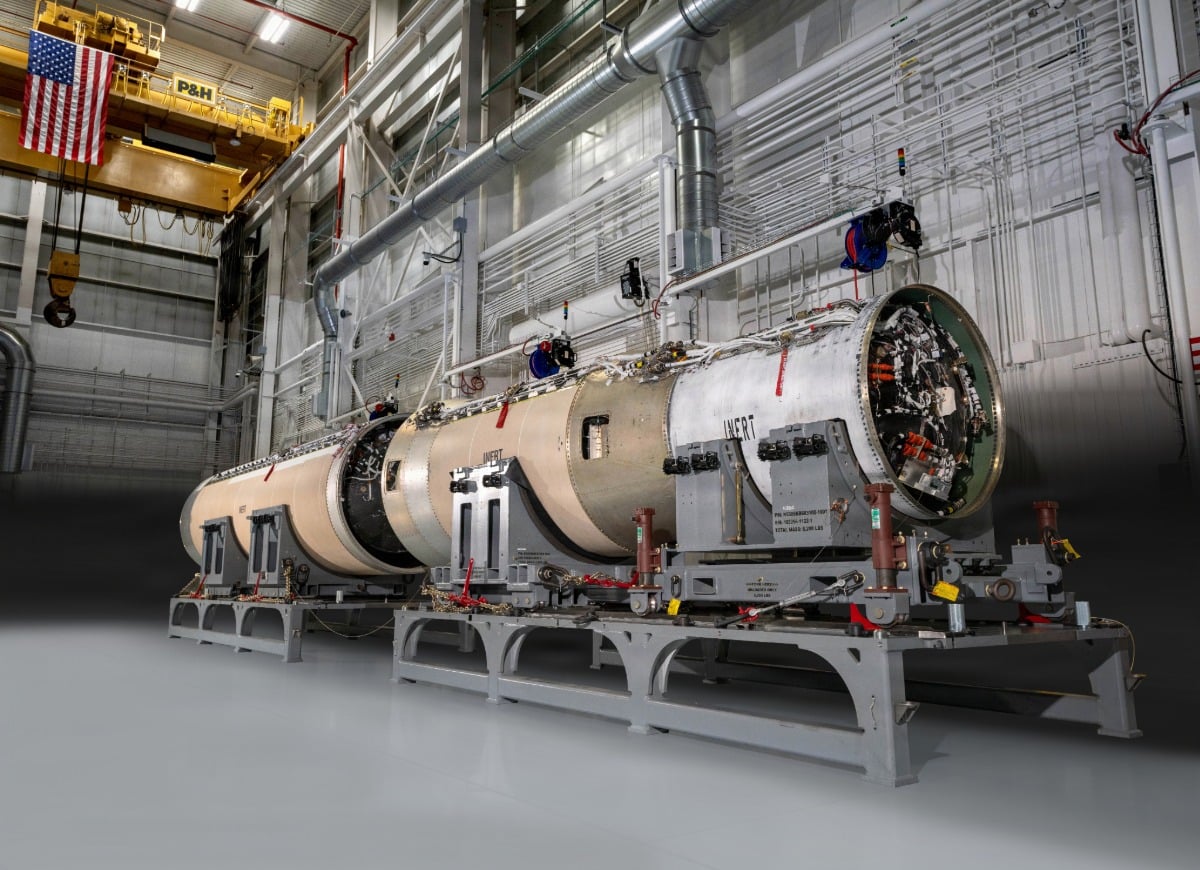
- The Air Force Nuclear Weapons Center published a pre-solicitation notice on June 25, 2026, for sole-source Reentry Vehicle Integration Support work awarded to Lockheed Martin Space Systems, anticipated December 2026.
- The contract covers integration of the Mk21 Reentry Vehicle and W87-0 warhead onto the new Sentinel ICBM, replacing the Minuteman III weapon system.
The U.S. Air Force is preparing to sole-source a contract to Lockheed Martin Space Systems to integrate America’s nuclear warhead reentry vehicle into the new Sentinel intercontinental ballistic missile, a critical step in transferring the country’s ground-based nuclear deterrent from the aging Minuteman III system that has stood watch since the 1970s to the weapon system that will carry that responsibility for the next half century.
The pre-solicitation notice, published June 25, 2026, by the Air Force Nuclear Weapons Center at Kirtland Air Force Base in New Mexico, describes the Reentry Vehicle Integration Support effort, known as RVIS, as work to integrate the Mk21 Reentry Vehicle and its W87-0 nuclear warhead onto the Sentinel weapon system.
The Air Force intends to award the contract directly to Lockheed Martin Space Systems Company, citing the company as the only vendor that possesses the requisite capabilities, intellectual property, software, support equipment, and specialized infrastructure to perform the work. Contract award is anticipated in December 2026.
Understanding what this contract covers requires understanding what a reentry vehicle is and why integrating it onto a new missile is a technically demanding undertaking that cannot simply be handed to a new contractor. A reentry vehicle is the cone-shaped section at the top of a ballistic missile that separates from the rocket after boost phase and carries the nuclear warhead through the extreme heat and pressure of atmospheric reentry before detonating at its designated altitude or ground level. The Mk21 reentry vehicle currently deployed on the Minuteman III carries the W87-0 warhead, a thermonuclear weapon that entered service in the 1980s and has been maintained under the Life Extension Program to ensure its reliability and safety through continued service. Transferring that reentry vehicle and warhead combination from a missile system that has operated for more than five decades to the entirely new Sentinel architecture requires engineering work that touches every interface between the warhead, the fuzing system, the post-boost vehicle, and the missile’s guidance and propulsion subsystems.
The Sentinel weapon system, being developed by Northrop Grumman as the prime contractor and design agent, is defined in the pre-solicitation notice as comprising four major sections: Air Vehicle Equipment, which is the missile stack itself; Weapon System Command and Control; Launch Systems; and Training. The Air Vehicle Equipment section integrates four subsystems: propulsion, post-boost, guidance, and the Payload Reentry System, which is the section that carries the Mk21 reentry vehicle. Lockheed Martin Space Systems’ role under the RVIS contract is to ensure that the legacy Mk21 reentry vehicle and its fuzing components integrate correctly and reliably into the Sentinel’s Payload Reentry System, a task that requires coordination across the Air Force, Northrop Grumman as the design agent, the National Nuclear Security Administration which manages the nuclear warhead side of the program, and Sandia National Laboratories, which has produced a new Fuze Mod Tester that the contractor will also be required to support.
The fuzing system deserves particular attention because it determines when and how a nuclear warhead detonates, making it one of the most safety-critical and technically sensitive components in the entire weapon system. The RVIS contract covers integration of what the notice calls the “Fuze Mod,” a modernized fuze system that must interface correctly with both the new Sentinel missile architecture and the Mk21 reentry vehicle’s legacy subsystems. The contractor will also support the existing legacy fuze System Test Console, the equipment used to test and verify fuze functionality, alongside the new Sandia-produced Fuze Mod Tester. Work scope covers repair, engineering, systems and equipment modification, software development, production engineering, and procurement across both the legacy reentry vehicle subsystems and the new test equipment.
The Minuteman III, which the Sentinel will replace, entered service in 1970 and has been continuously upgraded through modernization programs that have extended its operational life far beyond any original planning assumption. By the time Sentinel reaches full operational capability, some Minuteman III missiles will have been in service for more than six decades, making them among the longest-serving major weapons in American military history. The transition to Sentinel represents the most significant change to the American land-based nuclear deterrent in that entire period, touching every element of the weapon system from the missile motors to the launch control centers buried beneath the Great Plains.
The Mk21 reentry vehicle’s continued use on Sentinel, rather than development of an entirely new reentry vehicle, reflects a deliberate decision to leverage a proven nuclear warhead design while focusing new development resources on the missile airframe, guidance system, and command and control architecture. The W87-0 warhead carried by the Mk21 has a well-documented reliability and safety record accumulated through decades of service and life extension activities, and the National Nuclear Security Administration is responsible for ensuring that record continues as the warhead transitions to its new delivery system. That interagency coordination between the Air Force and the NNSA, which is a semi-autonomous agency within the Department of Energy rather than a Department of War organization, is one of the factors that makes nuclear weapon integration work unusually complex compared to conventional weapons programs where the warhead and delivery system are managed within a single department.
America’s nuclear deterrent has been standing continuous alert since the early 1960s, an unbroken watch maintained by generations of missileers in underground launch control centers across Montana, Wyoming, Colorado, Nebraska, and North Dakota. The work described in this pre-solicitation notice is the engineering foundation that ensures the next generation of that watch begins with a weapon that works exactly as designed, every time, whether it is ever used or not.