

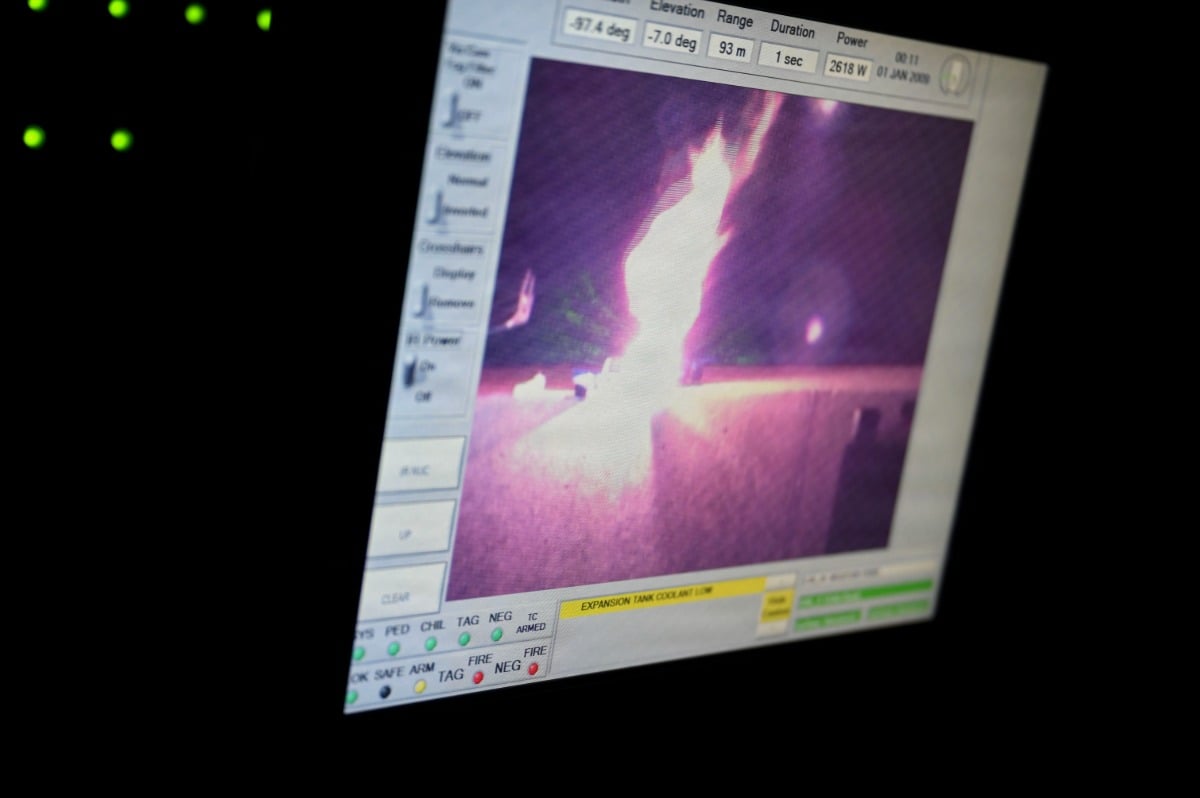
- Verus Research LLC received a contract worth up to $95 million from the Air Force Research Laboratory at Kirtland AFB for laser effects and analysis research, completing by June 2031.
- The competitive award, which drew two offers, covers technical expertise to enhance laser weapon test and data analysis capabilities at Kirtland Air Force Base, New Mexico.
The U.S. Air Force has awarded a contract worth up to $95 million to study how laser weapons affect their targets and how to analyze that data more effectively, accelerating a research effort that sits at the foundation of America’s push to field directed energy weapons as a primary defense against the drone and missile threats reshaping modern warfare.
Verus Research LLC, a defense research company based in Huntsville, Alabama, the city at the center of America’s missile and space defense industrial base, won the competitive contract from the Air Force Research Laboratory at Kirtland Air Force Base in New Mexico, the Air Force’s primary directed energy research installation.
Work will be performed at Kirtland and is expected to run through June 2031, giving the program a five-year horizon to expand the technical understanding of how high-energy lasers interact with and damage a range of targets, from small commercial drones to more demanding threats. Two companies competed for the award, which was structured as a cost-plus-fixed-fee contract, a pricing arrangement used when the government needs research that may evolve in scope and where locking in a fixed price would either overpay for straightforward work or underpay for discoveries that require deeper investigation.
The contract’s stated purpose, providing technical expertise to enhance development of both test and data analysis capabilities for laser effects research, places it in a category of scientific work that is less visible than the platforms that fire lasers but no less critical to getting those platforms into operational service. Understanding precisely how a laser beam damages a target, under what conditions that damage is sufficient to defeat the threat, how atmospheric conditions affect laser propagation and lethality, and how to instrument and analyze test events to extract reliable performance data are all problems that determine whether a laser weapon delivers the capability its power output suggests or falls short in ways that only rigorous testing and analysis can expose.
The Air Force Research Laboratory at Kirtland Air Force Base has served as the primary center of American directed energy research for decades, hosting programs across high-energy laser development, high-power microwave weapons, and the testing infrastructure that evaluates those systems against realistic targets and environmental conditions. Kirtland’s location in the New Mexico desert provides the combination of controlled airspace, extended sight lines, and relatively stable atmospheric conditions that directed energy testing requires, as laser performance in operational conditions depends heavily on air turbulence, humidity, and aerosols that scatter and distort the beam between the weapon and its target. A beam that performs reliably in a clean laboratory environment may fall short of required lethality at operationally relevant ranges under field conditions, and the research Verus will support is designed to characterize and quantify those gaps.
The contract award comes at a moment when the U.S. military’s investment in directed energy has reached levels not seen since the Reagan-era Strategic Defense Initiative, driven by the same drone proliferation problem that has redefined air defense priorities across every branch of the armed forces. Defense Secretary Pete Hegseth personally observed live firings of multiple high-energy laser and high-power microwave systems at White Sands Missile Range in New Mexico in June 2026, the first publicly known instance of a sitting defense secretary watching directed energy weapons fire, reflecting the political priority that laser weapons have acquired at the highest levels of the Department of War.
The Pentagon’s fiscal year 2027 budget request includes approximately $2 billion for directed energy research and development, a figure that dwarfs previous investment levels and reflects the institutional judgment that laser weapons have matured sufficiently to justify production-scale investment rather than continued prototype cycling.