

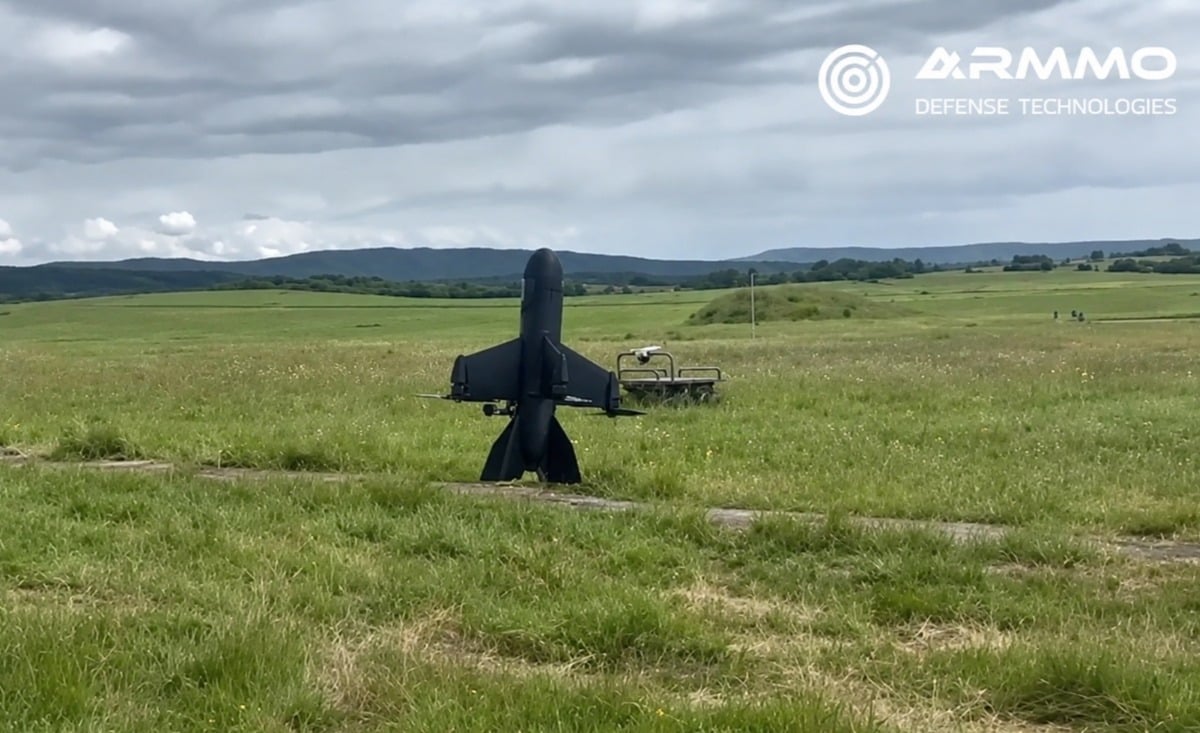
- Spanish company ARMMO Defense Technologies completed live BANDIT-X interceptor drone tests before military operators in Slovakia, validating the full operational cycle including takeoff, interception, and recovery.
- ARMMO co-founder Jaime Abrisqueta confirmed the tests on social media, noting the footage shows a real system flying, not a simulation or commercial render.
A Spanish defense firm has completed live flight testing of its BANDIT-X drone interceptor before military operators in Slovakia, demonstrating the full operational cycle of the system in what the company’s co-founder described as a validation milestone that separates real capability from the concept renders and commercial presentations that dominate the counter-drone industry.
ARMMO Defense Technologies, a Spanish defense technology company specializing in unmanned systems and counter-drone solutions, conducted the tests in Slovakia with military personnel present to observe and evaluate the system’s performance. Jaime Abrisqueta Ynzenga, co-founder of ARMMO, confirmed the testing in a post on social media, emphasizing that the footage circulating from the exercise shows an actual interceptor flying, not a simulation, render, or marketing production. That distinction matters considerably in the counter-drone market, which has seen an explosion of announced products since Russia’s full-scale invasion of Ukraine demonstrated the catastrophic potential of cheap attack drones against conventional military forces, and where the gap between product claims and demonstrated operational capability has often been wide enough to create serious procurement risk for militaries trying to make purchasing decisions.
The BANDIT-X completed what Abrisqueta described as the full operational cycle across the testing program, covering takeoffs, flight stability and navigation, high-speed operations, target interception, and recovery. That sequence is not as straightforward as it appears when listed as bullet points. Each phase of an interceptor drone’s mission imposes different and sometimes contradictory engineering demands on the airframe, propulsion system, and guidance architecture. A drone optimized purely for maximum speed may sacrifice the flight stability needed for reliable navigation or the precision required for terminal interception. A drone designed for gentle recoveries may not be able to absorb the structural stresses of high-speed flight. Completing the entire cycle reliably and repeatedly, rather than demonstrating individual phases in isolation, is precisely the engineering achievement that distinguishes a fielded system from a promising prototype, and it is the standard that Abrisqueta explicitly used to characterize the Slovakia tests.
Abrisqueta drew a pointed contrast between the BANDIT-X testing and what he observed at Eurosatory, the major international land defense exhibition held in Paris that draws defense companies and military procurement delegations from across NATO and partner nations.
“At Eurosatory we saw many interceptors, many concepts and many presentations. However, we did not see too many videos of systems flying in real tests nor many systems validated before military operators,” he wrote.
The counter-drone technology market has grown at a pace that few defense technology sectors have matched in recent years, driven by the operational lessons of the Ukraine war, where Russian Shahed-136 attack drones and first-person-view kamikaze drones have struck Ukrainian cities, power infrastructure, and military positions at a tempo and scale that overwhelmed conventional air defense systems not designed for that threat category. Ukraine’s experience demonstrated that effective counter-drone defense requires not just detection and electronic countermeasures but kinetic interceptors capable of physically destroying aerial threats that have been hardened against jamming or that fly profiles that radar-guided missiles cannot efficiently engage. The demand signal that created has attracted investment and product development from companies across Europe, Israel, the United States, and beyond, producing a crowded market where credible operational testing is one of the few reliable differentiators.