

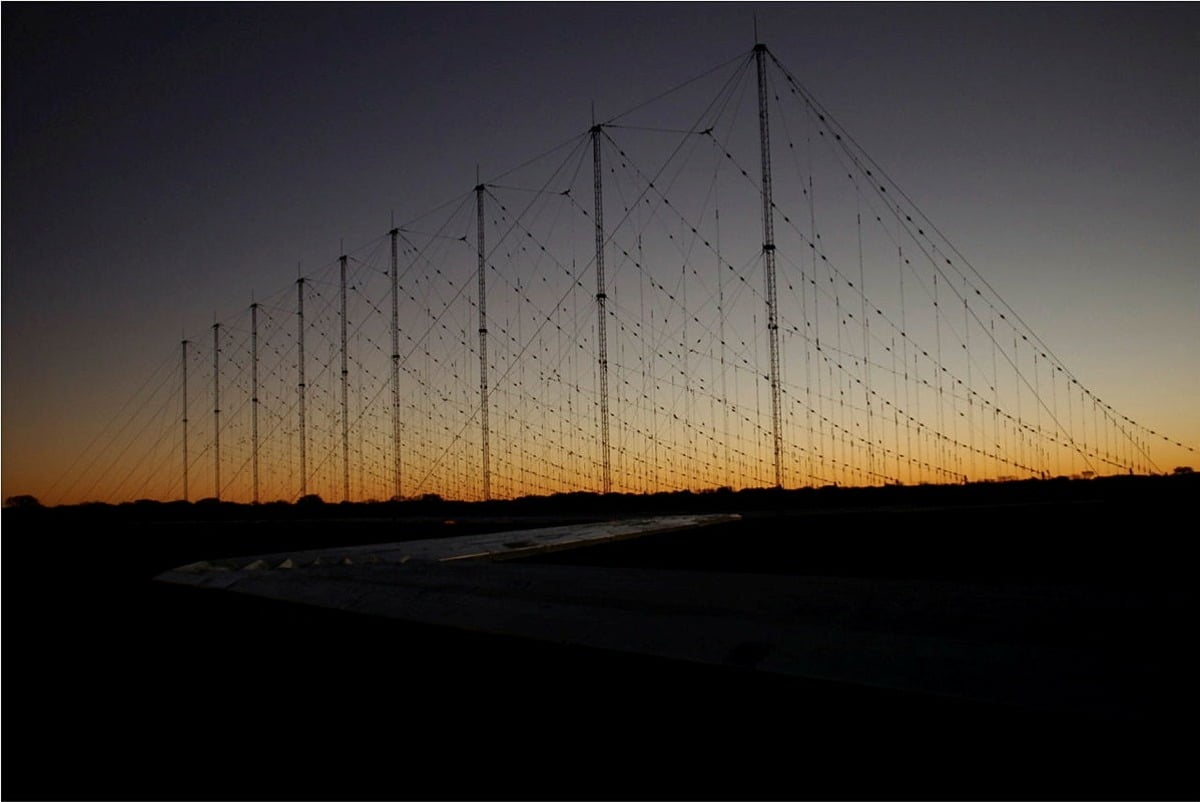
- Australia and Canada signed a $2.5 billion agreement on June 22, 2026, for BAE Systems Australia to deliver an Arctic over-the-horizon radar system to Canada.
- The deal is Australia's largest-ever defense export and the first international sale of its Jindalee OTHR technology, targeting initial Canadian operational capability by December 2029.
Australia has sold its most closely guarded surveillance secret to Canada in a $2.5 billion deal signed on June 22, 2026, that marks the first international export of the Jindalee over-the-horizon radar technology and the largest single defense export in Australian history, giving Canada a system capable of detecting aircraft and ships approaching from thousands of kilometers away through the Arctic, a region that has quietly become one of the most contested strategic corridors on earth.
The agreement, signed at an official ceremony in Canberra between Canadian Secretary of State for Defence Procurement Stephen Fuhr and Australian Deputy Prime Minister and Defence Minister Richard Marles, commits BAE Systems Australia as the industry partner and sets a delivery start date of July 1, 2026. Canada’s target for initial operational capability is December 2029, an ambitious timeline for a radar system of this complexity, and the Canadian government has committed the full $2.5 billion for the procurement.
The technology at the center of the deal is genuinely extraordinary in what it can do. An over-the-horizon radar, known as OTHR, works by bouncing high-frequency radio waves off the ionosphere, the electrically charged layer of the upper atmosphere that extends from roughly 60 kilometers (37 miles) to 1,000 kilometers (620 miles) above the earth’s surface, and using the reflected energy to detect objects that line-of-sight radar systems cannot see because of the curvature of the earth. The Australian JORN network, which has been operating in various forms since the 1970s and reached full operational status in the 1990s, can detect aircraft and maritime vessels at ranges of up to 3,000 kilometers (1,860 miles), a coverage footprint that no conventional radar system can match. A single OTHR installation watching the Arctic approaches to North America covers an area comparable to the entirety of Western Europe.
The Jindalee Operational Radar Network, known as JORN, provides wide-area surveillance of ships and aircraft across Australia’s northern approaches and has been maintained and evolved by BAE Systems Australia for decades, giving the company a depth of operational experience in OTHR lifecycle management that no other Western defense firm can match. BAE Systems Australia has supported every phase of JORN’s development from initial construction through multiple upgrades, and the company’s workforce in this domain represents more than 40 years of accumulated expertise in a technology that is notoriously difficult to build and operate. That expertise is precisely what Canada is buying, not just hardware, but the people who know how to make it work.
Canada’s need for this capability is not abstract. The country’s northern approaches through the Arctic Ocean and the Canadian Arctic Archipelago, a group of more than 36,500 islands north of the Canadian mainland, represent the shortest flight paths between Russia and North America, the same corridors that Cold War planners spent decades trying to monitor with the Distant Early Warning Line, a network of radar stations built in the 1950s that became obsolete long before the Russian military threat evolved into its current form. Russia has invested heavily in Arctic military infrastructure over the past decade, including airbases, naval facilities, and missile deployments in the high north, while the melting of Arctic sea ice has opened new maritime routes that did not exist at scale a generation ago. Canada has lagged behind in the sensors needed to watch all of it, a gap that defense experts and parliamentary reviews have flagged repeatedly as the country’s most critical surveillance deficit.
The A-OTHR program addresses the southern portion of that surveillance requirement, providing coverage from Canada’s border with the United States northward to the Arctic Circle. A second system, known as the Polar Over-the-Horizon Radar or P-OTHR, will eventually cover the far north and the Arctic Archipelago, though the location of that facility has not been publicly announced and remains classified. The two systems together will form the surveillance backbone of Canada’s contribution to NORAD modernization, the joint American-Canadian aerospace defense command that has been working to update its sensor architecture since both governments committed to a major modernization program in 2022.
The economic dimensions of the deal extend to both countries in ways that go beyond the headline contract value. The Canadian government estimates the A-OTHR project will contribute approximately $290 million annually to Canada’s gross domestic product and support roughly 2,270 jobs per year in the Canadian economy during the construction and delivery phase from 2026 to 2033. In Australia, the project supports approximately 300 high-value technical positions, and the export agreement creates a commercial and diplomatic foundation that positions Australian OTHR technology for future sales to other allies. The deal was not without controversy on the Canadian side: domestic radar developer D-TA Systems, which has built operational OTHR components and worked with Raytheon Canada on related programs, expressed disappointment at being passed over in favor of the Australian system, reflecting a tension between allied procurement and domestic industrial development that Canada’s government resolved in favor of speed and proven capability.
Craig Lockhart, Chief Executive Officer of BAE Systems Australia, framed the agreement’s significance in terms of what it means for both allied defense industries and the Five Eyes intelligence-sharing partnership.
“The export of Australian OTHR capability presents a significant opportunity for both Australian and Canadian industry and positions domestic firms to expand exports of high-value goods and services, particularly into allied defence and technology markets,” Lockhart said.
“Canada’s acquisition of a cutting-edge Australian OTHR system supports the strategic interests of both nations through enhanced detection and tracking of threats to North America, strengthening Five-Eyes situational awareness,” he added.
A Canadian OTHR system built on Australian technology and supported by the same workforce that maintains JORN will be interoperable with Australian surveillance data from day one, creating a unified picture of the approaches to North America that neither country could generate alone.
BAE Systems Australia is scheduled to begin delivery work on July 1, 2026, giving the program a running start toward the December 2029 initial operational capability target.