

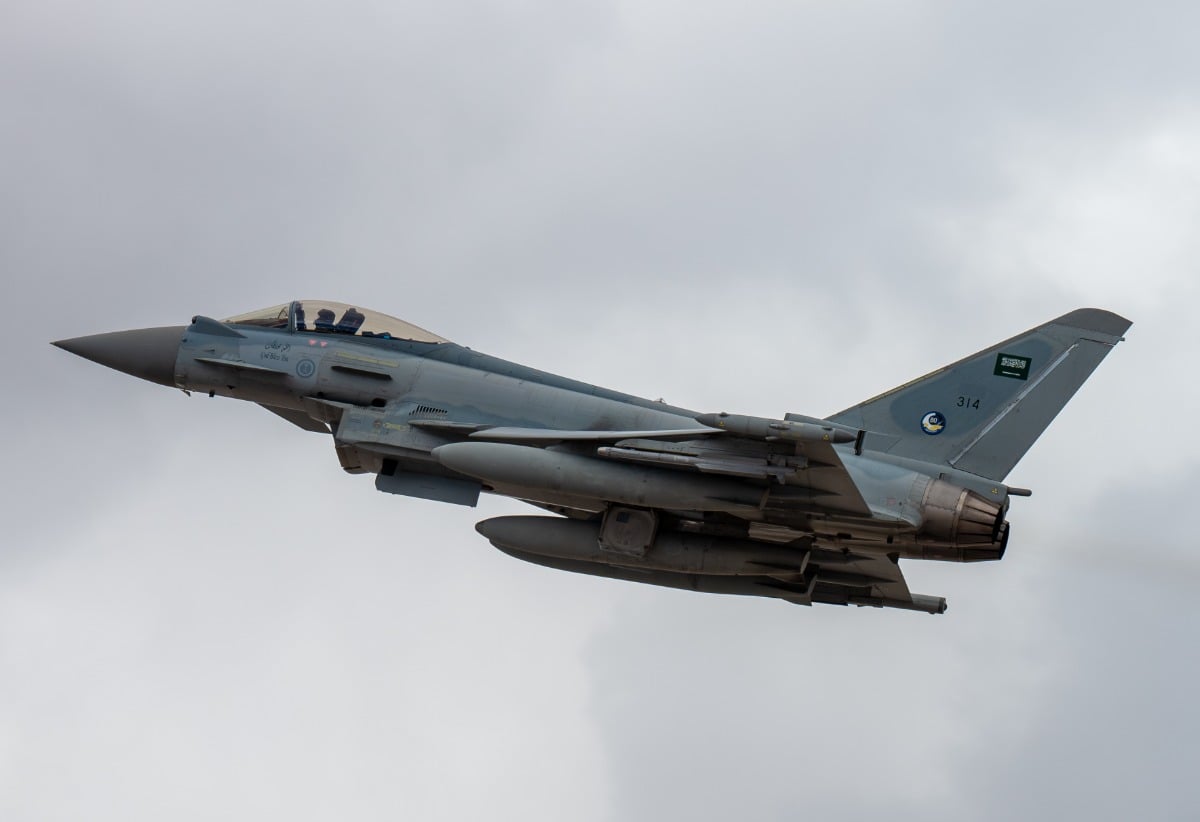
- King Fahd Air Base in Taif completed the first 2,500-hour heavy maintenance overhaul of a Royal Saudi Air Force Eurofighter Typhoon, taking 180 days.
- The overhaul was performed at a facility described as the only one of its kind outside Europe, with 80 percent of the workforce being Saudi nationals.
King Fahd Air Base in Taif, Saudi Arabia, has marked a significant milestone in the Royal Saudi Air Force’s drive toward defense self-sufficiency, completing the first scheduled heavy maintenance overhaul of an RSAF Eurofighter Typhoon following the aircraft’s accumulation of 2,500 flight hours.
The operation was conducted entirely on Saudi soil over a period of 180 days, at a facility described as the only one of its kind outside Europe, by a workforce composed of 80 percent Saudi nationals.
The milestone went largely unremarked in Western defense coverage, but its significance is hard to overstate. The Eurofighter Typhoon, a supersonic multirole combat aircraft built by a European consortium of BAE Systems, Airbus, and Leonardo that has been in service since 2003, has historically depended on specialized depots inside Europe for its most demanding maintenance work. The kind of overhaul just completed at Taif, known in aviation as a scheduled heavy maintenance check or depot-level inspection, is one of the most technically complex operations in military aviation: technicians disassemble major structural components of the airframe, inspect internal systems with a precision impossible during routine line maintenance, conduct structural integrity tests, replace parts as their technical condition requires, and then reassemble and requalify the aircraft for combat service before it can fly again.
BAE Systems and its Saudi partner Al-Salam Aircraft have worked for years toward what the companies describe as “in-Kingdom industrialization” of Typhoon support, starting with smaller capability transfers such as avionics repair. The Advanced Electronic Company, based in Saudi Arabia, became the first approved Typhoon avionics repair agent outside Europe as an early step in that journey. Completing a full 2,500-hour heavy maintenance cycle now represents a categorically different level of achievement, one that required not just tooling and technical manuals but the certified human expertise to perform work that, until now, only European facilities had done on this aircraft type.
Saudi Arabia operates 72 Eurofighter Typhoons, all of which have been delivered and 71 of which remain operational. Those jets are flown by three squadrons of the Royal Saudi Air Force’s 2nd Wing, all based at King Fahd Air Base in Taif, a mountain city located approximately 150 kilometers (93 miles) southeast of Jeddah in the Hejaz range at an elevation of around 1,478 meters (4,848 feet). The RSAF’s Eurofighter fleet has been employed operationally, with Typhoon aircraft from the 2nd Wing conducting sorties from Taif due to the base’s proximity to the Yemeni border. A fleet used in active operations accumulates flight hours faster than one held in reserve, which means the maintenance pipeline will remain under constant pressure. Bringing the 2,500-hour overhaul capability in-kingdom is not an administrative convenience. It is a logistical and strategic necessity.
According to Sulaiman Almuqeem, a Saudi defense professional with expertise in military logistics and projects, the center conducting this work is described as the only facility of its kind outside Europe certified to perform this level of Eurofighter Typhoon heavy maintenance, and the workforce completing the 180-day overhaul was 80 percent Saudi nationals. That combination of facts, certified international standing and a predominantly national workforce, represents the concrete output of a years-long push by the kingdom to do more than simply buy advanced military hardware. It reflects a deliberate effort to absorb the knowledge required to sustain that hardware independently.
The original Al-Salam agreement under which Saudi Arabia acquired its Typhoons included a provision for the creation of a maintenance and upgrade facility in the Kingdom, alongside an industrial technology transfer plan and training for thousands of Saudi nationals to support the aircraft through life. That plan, which began taking shape in the early 2010s, has now produced a workforce capable of executing the most demanding maintenance interval in the Typhoon’s service lifecycle. The 2,500-hour check is not the ceiling. As the fleet continues to accumulate hours across its 71 operational airframes, more aircraft will cycle through the same process, and the technical depth of the in-kingdom workforce will only increase with each repetition.
The broader context is Saudi Arabia’s Vision 2030 defense industrialization agenda, which sets a target of localizing 50 percent of military spending within the kingdom. Achieving certified heavy maintenance status for a complex European combat aircraft is precisely the kind of measurable, technically verifiable milestone that the program is designed to produce. Saudi Arabia has been advancing negotiations for a second tranche of 48 additional Eurofighter Typhoon aircraft, which would expand the fleet to 120 jets and dramatically increase the volume of work flowing through the Taif maintenance center. A facility that has just demonstrated it can handle the first 2,500-hour overhaul is now positioned to scale.