

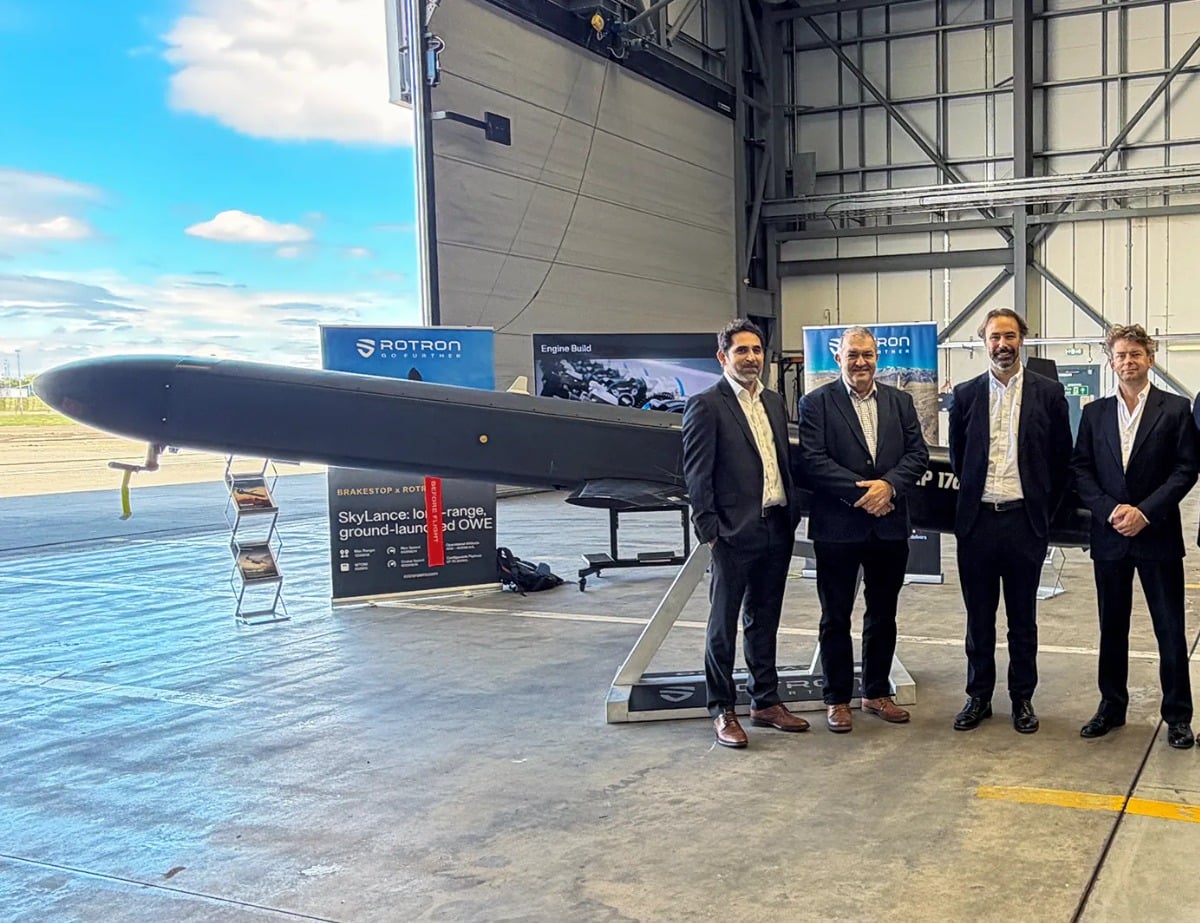
- Rotron Aerospace successfully flight-tested its SkyLance One Way Effect system under UK MoD Project Brakestop, a Taskforce Kindred funded program validating long-range strike technologies.
- The program has already created over 160 highly skilled jobs across the UK defense aerospace sector, with the propulsion system designed and manufactured entirely in the United Kingdom.
A small British aerospace company has successfully flight-tested a long-range strike weapon under a UK Ministry of Defence program, validating a development model that bypassed the traditional procurement bureaucracy and delivered a working one-way attack system at a fraction of the cost and time that established defense primes typically require.
Rotron Aerospace, a UK-based advanced defense technology company founded in 2008 and now a subsidiary of American autonomy and communications firm Ondas Inc., announced the successful trial of its SkyLance One Way Effect system under Project Brakestop, a Ministry of Defence initiative funded through Taskforce Kindred, the UK government’s dedicated program for accelerating the development and procurement of long-range strike capabilities.
The flight trial validates the core technologies underpinning the SkyLance system, which Rotron describes as a one-way effector, the military term for a weapon designed to fly to its target and destroy it rather than return to a base or be recovered after use. The company has not disclosed the specific range, warhead weight, or guidance system specifications of the SkyLance in publicly available materials, though it states the system delivers a substantially greater operational range than alternative solutions in its class, a claim it attributes to its proprietary propulsion technology, which is designed, developed, and manufactured entirely within the United Kingdom.
That propulsion capability is central to both the SkyLance’s operational appeal and Rotron’s commercial pitch to potential customers. One-way effectors, also known as loitering munitions or kamikaze drones in different configurations, have become one of the most watched weapons categories in global defense since the war in Ukraine demonstrated their ability to defeat armored vehicles, strike command nodes, and disrupt logistics at a cost per strike that conventional precision-guided munitions cannot match. The most widely known systems in this category include the Switchblade family produced by AeroVironment in the United States, the Ukrainian Beaver and Baba Yaga adapted agricultural drones, and the Iranian Shahed-136 that Russia has deployed in large numbers against Ukrainian civilian infrastructure. Rotron positions SkyLance in a distinct performance tier above the lighter, shorter-range commercial-derived systems that have dominated recent battlefield coverage, emphasizing range, survivability in contested airspace, and the sovereign British manufacturing chain that underpins every component.
Project Brakestop represents a deliberate departure from how the UK Ministry of Defence has historically developed weapons, and the political significance of that departure is visible in the attendance of Dan Jarvis, the Secretary of State for Defence, at Rotron’s celebration of the milestone, a level of ministerial engagement that signals this is not a routine procurement event but a program the government wants to hold up as a model. The traditional British defense acquisition cycle, governed by a complex set of approval gates, requirements documents, competitive tender processes, and contractual frameworks, typically spans years between initial concept and first flight of a new weapon system. Project Brakestop compressed that timeline dramatically by funding a small company directly to develop and demonstrate a product it was already technically capable of building, cutting out the lengthy requirements definition and contractor selection phases that consume enormous time and money in conventional programs.
Alex Head, Chief Executive Officer of Rotron Aerospace, addressed both the program’s achievement and its broader implications for how the United Kingdom develops military capability.
“Project Brakestop is one of the most innovative programmes the UK MoD has delivered in recent years. Collaboration between the MoD, wider government, QinetiQ and industry has been critical to its success.”
QinetiQ, the UK defense technology company spun out of the Defence Evaluation and Research Agency in 2001 that provides testing, evaluation, and technical advisory services to British and allied militaries, played a supporting role in the program alongside the Ministry of Defence and wider government stakeholders, a collaboration structure that gave Rotron access to facilities and expertise that a small company would not otherwise be able to engage independently.
Head continued with a characterization of what the program proves about the competitive position of smaller British defense companies relative to the established prime contractors that have traditionally dominated UK defense procurement.
“This programme proves agile UK SMEs can deliver complex defence capability at pace, often outperforming traditional procurement models. Through sovereign technology, rapid development and lower-cost delivery, we can provide better value for the taxpayer while strengthening the UK defence industrial base.”
The economic impact of Project Brakestop has already been substantial enough to cite as a concrete outcome alongside the technical milestone. Rotron states the program has directly created more than 160 highly skilled jobs across the UK defense aerospace sector, a figure that reflects the manufacturing and engineering ramp-up required to move from prototype development to a system capable of demonstration and eventual production at scale. Rotron’s vertically integrated model, handling engineering, manufacturing, and propulsion development internally rather than outsourcing to specialist subcontractors, concentrates that employment within the company’s own workforce and supply chain rather than distributing it across a wider industrial network.
The company’s projection of export revenue potential is ambitious: Rotron claims that every pound invested by the Ministry of Defence in defense innovation programs of this type could generate more than ten times the return in future export revenue, a multiplier that, if it proves accurate at scale, would transform the economics of British defense innovation spending from a national security cost into a net revenue generator for British industry. That projection is unverified and forward-looking, as the company’s own investor disclosures acknowledge, but it reflects the genuine commercial opportunity that a proven, cost-competitive, British-made long-range strike effector could access in a global market where demand for affordable one-way strike capability is growing faster than established suppliers can meet it.