

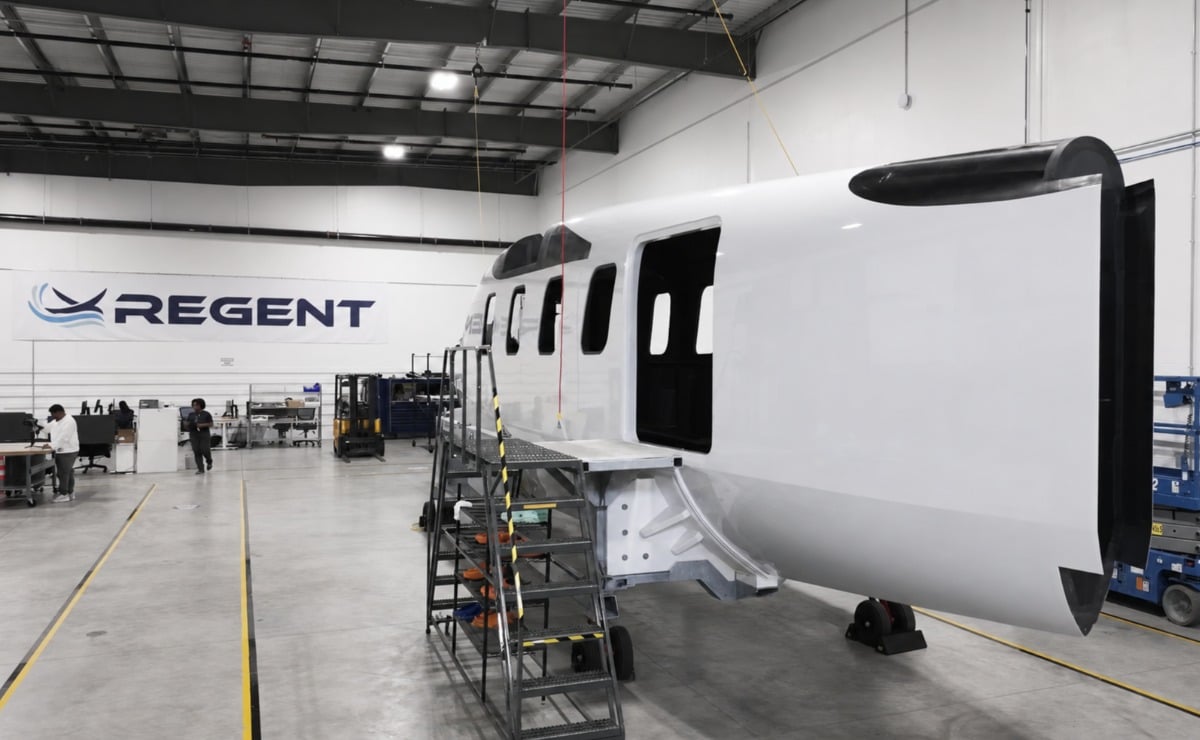
- REGENT Craft completed a 255,000-square-foot Seaglider Manufacturing Facility in North Kingstown, Rhode Island on June 16, 2026, supporting a commercial order book exceeding $10 billion.
- The facility will produce the 12-passenger Viceroy Seaglider and Squire drone variant, with $15 million in existing U.S. Marine Corps contracts supporting the defense business.
REGENT Craft, the Rhode Island company building what it calls an entirely new category of maritime transportation, announced June 16 that it has completed a 255,000-square-foot manufacturing facility in North Kingstown, Rhode Island, purpose-built for a vessel that travels like a boat, lifts onto underwater foils like a racing yacht, and then takes off to fly just above the water’s surface like a low-altitude aircraft, all within a single trip, with the company holding a commercial order book exceeding $10 billion across six continents and $15 million in contracts with the U.S. Marine Corps already secured for the defense application of the same technology.
The vessel REGENT builds is called a Seaglider, and it operates on a principle called wing-in-ground effect, a real aerodynamic phenomenon in which an aircraft flying very close to a surface, in this case water, generates significantly more lift and less drag than it would at altitude, because the compressed air cushion between the wing and the surface amplifies the wing’s efficiency in a way that is physically impossible to replicate higher up. Wing-in-ground effect vehicles have existed in various forms since the Soviet Union built enormous military variants called Ekranoplans during the Cold War, some of them large enough to carry tanks, but none of those designs achieved the combination of modern composite materials, electric propulsion, and hydrofoil technology that REGENT has assembled into the Seaglider’s three-mode operation sequence: floating on the hull at low speed near the dock, transitioning to underwater hydrofoils once clear of traffic, and then lifting off the foils to fly in ground effect at aircraft speeds just above the water, traveling within roughly a wingspan of the surface throughout the flight phase.
The completed facility at 1 Seaglider Way in Quonset Business Park gives REGENT the physical infrastructure to move from prototype development to serial production, and its layout reflects the specific manufacturing demands of a vessel that combines aerospace construction techniques with maritime certification requirements. Mark Duchesne, REGENT’s Vice President of Manufacturing and Supply Chain, described the design philosophy at the facility’s announcement.
“Every system, every tool, every layout decision was made with one goal: to produce the highest-quality Seaglider vessels in the world, consistently, at scale, and with the traceability that certification demands,” Duchesne said. The facility includes dedicated areas for structural assembly, wing and hydrofoil integration, battery and systems installation, and water-based test and acceptance operations, with Quonset Business Park’s direct waterfront access enabling sea trials without moving partially completed vessels across public roads, a logistical advantage that conventional inland manufacturing sites cannot offer.
REGENT currently produces two variants of the Seaglider from this facility: the Viceroy, a 12-passenger all-electric commercial vessel designed for short-to-medium coastal routes where the combination of aircraft-like speed and boat-like convenience offers a compelling alternative to conventional ferries or short-haul air travel, and the Squire, an unmanned drone variant of the same platform intended for cargo delivery, surveillance, and defense applications where removing the passenger cabin and its associated safety requirements allows a different configuration of the platform’s capabilities. The commercial order book exceeding $10 billion that REGENT reports reflects interest from airline and ferry operators who see the Seaglider as a solution to coastal mobility between cities that are too close to make commercial flying practical but too far apart for conventional ferry services to be competitive on travel time.

The defense dimension of REGENT’s business, currently anchored by $15 million in contracts with the U.S. Marine Corps, the naval infantry branch of the American military that specializes in amphibious operations, reflects a specific set of operational requirements that the Seaglider’s performance envelope addresses in ways that conventional maritime vessels cannot match. The Marine Corps has a persistent requirement for fast, low-observable maritime logistics and personnel movement across coastal and littoral environments, the shallow nearshore zones where conventional warships are most vulnerable and where the speed differential between a Seaglider traveling at aircraft-like speeds and a conventional fast boat traveling at conventional boat speeds translates directly into reduced exposure to threats during transit. A vessel that skims above the water surface rather than pushing through it also produces a fundamentally different radar signature than a conventional hull, because the primary contact point with the sea surface is the thin hydrofoil rather than the broad hull that traditional vessel designs present to surface-search radar.
Billy Thalheimer, co-founder and CEO of REGENT, announced the facility’s completion at the Reindustrialize conference in Detroit, a gathering focused on the renewal of American industrial capacity, and framed the announcement in terms that connect the specific technology to the broader national conversation about manufacturing competitiveness. “From our facility at 1 Seaglider Way, we will deliver Seaglider vessels to customers on six continents, create hundreds of high-quality American jobs, and show the world what it looks like when innovation and manufacturing meet at scale,” Thalheimer said. The company has committed to creating 300 jobs at the North Kingstown facility through Rhode Island’s Qualified Jobs Program, with the potential to expand to 750 positions over the next decade, and has already invested $71.5 million into Rhode Island’s economy and created more than 100 jobs ahead of the facility’s completion.
The Quonset Business Park site carries historical significance for American maritime manufacturing, having served as a major naval air station and later as an industrial center with deep ties to defense production across multiple generations of Rhode Island’s workforce, which gives the REGENT facility a geographic and historical context that connects the new technology to an established tradition of American maritime industrial capability rather than positioning it as an isolated startup venture in unfamiliar territory.
REGENT’s press release notes alignment with the Department of War’s Maritime Action Plan and broader administration initiatives on American shipbuilding and maritime dominance, connecting the company’s commercial development program to federal strategic priorities that have prioritized rebuilding the American maritime industrial base after decades in which domestic shipbuilding capacity declined relative to Asian competitors. A facility that produces vessels for both commercial coastal mobility customers and the Marine Corps, from American-sourced materials in a historic maritime industrial site, represents the kind of dual-use manufacturing capacity that those federal priorities are designed to cultivate.