

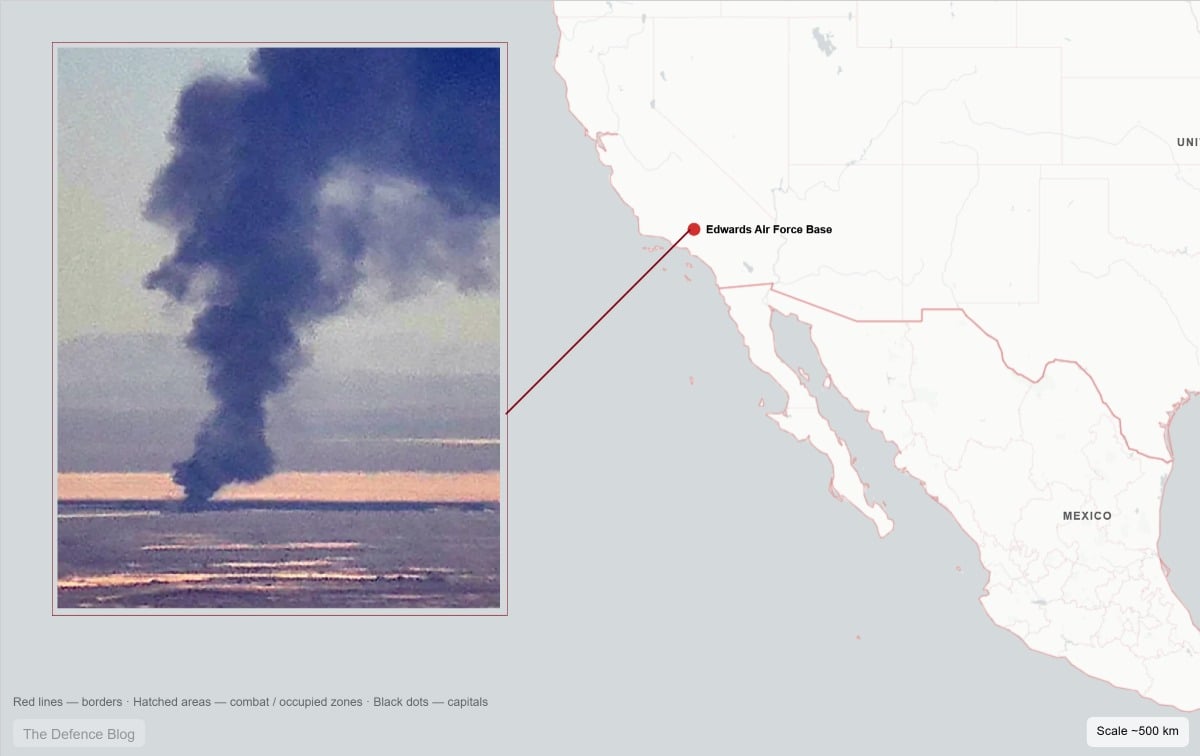
- Edwards Air Force Base confirmed a B-52 Stratofortress crashed shortly after takeoff at 11:20 a.m. on June 15, 2026, triggering an immediate emergency response.
- Crew status, cause of the crash, and the specific mission being flown have not been officially confirmed as of the time of publication.
One of America’s most iconic warplanes went down Monday morning at a military base in the California desert, setting off a large fire visible from miles away and triggering an immediate emergency response.
Edwards Air Force Base, the sprawling flight test installation located in the Mojave Desert roughly 160 km (100 miles) north of Los Angeles, confirmed that a United States Air Force B-52 Stratofortress crashed shortly after takeoff from the airfield at 11:20 a.m. local time. As of the time of writing, the status of the crew is unknown, no casualty figures have been released, and the cause of the crash has not been officially determined.
“A United States Air Force B-52 Stratofortress crashed shortly after takeoff on the Edwards airfield at 11:20 a.m.,” Edwards Air Force Base said in a statement posted to its official social media accounts. “Emergency crews immediately responded to the scene and the situation is ongoing. More information will be provided as it becomes available.” That statement represents the entirety of what base officials have confirmed. Everything beyond it, including crew status, the specific mission the aircraft was flying, and the sequence of events that led to the crash, remains unconfirmed or unknown.
Still images and video emerging from the scene showed a large fire with a heavy column of black smoke rising from the base, visible from considerable distance. The aircraft appears to have come down at or near the base’s main runway, based on initial unverified imagery, though the exact location has not been officially confirmed. News of the crash first surfaced in a post on an unofficial Air Force social media group before the base issued its official statement, with an early unverified report suggesting the aircraft involved carried tail number 061. That tail number has not been officially confirmed by the Air Force.
The B-52 Stratofortress is one of the most recognized aircraft in the history of military aviation, a long-range strategic bomber that has been in continuous service with the United States Air Force since 1955, longer than the careers of every pilot now flying it. The Air Force has a total B-52H inventory commonly listed at 76 aircraft, with 58 operated by active-duty units and 18 by the Air Force Reserve, all of them B-52H variants, the final and most capable production model. The aircraft carries a crew of five, can fly at altitudes up to approximately 15,240 meters (50,000 feet), and is capable of carrying conventional weapons, cruise missiles, and nuclear gravity bombs, giving it a role in both conventional strike operations and the air leg of America’s nuclear deterrent.
Edwards Air Force Base is not a frontline combat installation. It is the primary flight test center of the United States Air Force, home to the 412th Test Wing, the organization that conducts developmental and operational testing on virtually every aircraft and weapon system the Air Force fields. The 419th Flight Test Squadron at Edwards, which flies the B-52H under the tail code ED, is responsible for flight testing of the bomber platform, including the multiple concurrent upgrade programs currently underway on the aircraft. A B-52 operating from Edwards on a Monday morning would most likely have been conducting test and evaluation work rather than a training or combat mission, though that has not been confirmed.
The B-52 has a long history at Edwards, where it has served as both a test platform for the bomber’s own upgrades and as a mothership for experimental aircraft. The base’s relationship with the B-52 stretches back decades, and the aircraft’s continued presence in the test fleet reflects how much work remains to be done on a platform the Air Force plans to keep flying until at least the 2050s under the designation B-52J. That long service life is a testament to the aircraft’s design, but it also means that every airframe is irreplaceable until new production is authorized, which it has not been.
What caused Monday’s crash, whether mechanical failure, a flight control problem, an engine issue, or some other factor, is completely unknown at this stage. The Air Force will convene an accident investigation board, a formal process that typically takes months to complete and produces a public report that identifies contributing factors and recommendations for preventing similar incidents. Until that process runs its course, any cause assigned to Monday’s crash would be speculation.