

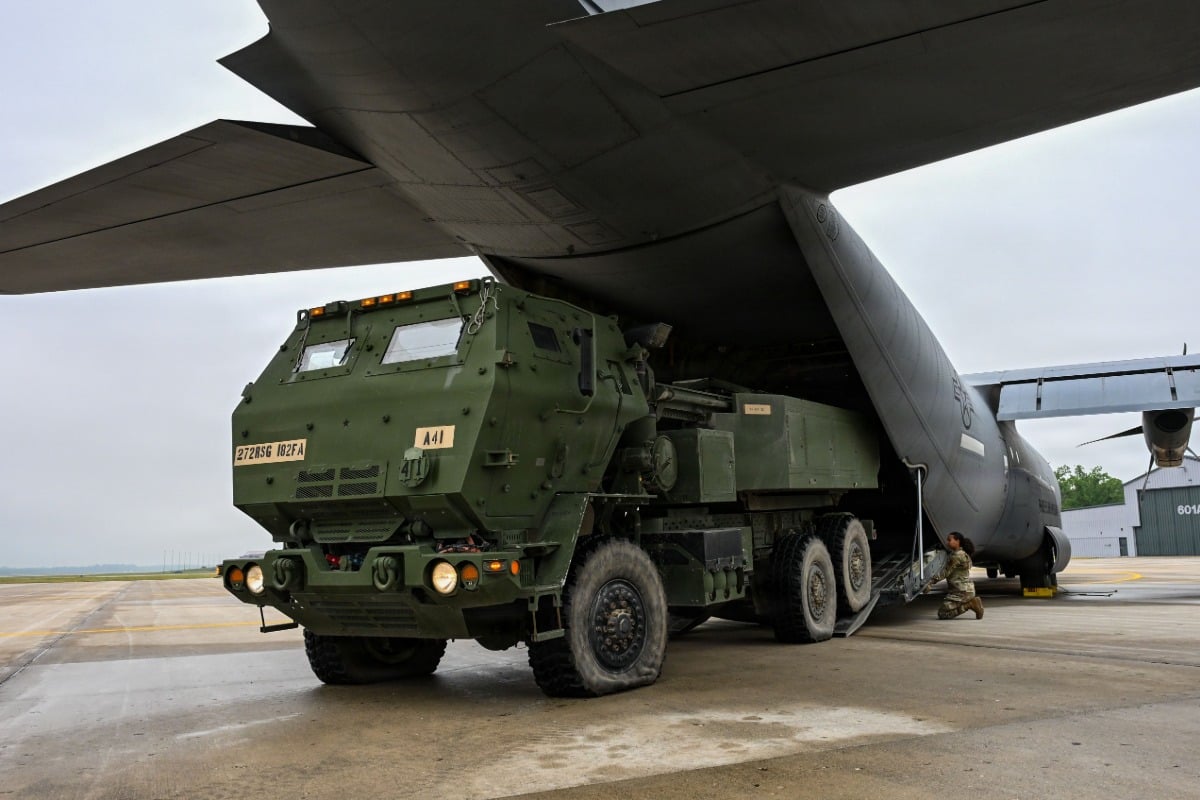
- Michigan Army National Guard soldiers flew a HIMARS launcher more than 3,200 km (2,000 miles) from Michigan to Fort Irwin, California on C-130J aircraft during NTC rotation 26-08, June 6-13, 2026.
- The NTC Minuteman Rotation was the first of its kind at Fort Irwin, integrating National Guard HIMARS deep fires with the 2nd Armored Brigade Combat Team, 3rd Infantry Division.
Michigan National Guard soldiers loaded a HIMARS rocket artillery launcher onto a C-130J transport aircraft in Michigan and flew it more than 3,200 km (2,000 miles) to the California desert, where they executed simulated precision strikes before extracting, completing a long-range joint Army-Air National Guard HIRAIN training event as part of the Army’s premier combat training center rotation.
The exercise, conducted June 6-13 at the National Training Center at Fort Irwin, California, marked the first-ever Minuteman Rotation at NTC, a new training concept that plugs National Guard units directly into the same high-intensity combat simulations that active-duty Army formations use to prepare for large-scale war.
The HIMARS, which stands for High Mobility Artillery Rocket System, is a truck-mounted rocket launcher that fires GPS-guided munitions at targets up to 80 km (50 miles) away with precision that earlier rocket artillery could not match, and up to 300 km (186 miles) with the Army Tactical Missile System. Ukraine’s use of HIMARS against Russian ammunition depots and command posts beginning in 2022 demonstrated how effectively the system can reach behind enemy lines and strike targets that conventional artillery cannot touch, and the U.S. Army has since been investing heavily in tactics that extend that capability further by flying the launcher to locations an adversary would not expect.
That is the concept underlying HIRAIN, short for HIMARS Rapid Infiltration, a highly coordinated joint operation in which a HIMARS launcher is airlifted to a forward or austere location, offloaded, used to execute a precision strike, then quickly reloaded onto the aircraft and extracted before enemy forces can detect or target the unit. The tactic is military “shoot and scoot” compressed to extreme speed and distance, eliminating the exposure time that makes static artillery systems increasingly vulnerable in a battlespace filled with sensors, counter-battery radars, and long-range precision fires. Lt. Col. Travis Hertlein, 1st Battalion, 94th Field Artillery Regiment commander, described the operational logic during a HIRAIN exercise at Cobra Gold 2026: “HIRAIN allows us to train to get into these locations and provide extended reach with 24/7 precision fire capability.”
The Michigan soldiers who executed the NTC Minuteman Rotation belong to Alpha Battery, 1st Battalion, 182d Field Artillery Regiment, Michigan Army National Guard, a unit equipped with HIMARS and trained for exactly this kind of rapid deployment fire mission. Capt. Courtney Bonneau, Alpha Battery Commander, described what the NTC exercise represented for a National Guard unit. “The Minuteman Rotation is a specialized, high-intensity training program at combat training centers that are designed to simulate real-world combat scenarios for rotational units, in a controlled, large-scale environment,” Bonneau said. “Being able to conduct this mission, within our annual training plan as National Guard Soldiers, was a great opportunity to train as we would fight in combat operations.”
The Air Force side of the mission was provided by the Rhode Island Air National Guard’s 143d Airlift Wing, flying C-130J Super Hercules transport aircraft, the modernized variant of the legendary four-engine turboprop that has carried cargo, troops, and special operations forces into austere landing zones for more than six decades. Getting a HIMARS launcher onto a C-130J requires the vehicle to lower its suspension by “kneeling,” a hydraulic adjustment that reduces the vehicle’s height enough to clear the aircraft’s cargo ramp and interior dimensions. The launcher is then driven aboard, secured with aircraft tie-down chains, and transported to the destination, where the process runs in reverse and the crew has minutes to prepare for a fire mission. Capt. Ben Newman, a C-130J pilot with the 143d AW, described why the joint training matters for both services. “The joint training is extremely beneficial for successful agile combat operations,” Newman said. “By understanding the interoperability between the Air Force and Army, we can align processes and terminology to achieve mission success.”
Sgt. 1st Class Corey Morawa, Platoon Sergeant of Alpha Battery, articulated the tactical value of the HIRAIN concept directly. “HIRAIN brings speed, reach and survivability to the deep fight by inserting a precision-fire platform that can be rapidly inserted to support any theater of operations,” Morawa said.
The Minuteman Rotation concept itself is new, designed to align National Guard annual training requirements with combat training center rotations so that Guard units train at the same standard and against the same simulated threats as their active-duty counterparts, rather than in separate lower-intensity exercises. The first Minuteman Rotation took place in March 2026 at the Joint Readiness Training Center at Fort Polk, Louisiana, involving Florida Army National Guard air defense soldiers. The NTC rotation in June was the first Minuteman Rotation at the National Training Center and a 2,000-mile HIRAIN event involving HIMARS.