

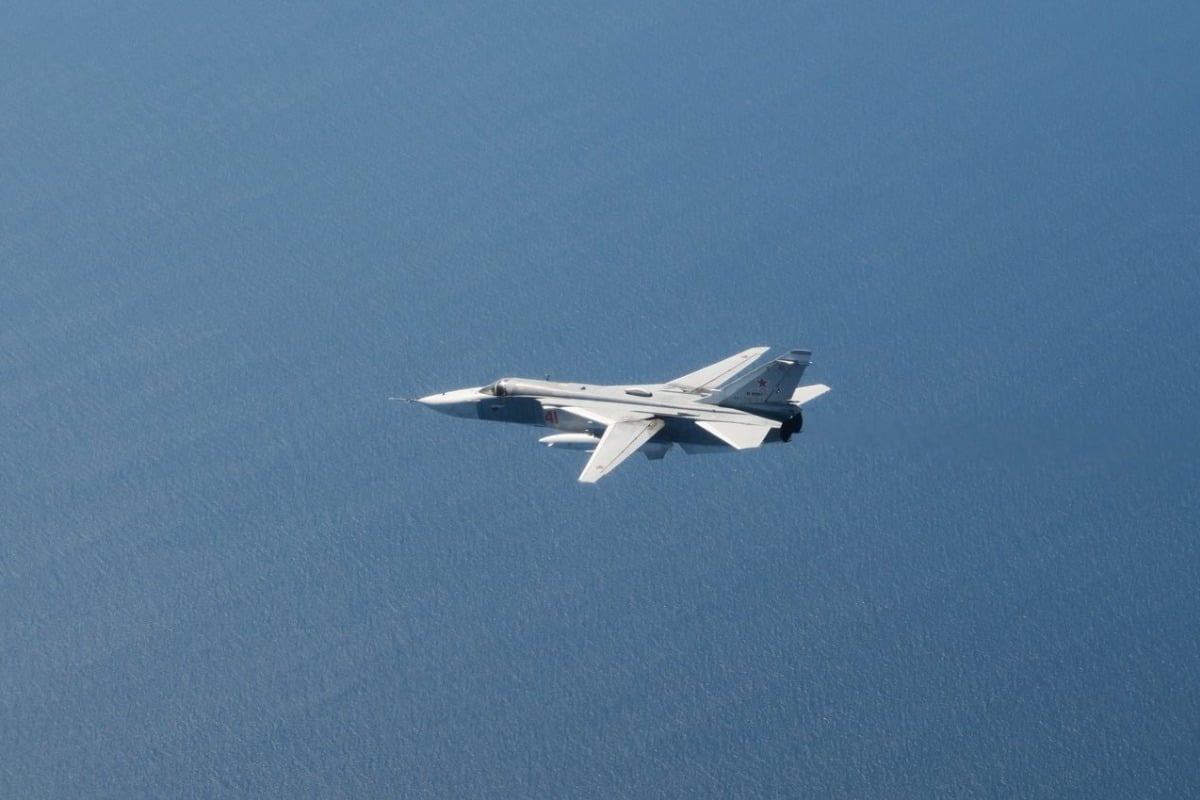
- Sweden scrambled two pairs of JAS 39 Gripen fighters on June 13, 2026 to intercept Russian Su-24 and Su-34 aircraft in both the southern and northern Baltic Sea.
- Danish combat aircraft also scrambled during the southern incident; Swedish airspace was not violated, and the Russian aircraft were tracked back toward Kaliningrad.
Swedish fighter jets launched twice in a single Friday to intercept Russian military aircraft operating near Swedish airspace over the Baltic Sea, in what Stockholm’s top military commander described as a serious pattern of Russian behavior threatening both territorial integrity and NATO alliance security. The Swedish Armed Forces confirmed on June 13, 2026 that its quick reaction alert force scrambled two pairs of JAS 39 Gripen fighter jets to meet Russian combat aircraft, with separate incidents occurring in the southern and northern parts of the Baltic on the same day. Allied combat aircraft also scrambled during the incidents to maintain security in shared airspace.
The Russian aircraft involved were identified as a Su-24 and a Su-34. The Su-24 is a Soviet-designed supersonic strike aircraft used by Russia for both ground attack and tactical reconnaissance missions, while the Su-34 is a more modern twin-seat strike fighter designed to deliver precision munitions at long range. Defense analyst Guy Plopsky noted that images from the incident show a Russian Air Force Su-24MR, the dedicated tactical reconnaissance variant of the Su-24, suggesting at least one of the Russian aircraft was conducting intelligence collection rather than a straightforward combat patrol. Neither aircraft violated Swedish airspace, according to the Swedish Armed Forces.
The JAS 39 Gripen is Sweden’s primary multirole combat aircraft, developed by Saab and operated by Sweden and several export customers. Sweden joined NATO in March 2024, and since then Swedish Gripens have participated in the alliance’s Baltic Air Policing mission, the NATO program under which member nations rotate fighter aircraft through Baltic states to maintain round-the-clock air surveillance over a region with no fast-jet air forces of its own. Sweden’s incident readiness force, the quick reaction alert element that keeps aircraft fueled, armed, and ready to scramble at minutes’ notice, is the domestic complement to that NATO role, maintaining surveillance over Sweden’s own airspace and surrounding area at all times.
Vice Admiral Ewa Skoog Haslum, Head of the Swedish Armed Forces’ Joint Operations Command, framed both incidents explicitly within a pattern rather than treating them as isolated events. “The Russian behaviour is serious and represents a recurring pattern that threatens both our territorial integrity and security,” Haslum said. “Swedish and allied combat aircraft acted swiftly, resolutely and clearly by intercepting the Russian aircraft and securing the territory of Sweden and the Alliance.”
Hanna Heurlin, press communicator for the Swedish Armed Forces, declined to speculate publicly about Russia’s intent, while making clear that the military’s assessment of the flights was not casual. “We cannot speculate as to why they flew there, but we consider this to be very serious,” Heurlin said. She also described the intercept itself as a deliberate signal, noting that showing up to meet a foreign aircraft in these circumstances carries its own message. “We have many different routines in the air, and it is a signal in itself to show up in situations like these,” she said.
Swedish Gripens intercepted and identified the Russian aircraft near Swedish airspace; Swedish officials confirmed that Swedish airspace was not violated. The Swedish Armed Forces also confirmed that, in light of an increased threat to allied airspace in the surrounding region, they have reinforced their presence and adjusted their readiness posture, a statement that goes beyond routine incident reporting and signals a deliberate operational response to a changed threat environment. The Swedish military has not publicly described what specific adjustments have been made, but the language of reinforced presence and adjusted readiness indicates that the two Friday incidents were not treated as routine encounters requiring no follow-up.
Russian military aircraft regularly fly near NATO airspace across the Baltic region, and alliance members scramble fighters to intercept and identify them under standing NATO protocols. The frequency and nature of those flights has increased measurably since 2022, however, with Baltic airspace incidents occurring more often and involving a wider range of aircraft types than was typical before Russia’s full-scale invasion of Ukraine.