

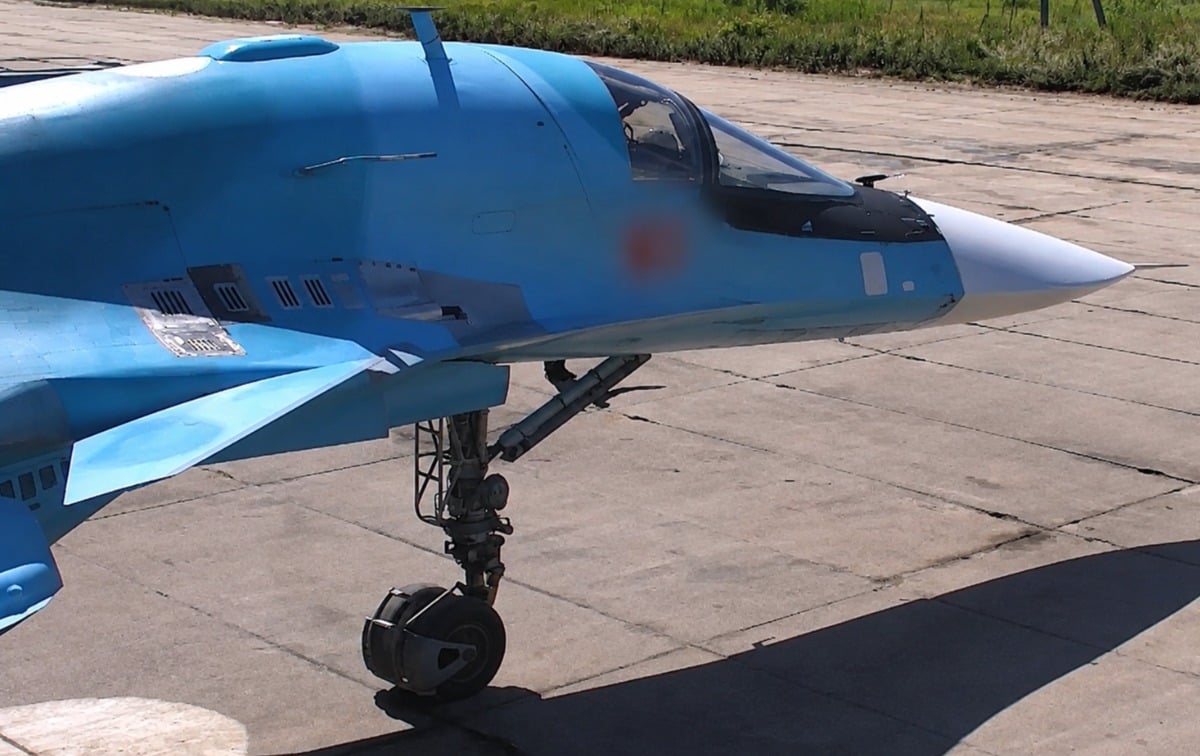
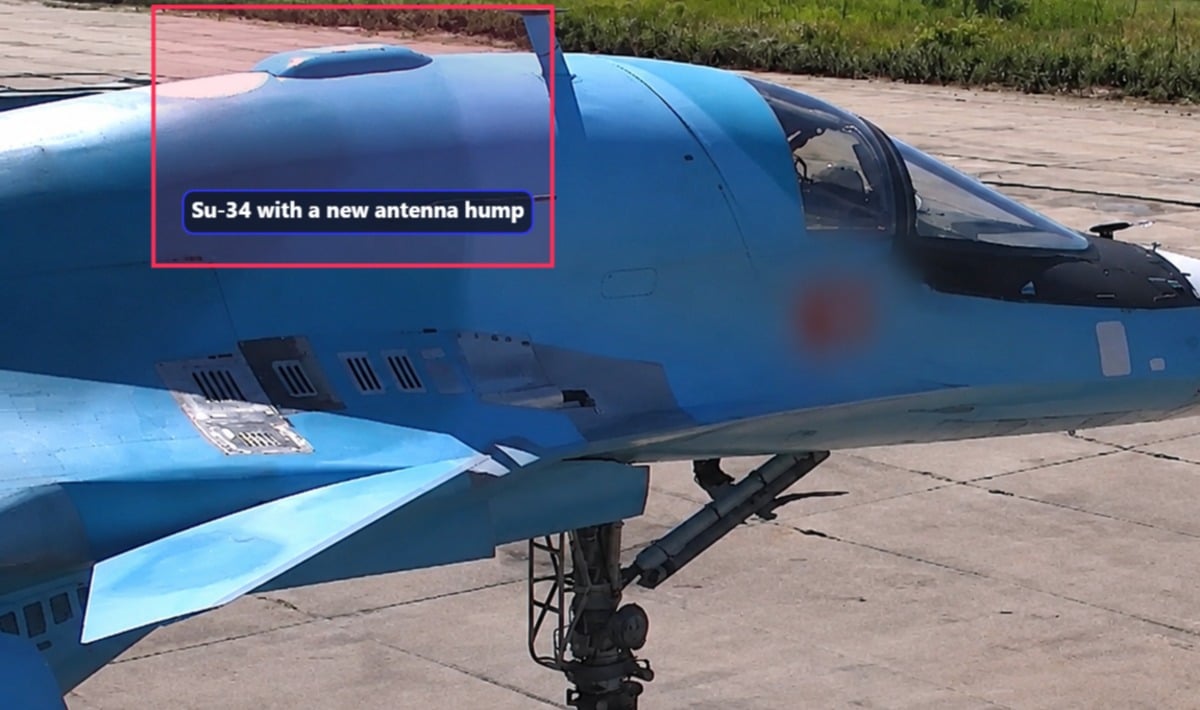
- Israeli defense analyst Guy Plopsky identified a new dorsal antenna hump aft of the cockpit on a modified Russian Su-34 in an official Russian MoD video on Su-34 operations against Ukraine.
- Plopsky previously noted the same modification in a May 2026 photograph from the Russian AviamiR34 Telegram channel, suggesting it may be a Su-34M or NVO battlefield upgrade variant.
A still image pulled from a newly released Russian Ministry of Defense video on Su-34 strike aircraft operations against Ukraine has provided what Israeli defense analyst Guy Plopsky described as “the clearest view yet” of what appears to be a new dorsal antenna hump fitted aft of the cockpit on at least one variant of Russia’s primary strike aircraft.
The observation, published by Plopsky on social media alongside the MoD video frame, adds a new confirmed data point to a modification he has been tracking since at least May 2026, when a photograph posted by the Russian Telegram channel AviamiR34 first showed the same structural change on what may be the same or a related aircraft.
The dorsal fairing identified sits aft of the cockpit on the upper fuselage spine, a location that on modern combat aircraft is typically used for satellite communication antennas, datalink equipment, or electronic warfare systems that require a clear sky-facing aperture unobstructed by the aircraft’s own structure.
The Su-34, designated Fullback by NATO and built by Sukhoi, is Russia’s dedicated supersonic strike fighter, a twin-seat side-by-side crew aircraft derived from the Su-27 Flanker family and designed specifically for precision ground attack at extended range. It entered Russian Air Force service around 2014 and has been one of the primary platforms Russia has used throughout its war against Ukraine, delivering both guided precision munitions and unguided free-fall bombs across the full depth of the Ukrainian theater. The aircraft has a maximum combat radius of approximately 1,100 km (684 miles) with a standard weapons load, carries up to 8,000 kg (17,600 lb) of ordnance on twelve hardpoints, and features a built-in electronic warfare suite designed to suppress enemy air defenses during strike missions.
The significance of a new dorsal antenna installation becomes clear when considered against the operational challenges Russia has faced in delivering precision guided munitions at standoff range. Guided aviation weapons, particularly glide bombs with satellite navigation guidance such as the UMPK family of glide bomb conversion kits that Russia has deployed extensively since 2023, require the launching aircraft to maintain a reliable data connection for targeting updates, weapon release calculations, and in some variants post-release guidance corrections. That data connection, whether it runs through satellite links, ground-based datalinks, or a combination of both, is only as good as the antenna system that supports it. An aircraft with a degraded or limited satellite communication capability is an aircraft that cannot reliably deliver precision-guided munitions at the distances and accuracy levels that standoff strike requires.
In May 2026, Plopsky noted that the AviamiR34 photograph “likewise shows the new version of the Su-34 strike fighter,” adding: “As I’ve previously noted, this could be a Su-34M or a new version of the Su-34 (NVO). Here, too, we can see the new dorsal fairing (antenna housing?) aft of the cockpit.” The Su-34M designation refers to a modernized variant of the aircraft that Russia has been developing, though publicly available details on its specific upgrades remain limited.
What Plopsky has not confirmed, and what the available imagery does not establish with certainty, is exactly what the dorsal fairing contains. The antenna hump interpretation is the most technically logical inference given its location, size, and the operational context in which modified Su-34s have been observed, but without access to the aircraft’s specifications or a direct confirmation from Russian defense industry sources, the precise function of the modification remains an educated assessment rather than a confirmed fact. The possibility that it houses electronic warfare equipment, an enhanced radar warning receiver array, or a communications relay system for coordinating with other aircraft in a formation cannot be definitively ruled out from imagery alone.
Russia has been making progressive modifications to its Su-34 fleet throughout the war, responding to operational feedback from crews flying the aircraft in the most heavily defended airspace in Europe. Ukrainian air defenses, including long-range surface-to-air missile systems, fighter aircraft armed with beyond-visual-range missiles, and the increasingly capable drone-based threat network, have imposed significant attrition on Russian aviation, forcing Russian planners to push strike aircraft to greater release distances, develop new electronic warfare countermeasures, and equip aircraft with systems that allow them to deliver precision weapons from beyond the engagement envelopes of the most dangerous Ukrainian air defense systems.
The pattern of Russian aircraft modification that Plopsky has been documenting on the Su-34 fits within a broader documented trend. Oryx, the open-source equipment loss tracking blog, has documented multiple Russian Su-34s destroyed or damaged since February 2022, losses that have created pressure to improve the survivability and effectiveness of the remaining fleet. Each confirmed modification to the Su-34 airframe tells part of the story of how Russia is trying to sustain a precision strike capability against an adversary that has become progressively better at making that capability expensive to exercise.
A new hump on a Russian strike jet’s spine is a small thing to observe. What it represents, if Plopsky’s interpretation holds, is Russia continuing to invest in making its most capable strike platform more effective at precisely the moment when Ukraine needs it to be less so.