

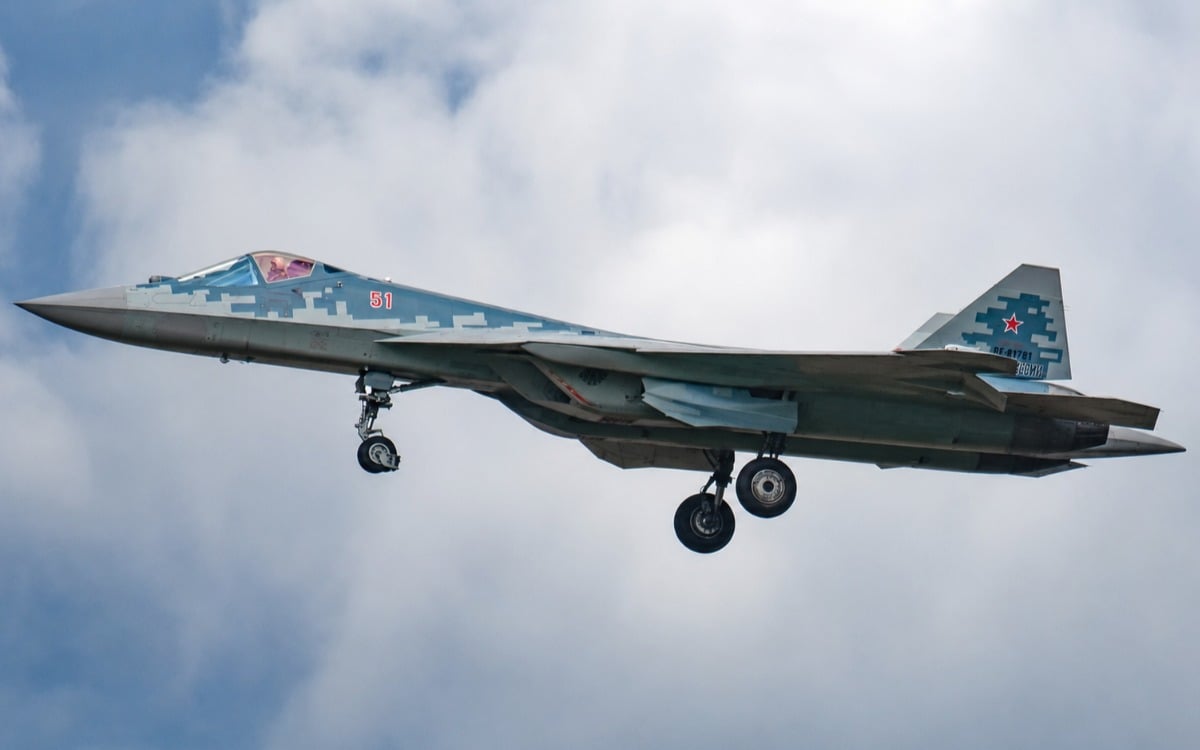
- Russian military analyst Maksim Kalashnikov publicly challenged Putin's claim that the Su-57 is the world's best fighter, citing its limited role in Ukraine compared to Israeli F-35 combat operations against Iran.
- Russian military commentators noted the Su-57 has not achieved air superiority over Ukraine and cited engine, avionics, and stealth shortfalls as reasons it lacks true fifth-generation status.
Days after Vladimir Putin called the Su-57 the best fighter jet in the world, Russian military bloggers and analysts are publicly pushing back, pointing to the aircraft’s limited and largely standoff role in the war rather than visible operations in contested Ukrainian airspace as the most damning rebuttal to their president’s claim.
The criticism emerged in the Russian military commentary space following Putin’s remarks at a meeting with news agency heads, where he described the Su-57 as a fifth-generation aircraft he believes to be the best in the world today and offered to supply it to India. The response from within Russia’s own defense analysis community was sharper than such commentary typically becomes in a media environment where criticism of military programs carries real professional and personal risk.
Military analyst Maksim Kalashnikov, one of Russia’s more prominent independent defense commentators, framed his challenge as a direct comparison with the F-35.
“If the Su-57 is a better aviation complex than the notorious F-35, then where is it in Ukraine?” Kalashnikov wrote. “The F-35s in the Israeli Air Force worked against Iran as if there was no air defense there at all. They struck air defense systems and hit critically important targets. But do we see analogous actions by the Su-57 in Ukraine? No, just drones and missiles. Do the Su-57s even follow behind their waves? In this life, deeds matter, not words. We’ve already been fed enough words.”
Since 2024, Israeli F-35I Adir aircraft have been used repeatedly in strikes against Iranian territory and Iranian-linked targets, including air defense systems, nuclear facilities, ballistic missile sites, and military command infrastructure.
The most significant single operation was Operation Rising Lion on June 13, 2025, in which over 200 Israeli aircraft including F-35s struck more than 100 targets across Iran, according to the Israeli Defense Forces. Israeli F-35 operations against Iran have continued into 2026. Throughout this campaign, Israeli stealth aircraft penetrated Iranian air defenses repeatedly without confirmed losses to those systems. Kalashnikov’s implicit argument is that if the Su-57 genuinely exceeds the F-35 in stealth and electronic warfare capability as Putin claims, Russia should have been able to demonstrate comparable performance in Ukraine’s contested airspace. Instead, as he notes, the Russian Aerospace Forces have relied on cruise missiles, Shahed drones, and glide bombs rather than putting the Su-57 into meaningful contested airspace roles.
A separate line of commentary appearing beneath coverage of Putin’s remarks extended the criticism further, addressing the aircraft’s fundamental technical status rather than just its operational employment.
One commenter wrote: “Without the S-70 Hunter, the Su-57 is also a museum rarity that never even became a true fifth-generation aircraft — not in terms of engines, not in avionics, not in stealth. Everyone can see the result of this state of affairs in the special military operation [War in Ukraine], where the Russian Aerospace Forces have failed to achieve air superiority over contested territory and have lost air superiority over Russian territory itself.”
The S-70 Okhotnik, or Hunter, referenced in that comment is Russia’s heavy unmanned combat aircraft developed by Sukhoi as a loyal wingman and strike platform designed to operate in coordination with the Su-57, extending its sensor reach and providing additional strike capacity while keeping the crewed aircraft out of the most dangerous engagement envelopes.
The S-70 Okhotnik’s operational history over Ukraine adds a layer of embarrassment that the Russian commenters alluded to without spelling out. On October 5, 2024, an S-70 prototype with serial number 074 Red lost contact with its ground operator due to a technical malfunction and began drifting toward Ukrainian-controlled territory near Kostiantynivka in the Donetsk region. Faced with the prospect of Russia’s most advanced combat drone prototype falling intact into Ukrainian hands, the accompanying Su-57 pilot fired an air-to-air missile and shot the S-70 down. Ukrainian forces recovered the wreckage approximately 16 km (10 miles) from the front line. Ukrainian and Western specialists examined the recovered components, and initial assessments cast doubt on Russian claims about the drone’s advanced capabilities, with one Ukrainian defense expert quoted by Defence Blog describing it as “more like a glider equipped with basic flight capabilities and radio controls” rather than the sophisticated stealth platform Russian promotional materials had advertised. The Su-57, designed as the S-70’s command relay and loyal wingman, had been forced to destroy its own partner aircraft. Whatever the technical cause of the malfunction, the episode illustrated precisely the kind of networking and systems integration gap that Russian commenters are now citing in their criticism of the Su-57 program more broadly.
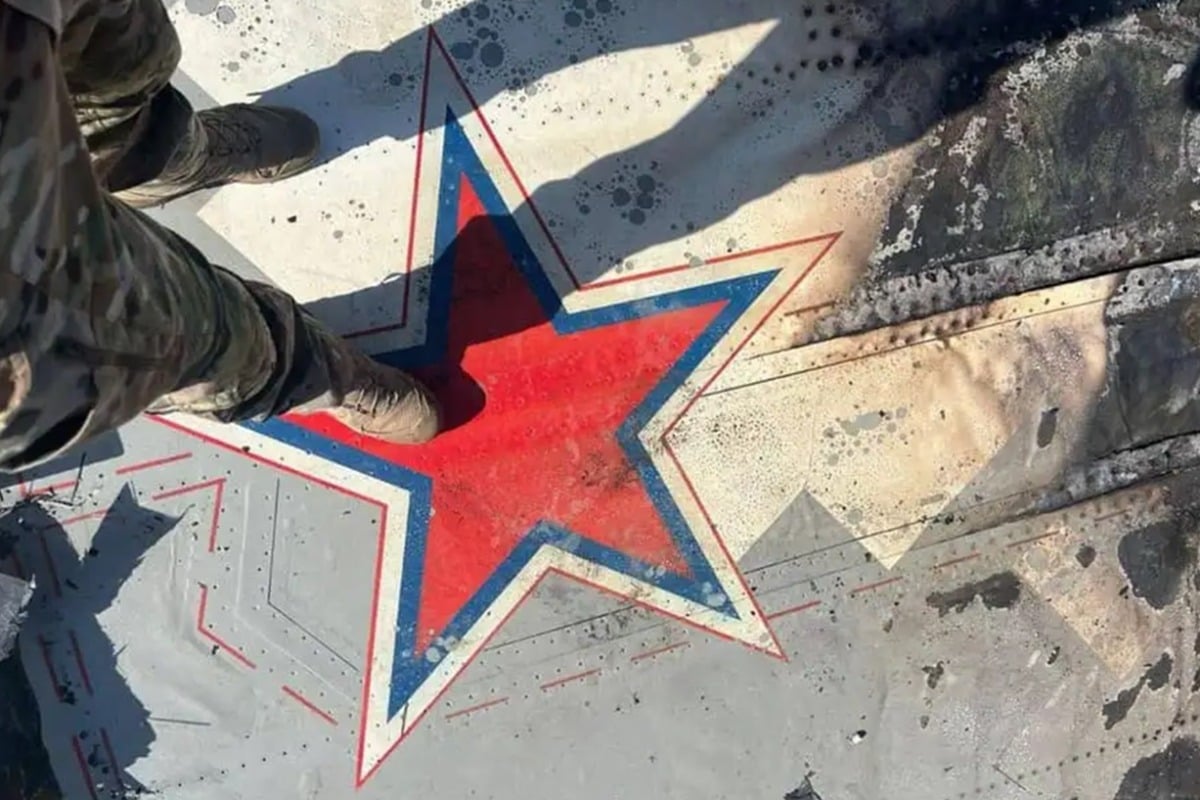
The technical criticisms in the commentary track the same analytical terrain that Western defense analysts have covered. Russia’s current Su-57 production aircraft fly with the AL-41F1 engine, a derivative of the Su-35’s powerplant rather than the intended next-generation Product 30 engine that would provide the supercruise capability that distinguishes genuinely fifth-generation aircraft in that performance category. The Product 30 engine program has experienced delays whose precise status remains unclear, but the Russian military aviation press has acknowledged the gap between the interim engine and the intended design for years. On stealth, independent analysts and Western defense institutions have noted that the Su-57’s inlet design and external surface treatment fall short of the signature management achieved in the F-22 or F-35, though Russian official sources dispute those assessments.
The Su-57’s limited visible role in meaningful combat operations over Ukraine after more than four years of full-scale war is the central empirical fact that no amount of official rhetoric can reframe. Russia has lost pilots and aircraft over Ukraine, and the logical conclusion of that risk calculus, that the Su-57 fleet is too small and too irreplaceable to risk in contested airspace, actually validates the skeptics’ argument rather than refuting it. A weapon system held back because its losses cannot be sustained is, whatever its theoretical specifications, not demonstrating the battlefield performance its proponents claim.
That a critique this direct is circulating openly in Russian military commentary, rather than being confined to private channels, reflects the accumulated frustration within Russia’s defense analyst community after years of promised transformation that has not materialized in observable battlefield results. Whether the commentary changes anything in procurement or operational planning is a different question entirely.