

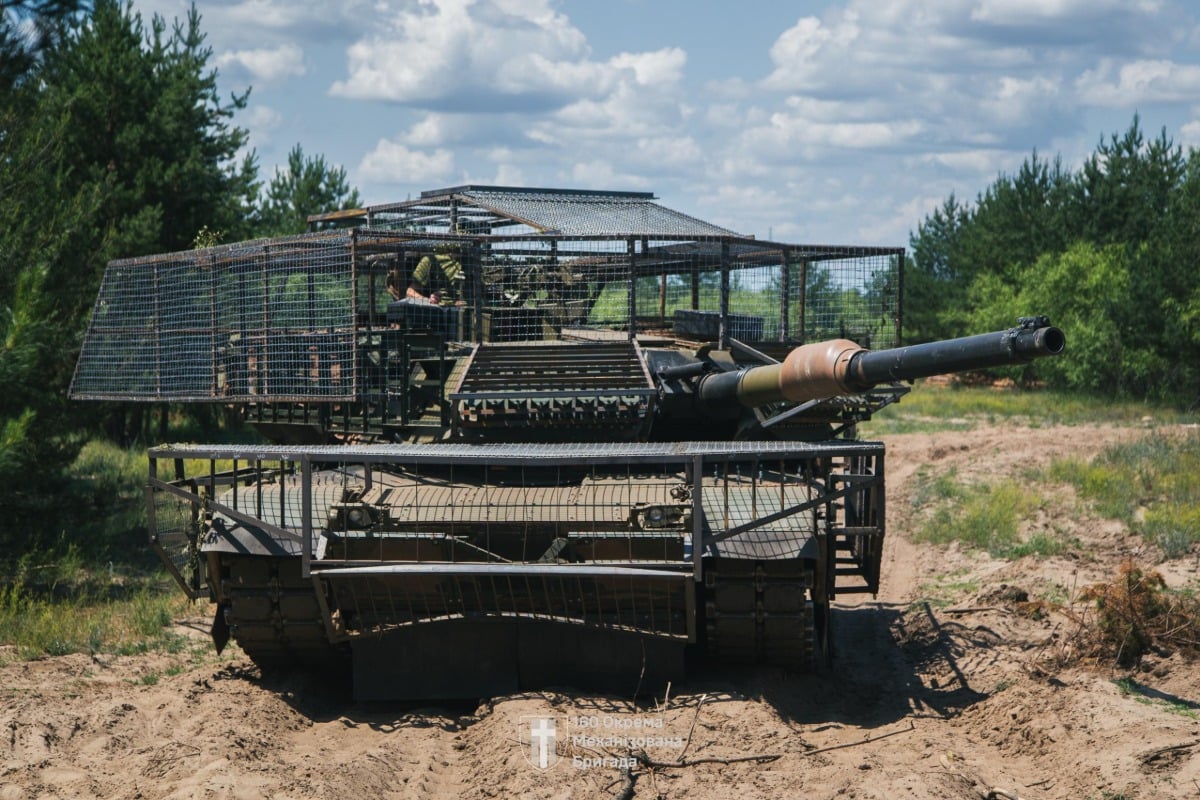
- Ukraine's 160th Mechanized Brigade published photos of its M1A1 AIM Abrams tank "Lucifer" fitted with modular anti-drone cages protecting the turret, hull sides, and rear.
- The tank is one of 49 Australian-donated M1A1 AIM Abrams transferred to Ukraine and is operated by the brigade's tank battalion.
A Ukrainian Abrams tank named “Lucifer,” operating with the tank battalion of the 160th Separate Mechanized Brigade, has been photographed with an extensive set of modular anti-drone cage structures fitted to both its turret and hull, offering a close look at how Ukrainian crews are adapting one of America’s most advanced main battle tanks to survive a battlefield defined by cheap, lethal drones.
The 160th Separate Mechanized Brigade, a mechanized unit formed in June 2024 as part of Ukraine’s expansion of ground forces, published the images, which show the tank’s distinctive Australian-origin markings alongside the locally fabricated protective additions.
The vehicle is an M1A1 AIM, the variant Australia donated to Ukraine after announcing the transfer of 49 tanks from its own inventory in October 2024. Australian M1A1 Abrams retain the Abrams gas-turbine powerplant, but reports say their engines were configured to operate on diesel fuel rather than the JP-8 standard used by U.S. Army Abrams, which offers a logistical advantage on the front line because Ukrainian forces already operate a predominantly diesel fleet. That practical advantage made the Australian tanks particularly valuable once they arrived in theater, and as of early 2026, Australian-supplied M1A1 Abrams had become part of Ukraine’s Abrams fleet in sectors including Pokrovsk.
What makes the “Lucifer” photographs significant is the design of the cage modifications. Rather than the simple flat-roof structures seen on earlier Ukrainian armored vehicle adaptations, the caging on this tank uses a modular architecture that allows the turret to rotate freely while still providing overhead protection, a crucial engineering challenge that simpler cage designs often fail to solve. Cages that lock the turret in place to protect the roof defeat the purpose of having a main gun, so the modular approach, with separate sections protecting the turret independently from the hull side and rear panels, preserves the tank’s combat utility while addressing its most exposed vulnerabilities. The side and rear hull sections receive their own protective panels that shield against attacks from the lateral and rear arcs, the angles from which FPV drones most commonly approach armored vehicles.
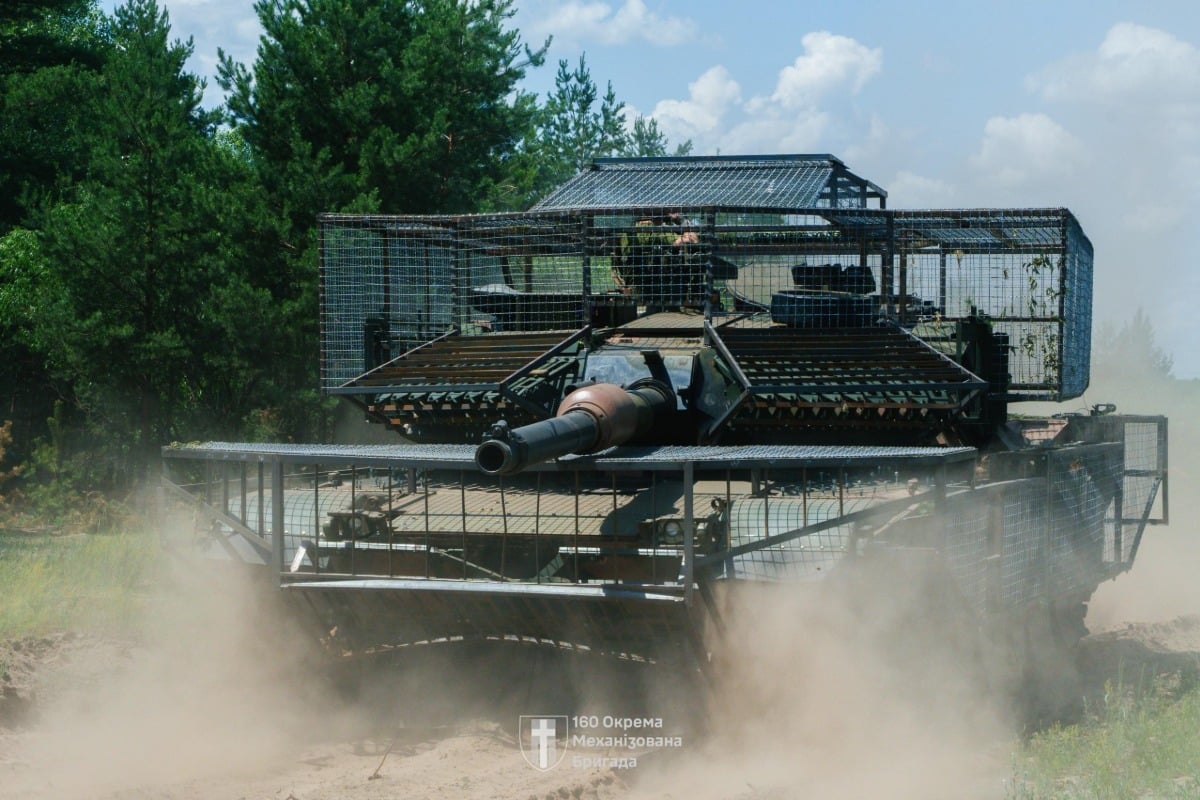
FPV stands for first-person view, describing the camera and goggles setup that allows a drone operator to fly the aircraft as if sitting inside it, giving the pilot the precision needed to thread a drone into the engine compartment, through a hatch gap, or against a vehicle’s thinnest armor at the rear. Standard Abrams tanks have no factory-fitted protection against this threat category. The M1A1’s armor package was designed around the threats of the Cold War era, specifically the anti-tank missiles and kinetic penetrators of Soviet-era opposing forces, and while it is formidable against those threats, the engine deck presents a relatively thin armor roof and the vehicle’s rear is its most vulnerable arc. Ukrainian crews improvising their own solutions are solving a problem that no American tank program anticipated when the Abrams was designed in the 1970s.
The modifications on “Lucifer” signal that these adaptations have moved beyond isolated improvisation by individual units. The modular cage design, with its engineering solution for turret rotation clearance and its dedicated hull-side and rear panels, reflects accumulated battlefield experience translated into a replicable approach. What began as welding whatever was available onto whatever was most vulnerable has evolved into a recognizable protective architecture that other crews can observe, copy, and refine.