

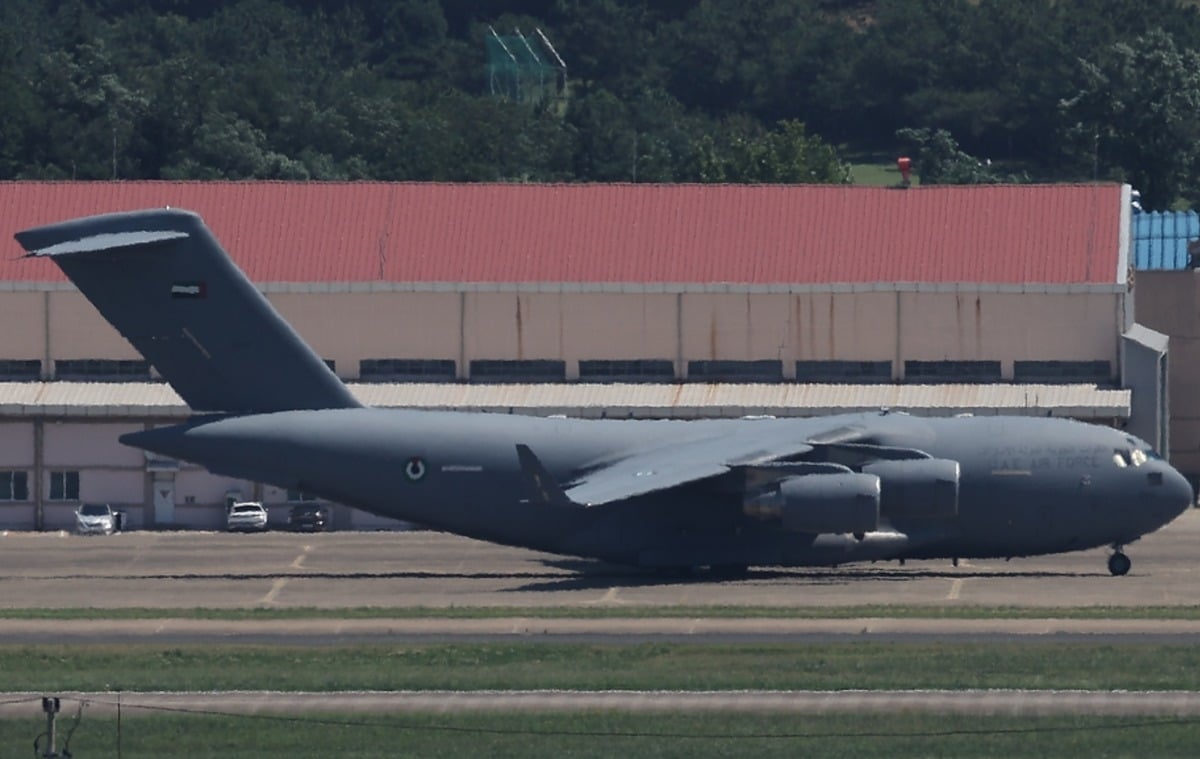
- The UAE dispatched eight C-17 transport aircraft to Daegu Air Force Base, South Korea to airlift its third Cheongung-II battery and interceptor missiles, bypassing the Strait of Hormuz blockade.
- The two Cheongung-II batteries already deployed in the UAE fired over 60 interceptor missiles against Iranian attacks, recording an approximately 96% intercept success rate, Yonhap reported.
The United Arab Emirates has dispatched multiple C-17 military transport aircraft to South Korea this week to airlift a new Cheongung-II air defense battery and dozens of interceptor missiles back to the Gulf, bypassing sea routes rendered impassable by the ongoing closure of the Strait of Hormuz, Yonhap News Agency reported.
South Korean military and defense industry sources confirmed the operation, with at least one C-17 spotted on the runway at Daegu Air Force Base on June 12 as the airlift continued. A total of eight UAE transport aircraft are being deployed in sequence to move the hardware, arriving at Daegu one after another to load and depart, with the delivery accelerated approximately one month ahead of the originally contracted schedule.
Under normal circumstances, heavy military equipment like air defense batteries moves by ship, and no military planner chooses air freight unless the sea route is gone. A single C-17 Globemaster III, the American-built strategic transport aircraft operated by the UAE Air Force, can carry roughly 77,500 kg (170,000 lb) of cargo, and moving an entire Cheongung-II battery requires multiple aircraft to lift all its components. Sending eight of them from the Gulf to South Korea and back represents a substantial logistical and financial commitment that Abu Dhabi would not absorb if any alternative existed. The Strait of Hormuz, the narrow waterway between Iran and Oman through which roughly 20% of the world’s seaborne oil trade flows, has been effectively closed since Iran imposed a blockade earlier this year following U.S. and Israeli strikes on Iranian territory, leaving the UAE without a viable sea route for receiving equipment from its Korean suppliers.
What drove Abu Dhabi to this level of urgency is grounded in what happened when Iranian forces launched missile and drone attacks across the Gulf following the outbreak of hostilities. The two Cheongung-II batteries already deployed and operational in the UAE entered the fight alongside American Patriot systems and Israeli-supplied Arrow interceptors. According to Yonhap, those two batteries fired at least 60 interceptor missiles during the engagements, recording an intercept success rate of approximately 96%. That performance under live combat conditions transformed Abu Dhabi’s approach to the remaining eight batteries in the contract, pushing every delivery date as far forward as the production schedule and now the airlift could allow.
This week’s operation is not the first time UAE transport aircraft have appeared at Daegu on an urgent mission. As the Asian Military Review reported, a UAE Air Force C-17 was photographed at the base on March 9, being loaded with KM-SAM Block II interceptor missiles, with Seoul accelerating delivery of approximately 30 missiles drawn directly from South Korean Air Force reserves to replenish UAE stocks depleted by the initial wave of Iranian attacks. That March operation involved missiles only, making the current airlift, which includes an entire battery launcher system alongside additional rounds, substantially larger in scope and strategic weight.
The Cheongung-II, known internationally as the KM-SAM Block II, is a medium-range surface-to-air missile system developed by South Korea’s Agency for Defense Development, with production shared across LIG Nex1, Hanwha Systems, and Hanwha Aerospace. Each battery consists of four launcher vehicles each carrying eight ready-to-fire interceptor tubes, a multi-function radar, and an engagement control station. The system is designed to intercept both aircraft and ballistic missiles at altitudes below 40 km (25 miles) and at ranges of approximately 40 to 50 km (25 to 31 miles), placing it in a broadly comparable role to the U.S.-built Patriot PAC-2 system but at a significantly lower cost per battery. The battery now being airlifted is the third unit under the UAE’s contract, which The Defence Blog covered when South Korea announced the $3.5 billion deal for 10 batteries in January 2022, representing at the time the largest guided-weapons export contract in South Korean history.
Saudi Arabia and Iraq both signed deals for the Cheongung-II in 2024, adding pressure to an already strained production line, and the system’s combat debut in UAE service has since generated procurement inquiries from additional countries that Seoul has not yet named publicly. The Korea Times cited South Korean Presidential Chief of Staff Kang Hoon-sik as confirming that queries had arrived from multiple unnamed nations after the system’s combat performance became known, a pattern that defense exporters understand well: a missile defense system that proves itself against real ballistic missiles in a live conflict is a fundamentally different commercial proposition than one validated only in test ranges.
A battery sitting in South Korea waiting for a ship that cannot sail through a blockaded strait does nothing to protect Abu Dhabi. A battery delivered by eight successive airlifts and operational within weeks does. The UAE’s willingness to absorb the cost and complexity of this operation is the clearest possible measure of how seriously Abu Dhabi views the current threat and how much confidence the Cheongung-II’s combat record has earned.