

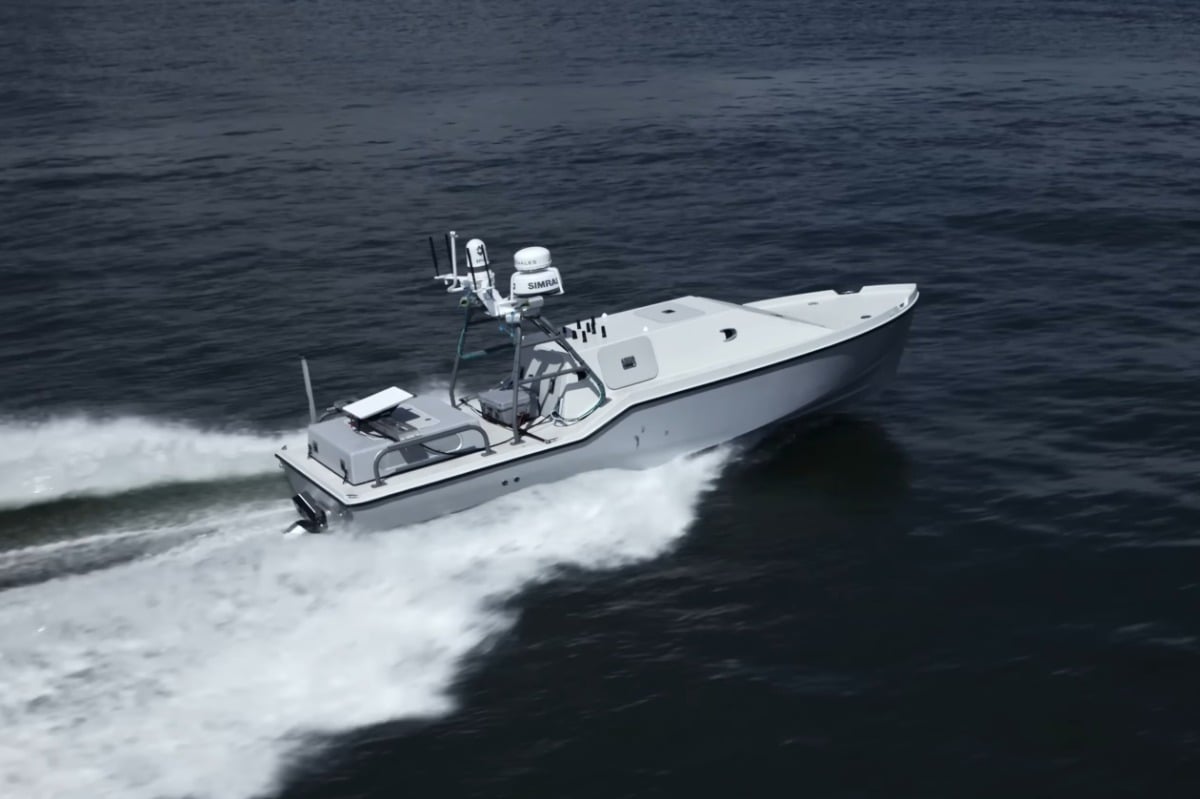
- Saronic Technologies confirmed its Corsair autonomous surface vessel located and recovered two U.S. Army Apache helicopter crew members near Oman on June 8, 2026.
- The Corsair is a 24-foot autonomous vessel with 35-plus knot top speed, 1,000 nautical mile range, and 1,000-pound payload capacity, operated by Task Force 59 in the 5th Fleet area.
A U.S. Navy unmanned surface vessel located and recovered the aviators from a downed Army helicopter on June 8, 2026, near the coast of Oman, transporting them to a safe point on the water before they were airlifted to safety, in what appears to be the first publicly reported personnel recovery by an unmanned surface vessel.
Saronic Technologies, an Austin, Texas-based startup that builds autonomous surface vessels, confirmed that its Corsair unmanned boat was used in the rescue operation that followed the downing of a U.S. Army AH-64 Apache helicopter near the Omani coast. U.S. Central Command had announced the rescue of both crew members that evening, noting that the operation was led by U.S. Naval Forces Central Command and the 82nd Airborne Division, with support from U.S. Air Force and Navy units including Task Force 59, the 5th Fleet’s dedicated unmanned systems task force. Reuters defense correspondent Phil Stewart subsequently reported, citing U.S. Central Command, that a U.S. Navy unmanned surface vessel had located and rescued the aviators. Saronic’s confirmation identified that vessel as the Corsair.
“The U.S. military confirmed that a Saronic Corsair was used in the first-of-its-kind rescue operation following the downing of a U.S. Army helicopter,” Saronic wrote in its statement. “At Saronic, we build autonomous vessels to extend capability into the most demanding and dangerous environments. Knowing Corsair could play a role in helping bring our service members home safely is exactly why we build.”
The Corsair is a 24-foot (7.3-meter) autonomous surface vessel capable of carrying up to 1,000 pounds (453 kg) of payload and operating at a top speed of more than 35 knots (65 km/h) over a range exceeding 1,000 nautical miles (1,852 km). It operates without any crew aboard, controlled remotely or autonomously, and is designed for multi-mission deployment in exactly the kind of contested or hazardous maritime environments where sending a crewed vessel carries significant risk. Task Force 59, which coordinates the Navy’s unmanned surface and aerial systems in the 5th Fleet area of responsibility covering the Persian Gulf, Red Sea, and Arabian Sea, has been operating Corsair vessels as part of its maritime surveillance and domain awareness mission in that region.
Search and rescue operations in contested or dangerous maritime environments have historically required sending crewed ships or helicopters into the same threat environment that created the emergency in the first place. A helicopter crew that goes down in waters where enemy forces are active, or in sea states too rough for immediate helicopter recovery, has historically depended on crewed surface vessels to reach them, with all the risk that entails for the rescue crew. An autonomous surface vessel that can transit to a location at high speed, locate survivors, and hold them safely until a crewed aircraft arrives for extraction changes that calculus fundamentally.
The AH-64 Apache that went down on June 8 was conducting a patrol mission in regional waters near the Omani coast. The cause of the helicopter’s loss remains under investigation, and U.S. Central Command has not disclosed what brought the aircraft down. Both aviators were recovered within approximately two hours of the helicopter going into the water and were reported in stable condition. The speed of the recovery and the survival of both crew members are the outcomes that matter most in human terms, and the Corsair’s role in achieving those outcomes is the detail that matters most in strategic terms.
Saronic Technologies was founded in 2022 and has grown rapidly within the defense autonomous systems market. The company launched its first Marauder medium unmanned surface vessel earlier in 2026, going from initial design to on-water trials in under a year at its Franklin, Louisiana shipyard, and has been expanding its fleet of autonomous vessel types to cover different mission profiles. The Corsair, at 24 feet, is considerably smaller than the Marauder but optimized for speed and rapid deployment rather than heavy payload, making it well suited for the kind of quick-reaction mission that the Oman rescue required. Saronic has said it is building toward production capacity of up to 20 Marauder-class vessels per year by end of 2026, and the Corsair program runs alongside that larger platform effort.