

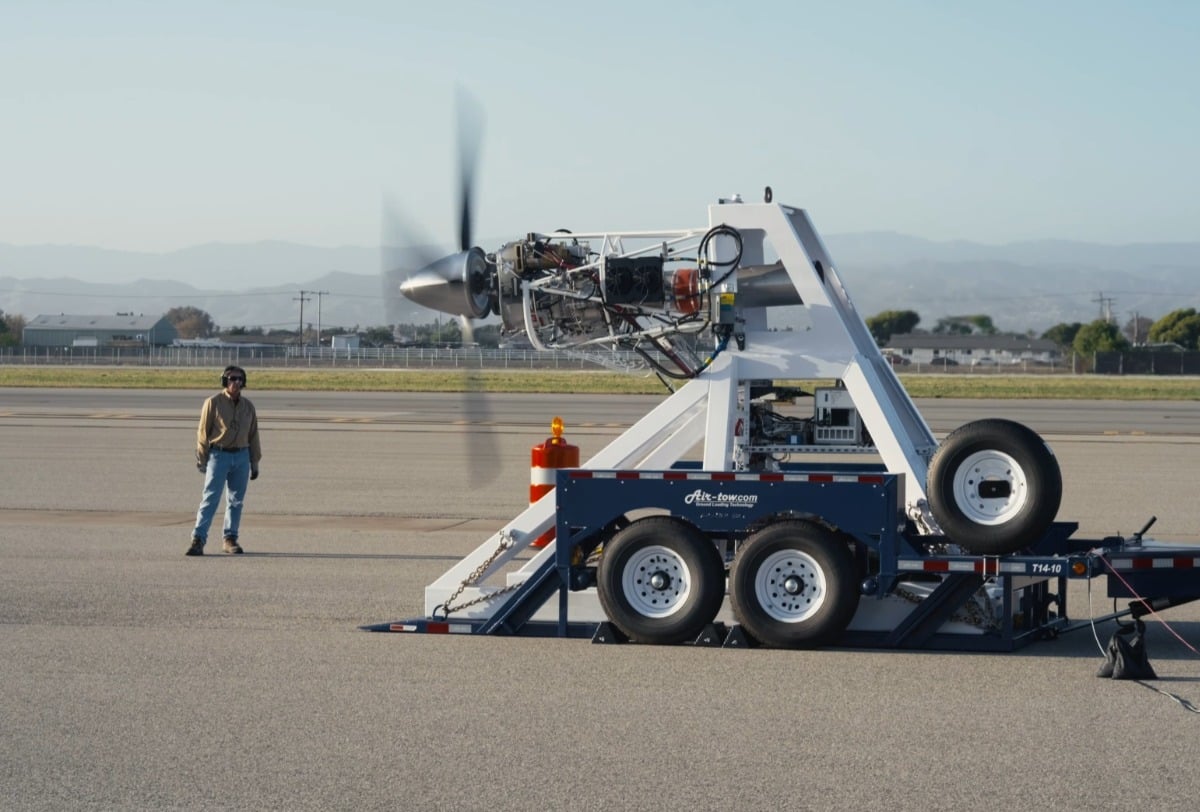
- Swarm Aero selected Honeywell's TPE331 turboprop engine for its Group 5 multi-mission UAS, with initial propulsion systems already delivered, announced June 9, 2026.
- The company has raised $59 million in total funding and operates an 80,000-square-foot manufacturing center in Fayetteville, Arkansas; the aircraft will be publicly revealed later in 2026.
A defense startup building large autonomous drone swarms has selected one of aviation’s most battle-tested turboprop engines to power its aircraft, pairing a sixty-year-old powerplant with next-generation swarm technology in a bet that proven reliability at scale matters as much as cutting-edge innovation.
Swarm Aero, an Oxnard, California-based developer of large UAV swarms, operates an 80,000-square-foot (7,432-square-meter) Advanced Manufacturing Center in Fayetteville, Arkansas.
The company announced on June 9 that it has selected Honeywell Aerospace’s TPE331 turboprop engine as the powerplant for its Group 5 multi-mission unmanned aircraft system. The delivery of initial propulsion systems indicates the program has moved into hardware integration, while the aircraft itself has not yet been publicly revealed. Swarm Aero has raised $59 million in total funding, including a $35 million Series A round led by Two Sigma Ventures and Silent Ventures.
The Group 5 designation places Swarm’s aircraft in the largest and most capable category of military unmanned systems as defined by the U.S. Department of War. Group 5 UAS are defined as systems weighing more than 600 kg (1,320 lb) and operating above 5,486 m (18,000 ft) altitude, the category that includes platforms like the MQ-9 Reaper and Global Hawk. These are not small tactical drones. They carry substantial payloads, fly long distances, and require real propulsion systems. The selection of a turboprop engine rather than an electric motor reflects the mission profile Swarm is targeting: long-range, multi-mission operations requiring endurance that battery technology cannot currently support at this scale.
The TPE331 that Swarm selected is a turboprop engine with a history stretching back to its original certification in 1965. More than 13,000 examples have been delivered, accumulating 122 million flight hours across military, commercial, and agricultural applications. The TPE331 has powered aircraft such as the Fairchild AU-23, Mitsubishi MU-2, Aero Commander/Twin Commander series, and Fairchild/Swearingen Merlin/Metro family aircraft. The engine has been continuously refined since its original certification, meaning the version Swarm is installing benefits from six decades of iterative improvement while carrying an operational track record that no newly designed powerplant can match. That combination of maturity, documented reliability, and supply chain depth is exactly what a startup building aircraft at production scale needs from a propulsion supplier, since engine availability and spare parts access can limit production rate as directly as manufacturing capacity.
“In many ways, an aircraft is designed around its powerplant. It’s a deep relationship that requires both the aircraft maker and engine maker to work extremely closely together. When we evaluated our options, we were looking for an engine manufacturer that saw us as more than a customer, and we found exactly that in Honeywell,” said Peter Kalogiannis, co-founder and chief engineer of Swarm Aero. “The TPE331 is a proven, cost-effective, high-performance engine with an extraordinary legacy, and we’re proud to build our aircraft around it.”
The partnership extends beyond a simple supplier relationship. Honeywell and Swarm say they are actively collaborating across multiple dimensions of aircraft design, development, maintenance, and operations, the kind of deep integration that shapes how an airframe is structured around its powerplant from the earliest design stages rather than adapting an existing design to accept a new engine late in development.
Matt Milas, President of Defense and Space at Honeywell Aerospace, placed the partnership in the context of how large-scale defense programs are being reconceived. “The defense landscape is shifting toward collaborative, distributed, and autonomous operations, where delivering capability at scale is as critical as innovation itself,” Milas said. “By combining the trusted performance of the TPE331 with Swarm Aero’s platform, we’re enabling a new model for rapidly deploying mission-ready systems.”
Rather than fielding a small number of expensive, highly capable individual aircraft, Swarm is building toward large numbers of aircraft that operate together under the command of small teams using the company’s own command and control software. The economics of that model depend on cost-effective production, which is why the company’s design philosophy explicitly integrates proven commercial aerospace technology rather than custom-developed components wherever possible. Oliver Palmer, co-founder and COO of Swarm Aero, framed it as a fundamental shift in thinking.
“We’re not just building an aircraft but an ecosystem that can produce and operate them at scale,” Palmer said. “Merging cutting-edge technology with proven, reliable systems, like the TPE331 is a key need of our customers, and what the company is designed from the ground-up to achieve.”
The aircraft itself has not yet been publicly revealed. Swarm says the unveiling will happen later in 2026, which means the engine announcement precedes the platform reveal, a sequencing that reflects the importance of the propulsion choice to the overall program and the value of establishing Honeywell as a credible industrial partner before the aircraft is publicly assessed. For a startup competing in a market where credibility and production capacity matter as much as technical performance, the TPE331’s documented history and Honeywell’s institutional depth provide a floor of credibility that a less established propulsion partner could not offer.