

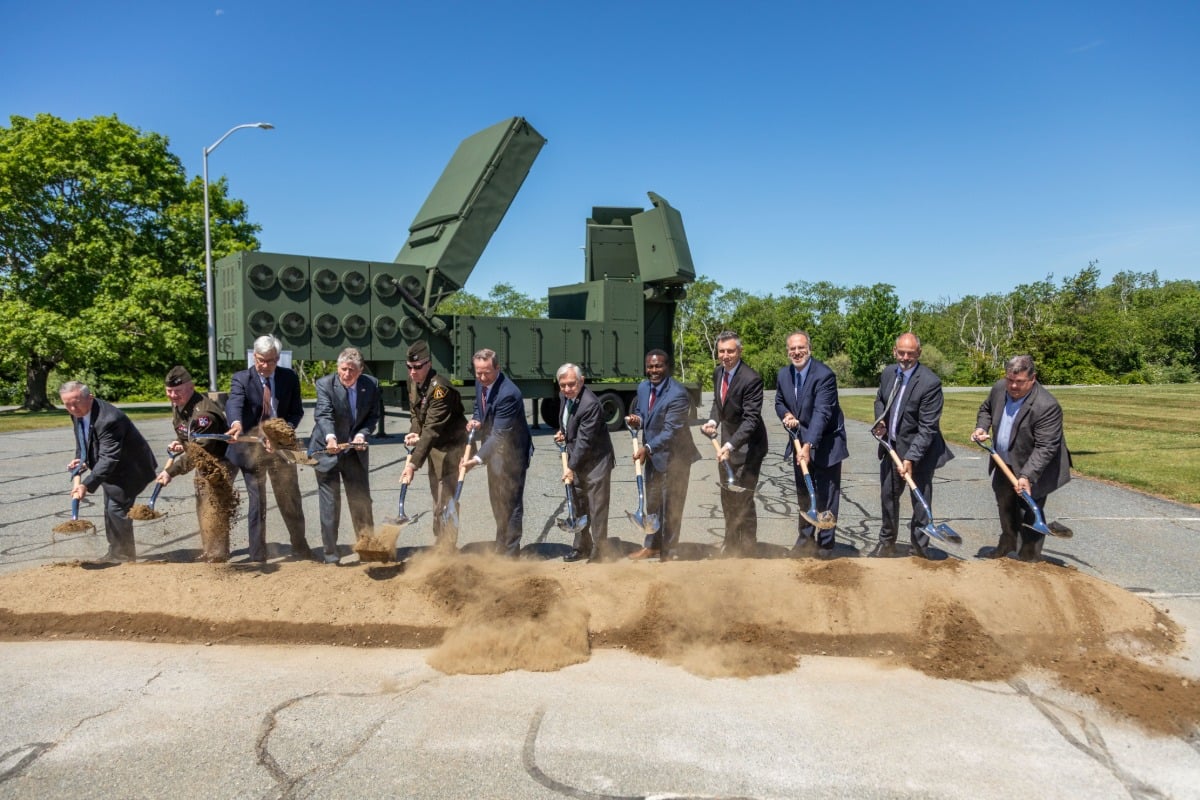
- Raytheon announced a $100 million expansion of its Portsmouth, Rhode Island facility on June 8, 2026, to accelerate LTAMDS testing and boost Patriot GEM-T subcomponent production.
- The announcement follows a $53 million expansion at Raytheon's Andover, Massachusetts radar facility, bringing combined recent investment across both sites to over $150 million.
Raytheon, an RTX business, is investing $100 million to expand its Portsmouth, Rhode Island, facility, accelerating production and testing of two of the most in-demand air defense systems in the world as governments across NATO and beyond race to bolster protection against ballistic missiles, hypersonic weapons, and increasingly sophisticated aerial threats.
The investment, announced June 8, will expand the Portsmouth campus to increase testing capacity for the Lower Tier Air and Missile Defense Sensor, known as LTAMDS, and boost production of Patriot GEM-T missile subcomponents. The announcement follows a $53 million expansion Raytheon broke ground on eight months earlier at its Radar Production Facility in Andover, Massachusetts, bringing the company’s combined recent facility investment across two sites to more than $150 million. Together, the two expansions reflect the scale of demand pressure Raytheon is managing as the Patriot system and its associated technologies find themselves at the center of global air defense procurement decisions.
LTAMDS is the radar designed to replace the aging AN/MPQ-65 radar currently used in Patriot batteries, the air defense system that fires the interceptor missiles. Where the legacy radar uses a single fixed array that provides coverage in one primary direction, LTAMDS uses multiple arrays arranged around the unit to provide full 360-degree coverage simultaneously, eliminating the blind spots that adversaries have been able to exploit in existing Patriot configurations. The system is specifically designed to track and engage hypersonic weapons, a category of threat that travels at speeds exceeding Mach 5 and follows unpredictable flight paths that earlier radar architectures were not designed to handle. Raytheon says LTAMDS recently completed its ninth successful flight test, using its multiple arrays to track and intercept a surrogate hypersonic target, a milestone that advances the program toward fielding with the U.S. Army and international customers. Raytheon is currently under contract for multiple LTAMDS radars for the U.S. Army and Poland, one of the largest buyers of Patriot systems globally as Warsaw builds one of NATO’s most substantial ground-based air defense networks.
The Patriot Advanced Capability-2 Guidance Enhanced Missile-Tactical, or GEM-T, is one of the Patriot system’s interceptors and is designed to engage airborne threats, including tactical ballistic missiles. The GEM-T is an evolution of the PAC-2 missile family that has been in service since the early 1990s, modified with enhanced guidance software and seeker improvements that extend its effectiveness against newer threat categories. Patriot systems gained renewed prominence after their use in Ukraine against Russian missile attacks, including ballistic missile threats. That combat validation has driven procurement interest across multiple countries that had been evaluating their air defense options, and the resulting demand on Raytheon’s production lines has been significant.
“This investment strengthens our ability to deliver critical air and missile defense capabilities to customers around the world,” said Tom Laliberty, president of Land and Air Defense Systems at Raytheon. “Expanding in Portsmouth allows us to scale production, advance LTAMDS testing, and ensure the U.S. Army and our international partners receive these systems as quickly as possible.”
The Portsmouth facility has been part of Raytheon’s Rhode Island footprint for more than 60 years and currently employs more than 850 people across programs covering undersea technology, combat systems, and radars. The $100 million expansion will add to that workforce and physical capacity, though Raytheon has not disclosed specific employment projections or a detailed timeline for construction completion. The campus sits within a broader Rhode Island defense industrial ecosystem that has historically supported naval programs including submarine systems given the state’s proximity to Naval Station Newport and Naval Undersea Warfare Center Newport.
The broader context for both the Portsmouth and Andover expansions is a defense industrial base under sustained pressure to produce air defense systems faster than its existing capacity allows. Patriot batteries have been transferred to Ukraine and other partners under U.S. foreign military assistance programs, drawing down U.S. Army stockpiles and creating replenishment demand that sits on top of new procurement orders from allied nations. Germany, the Netherlands, Sweden, Romania, and Greece are among the European NATO members that operate Patriot systems and are seeking upgrades or additional batteries, while countries including Saudi Arabia, Japan, South Korea, and Taiwan maintain substantial Patriot fleets requiring ongoing missile and component supply. Poland’s procurement of additional Patriot capacity under its Wisła program has been among the most significant recent contracts, and the LTAMDS contract for Poland specifically positions that country to receive the most capable version of the radar as it builds out its integrated air defense architecture.