

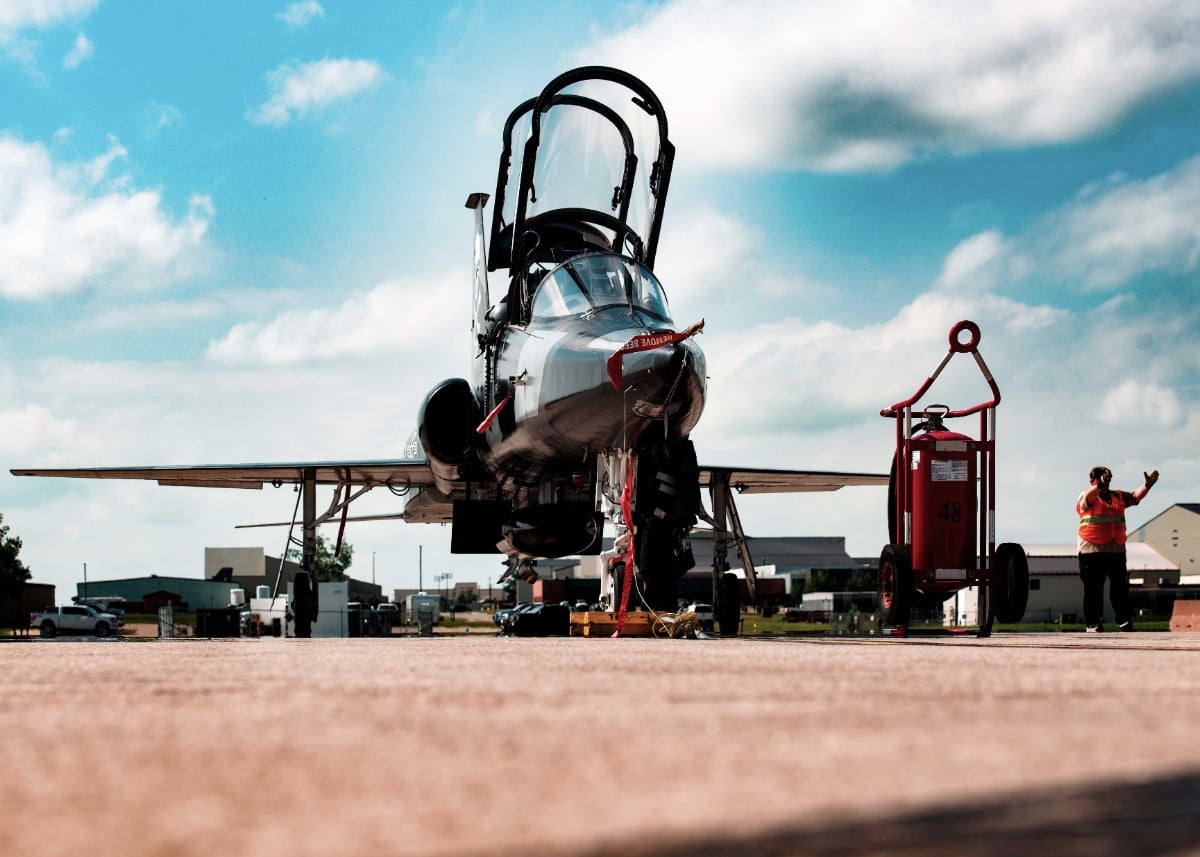
- The U.S. Air Force awarded a $4 billion, 10-year base support contract on June 8, 2026, to 19 companies covering 11 AETC installations through June 2036.
- The contract covers more than 20 service categories including aircraft maintenance, fire services, IT, and airfield management across bases in Oklahoma, Texas, Alabama, Arizona, Mississippi, and New Mexico.
The U.S. Air Force awarded a $4 billion contract on June 8, to keep its training bases running for the next decade, selecting 19 companies to provide everything from aircraft maintenance and fire services to IT support, grounds keeping, and human resources across eleven Air Education and Training Command installations, including several of the Air Force’s main pilot training bases.
The contract, meaning the government pays for services as it orders them rather than committing to a fixed schedule, runs through June 2036 and covers Air Education and Training Command, the Air Force organization responsible for all initial flight and technical training for American airmen.
The eleven bases covered by the contract form the backbone of the Air Force’s training system, and understanding what they do explains why a $4 billion support contract is neither surprising nor excessive. Vance Air Force Base in Enid, Oklahoma, and Laughlin AFB in Del Rio, Texas, train undergraduate pilots on the T-6 Texan II turboprop and T-38 Talon jet. Sheppard AFB in Wichita Falls, Texas, runs the Euro-NATO Joint Jet Pilot Training program, the only multinational undergraduate pilot training program of its kind, producing pilots for fourteen NATO nations. Luke AFB in Glendale, Arizona, is the world’s largest F-35 training base, where new Lightning II pilots from the U.S. and allied nations complete their initial qualification. Keesler AFB in Biloxi, Mississippi, focuses on cyber operations and technical training across a wide range of Air Force specialties. Maxwell AFB in Montgomery, Alabama, hosts Air University, the professional military education institution that trains Air Force officers at every career stage. Holloman AFB in Alamogordo, New Mexico, trains F-16 pilots. Goodfellow AFB in San Angelo, Texas, runs intelligence, surveillance, and reconnaissance training. Columbus AFB in Columbus, Mississippi, and Altus AFB in Oklahoma train additional pilots and airlifters respectively. Joint Base San Antonio in Texas serves as the headquarters of AETC and hosts multiple training pipelines simultaneously.
Keeping all of those bases operational requires an enormous range of support functions that the Air Force does not perform with uniformed personnel. The contract covers transient aircraft maintenance, meaning servicing of aircraft passing through a base rather than permanently assigned there; resource management, which is the financial administration that tracks and allocates the base’s funding; communications and information technology, covering everything from network infrastructure to help desk support; visual information and publishing services; installation engineering, which handles infrastructure repair, construction project support, and facilities management; grounds maintenance; emergency management; fire and emergency services; airfield management; supply and logistics; transportation; community services, which operates facilities like gyms, dining halls, and family support centers; human resources; weather observation and forecasting; and custodial services. The breadth of that list reflects how much of a modern military installation’s daily operation depends on contractor support rather than uniformed military personnel, a model the Air Force and other services have relied on increasingly since the 1990s.
The 19 companies selected span a range of sizes and specializations, and several of them are Alaska Native corporations or Native American-owned businesses. Akima Intra-Data LLC, Akima Global Logistics LLC, Alutiiq Operations Services LLC, Bering Straits Management Services LLC, and Alcyon Inc. all trace ownership to Alaska Native Corporation structures that receive certain contracting preferences under federal small business law, while Choctaw Defense Services Inc. is affiliated with the Choctaw Nation of Oklahoma and Fortis Native Group LLC is associated with the Poarch Band of Creek Indians in Alabama. That concentration of Native-owned businesses across a major Department of War contract is not coincidental: Section 8(a) of the Small Business Act provides significant competitive advantages to socially and economically disadvantaged businesses, and Alaska Native Corporations occupy a particularly favorable position within that framework that has made them major players in federal services contracting for decades.
The $4 billion figure is a ceiling, not a guarantee; the Air Force obligated only $47,500 at the time of award, with the remaining value to be spent through task orders as services are actually ordered across the ten-year period.
The timing of this contract matters for pilot production. The Air Force has been working to expand its pilot training throughput after years of pilot shortage, and the infrastructure supporting that training, from the runways where student pilots practice touch-and-goes to the simulators where they rehearse emergency procedures to the weather forecasters who clear or hold flight operations, depends entirely on the kind of base support services this contract funds. A training base that cannot maintain its aircraft, cannot keep its IT systems running, or cannot staff its fire department cannot train pilots. A $4 billion, decade-long contract is the mechanism through which the Air Force ensures none of those things fail at the installations that produce the aviators it needs.