

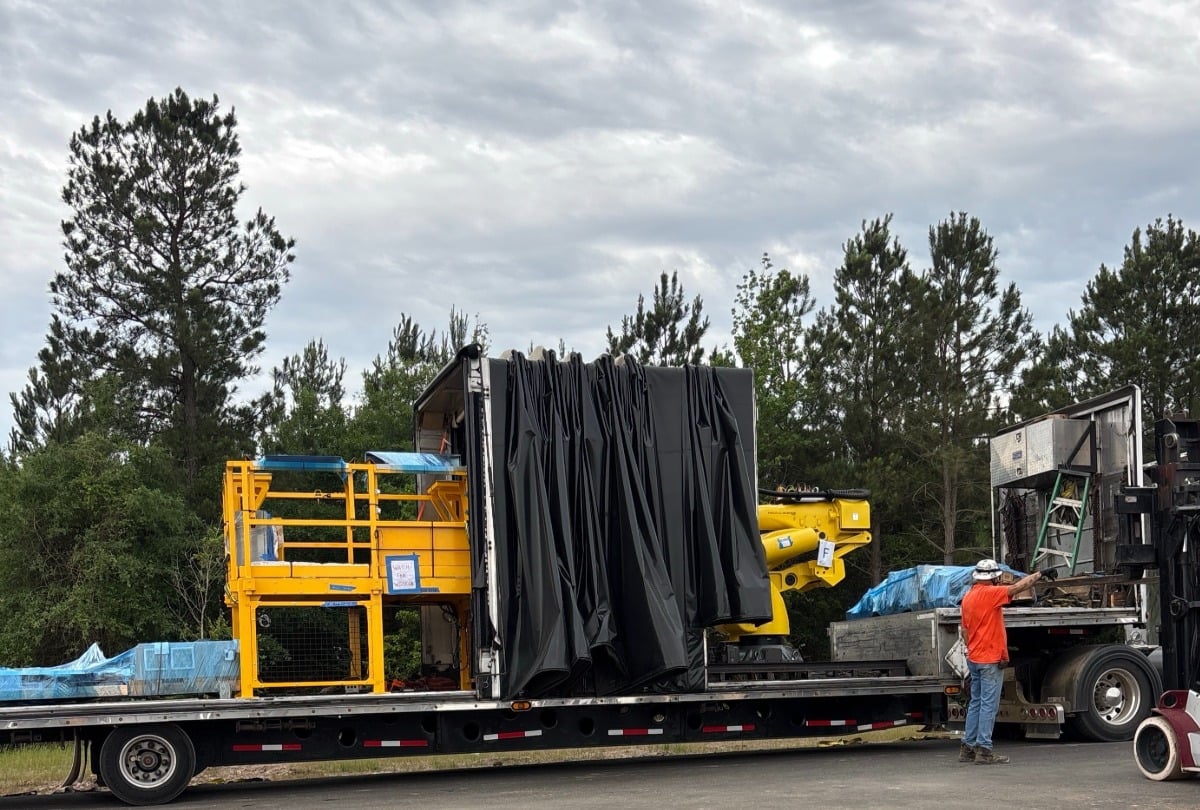
- L3Harris announced the arrival of robotics equipment at its new GMLRS solid rocket motor facility in Camden, Arkansas, part of a $215.6 million Pentagon-funded expansion.
- The Camden expansion includes a 60,000-square-foot centralized production facility that cuts internal motor transit distances by 80 percent to increase production rate.
Industrial robots have arrived at L3Harris Technologies’ new GMLRS facility in Camden, Arkansas, marking a visible step in the Pentagon’s drive to rebuild the American munitions production base at a pace the country has not attempted since the Cold War.
L3Harris posted photographs of the robotic arms on its official social media account, describing the deliveries as “another step in expanding production capacity, advancing manufacturing and delivering critical propulsion capability at scale and speed.”
GMLRS stands for Guided Multiple Launch Rocket System, the 227 mm (8.9 in) GPS-guided rocket fired from the HIMARS launcher and the larger M270 multiple launch rocket system. At roughly 4 meters (13 feet) long, each GMLRS rocket carries an approximately 90 kg (200 lb) unitary warhead to ranges of more than 70 km (43 miles) with accuracy measured in meters rather than hundreds of meters, giving ground commanders the ability to destroy a specific building, vehicle, or troop concentration without the collateral damage radius that older unguided artillery rounds carry. The system became globally recognized through its use in Ukraine, where HIMARS and GMLRS entered service in the summer of 2022 and immediately changed the operational picture by allowing Ukrainian forces to strike Russian logistics hubs, ammunition depots, and command posts far behind the front line with a precision that Russian air defenses could not reliably intercept. As The Defence Blog has reported, the U.S. Army has placed multiple large orders for GMLRS replenishment since 2022, and Lockheed Martin’s Precision Fires Center of Excellence in Camden, which assembles the complete rockets, has been operating at elevated production rates throughout the conflict.
What L3Harris is building in Camden is not the rocket assembly itself but the solid rocket motor that propels it, the propulsion component that must ignite reliably, burn at the correct thrust profile, and sustain that burn for the seconds needed to push the warhead to its target. Solid rocket motors are among the most technically demanding components in the precision munitions supply chain, requiring specialized facilities with controlled environments for propellant mixing, curing, and loading, and they cannot be scaled up quickly by simply adding workers or shifts.
The factories that produce them must be designed, constructed, equipped, and certified through a process that takes years, which is why the Department of War began funding the Camden expansion through its Defense Production Act Title III program in early 2025. That program, which can compel domestic production investments in critical national security goods, is the mechanism the federal government used to co-fund the $215.6 million Camden expansion alongside L3Harris’s own capital contribution.
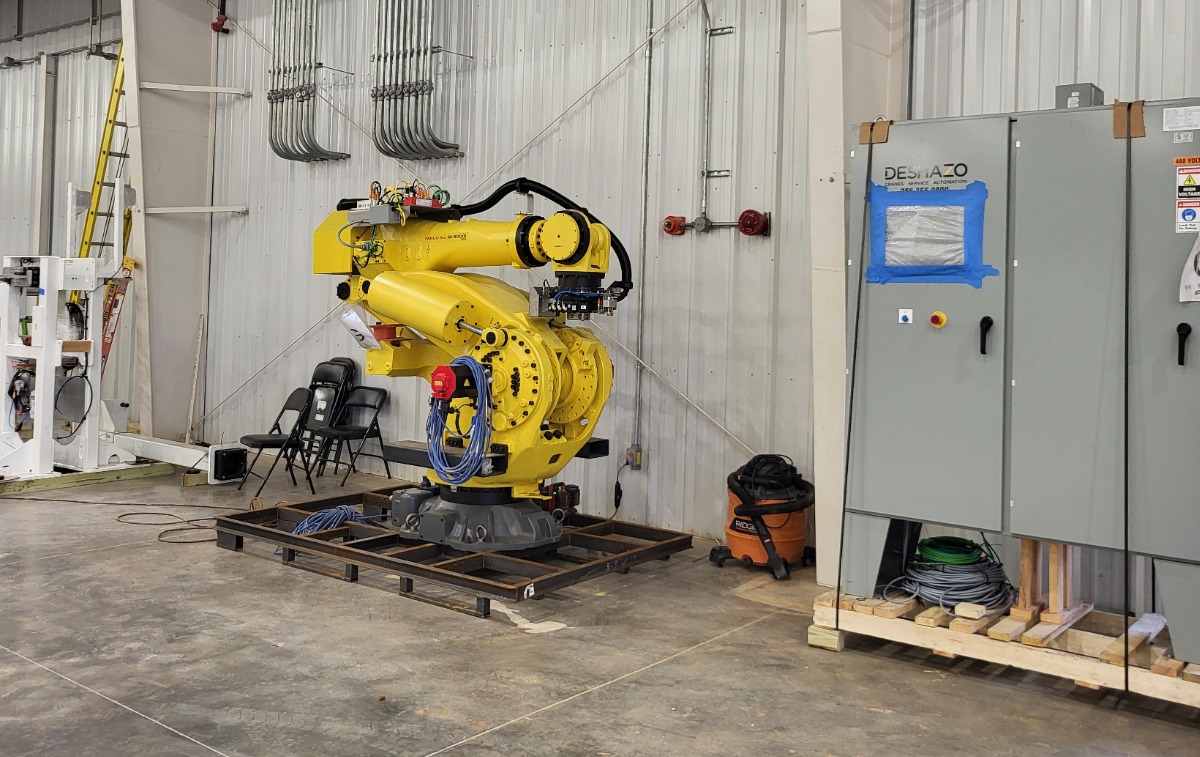
The Camden expansion’s design reflects lessons from the Ukraine experience about what matters in high-volume precision munitions production. The centerpiece is a 60,000-square-foot (5,574-square-meter) facility that centralizes production of one key program under a single roof, cutting the distance rocket motors travel during the manufacturing process by 80 percent compared to the existing layout. Moving propellant and partially assembled motors between buildings is not just a logistics inconvenience; it is a safety constraint, a quality control variable, and a production rate bottleneck. Eliminating most of that internal transit by consolidating under one roof compresses the production cycle and reduces the points at which a mistake or delay in one building can hold up work in another. The expansion also includes a dedicated propellant mixer building and additional propellant processing buildings, the infrastructure needed to increase the volume of propellant produced per day rather than simply moving existing propellant through a different building layout.
Ken Bedingfield, President of Aerojet Rocketdyne at L3Harris, described the Camden expansion as part of what he called the “Arsenal of Democracy 2.0” in remarks at the February 2025 groundbreaking ceremony, a deliberate echo of President Franklin Roosevelt’s World War II framing of American industrial mobilization as a strategic asset in its own right. The robotics arrivals L3Harris posted on social media are the first concrete evidence that the construction phase, which followed the February 2025 groundbreaking, has now advanced to the point of equipment installation, a milestone that typically precedes production qualification and ultimately the first motor output from the new lines.
Camden, Arkansas, has been central to American missile and rocket production for decades. The city sits in the pine forests of south Arkansas and hosts both the L3Harris propulsion facility and Lockheed Martin’s GMLRS assembly operation, making it one of the most important single nodes in the U.S. precision fires supply chain. The Defence Blog has previously reported on the broader Camden industrial ecosystem’s role in THAAD interceptor production and on L3Harris’s parallel expansion at its Huntsville, Alabama facility, where the company spent $25 million adding 130,000 square feet (12,077 square meters) of manufacturing space in a separate capacity increase announced on June 1, 2026. Taken together, the Camden and Huntsville investments reflect a company that has identified solid rocket motor production as a strategic growth segment and is investing capital at a rate that matches the Department of War’s urgency on the same problem.