

- The IDF struck strategic Iranian air defense systems on June 8, 2026, destroying systems Iran had deployed to restore capabilities degraded during Operation Roaring Lion.
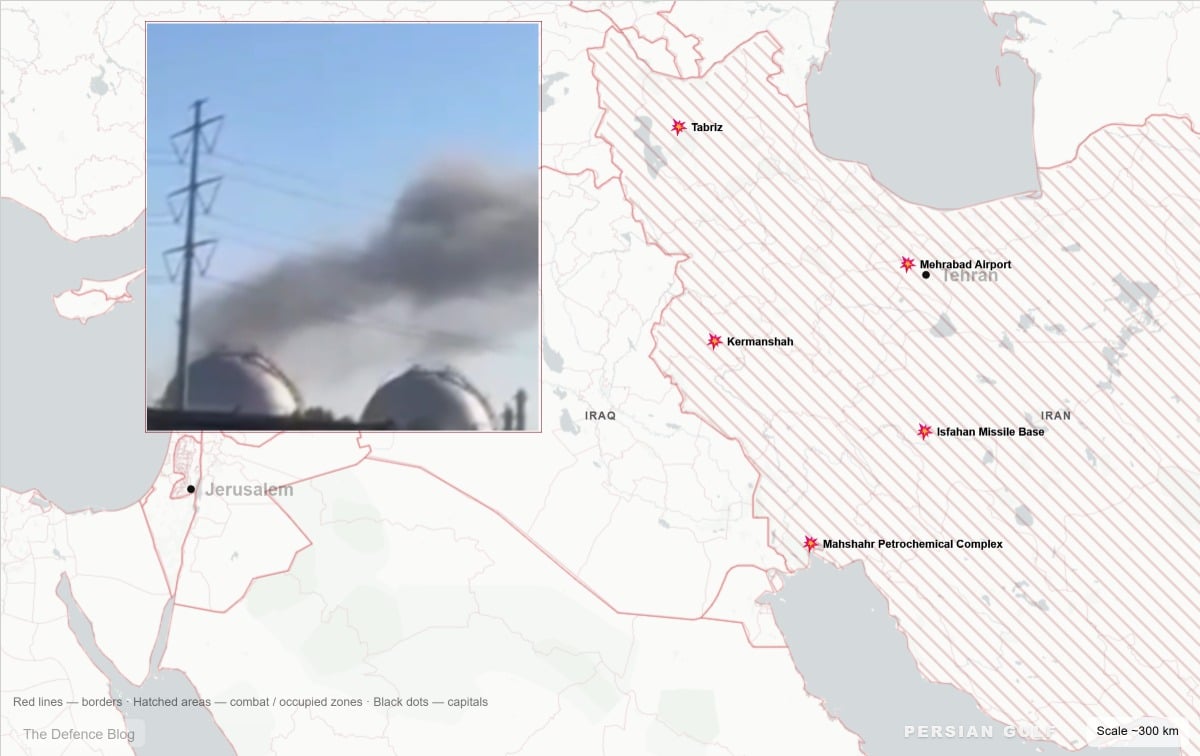
- Explosions were reported in Isfahan, at Mehrabad Airport in Tehran, at the Mahshahr petrochemical complex, and in Kermanshah and Tabriz following the Israeli strikes.
Israel struck back against Iran overnight on June 8, 2026, sending dozens of fighter jets deep into Iranian airspace to dismantle air defense systems that Tehran had recently deployed to restore capabilities destroyed during an earlier Israeli campaign called Operation Roaring Lion.
The Israeli Defense Forces confirmed the strikes in a statement on June 8, saying the Air Force had “completed a large-scale strike on strategic defense systems belonging to the Iranian terror regime” and that the operation “led to the dismantling of these systems.” Explosions were reported in Isfahan, at Mehrabad Airport in Tehran, at the petrochemical complex in Mahshahr, and in Kermanshah and Tabriz, according to open-source reports and regional monitoring channels, though the IDF’s confirmed strike list focuses specifically on the defense system targets rather than all reported locations.
The IDF’s public statement frames the strikes explicitly in terms of maintaining freedom of operation in Iranian airspace, a concept that has been central to Israeli Air Force strategy throughout the conflict. Since Operation Roaring Lion, the Israeli name for the campaign that significantly degraded Iran’s surface-to-air missile network, the Iranian military had been quietly redeploying air defense systems across multiple areas of the country to rebuild its ability to detect and shoot down Israeli aircraft. The June 8 strikes were designed to eliminate those reconstituted systems before they could meaningfully complicate Israeli air operations, extending the window of relative air superiority the Israeli Air Force has maintained over Iranian territory since the earlier campaign.
Mehrabad Airport in western Tehran, which the IDF confirmed hitting in earlier waves of the conflict, holds particular operational significance. According to the IDF, the facility serves the Islamic Revolutionary Guard Corps’ Quds Force, the branch of Iran’s military responsible for supporting proxy groups across the Middle East, and functions as a central hub for arming and financing Iranian-backed forces in Lebanon, Yemen, Iraq, and Syria. Striking Mehrabad is not simply a matter of hitting an airport; it is an attempt to sever a logistics artery that has kept Hezbollah, the Houthis, and other Iranian proxies supplied with weapons, cash, and personnel for decades. Whether the June 8 strikes caused sustained damage to those operations or merely temporarily disrupted them is not yet clear from available information.
The Isfahan strikes reported on June 8 are consistent with a pattern the IDF has maintained throughout the conflict. Isfahan province hosts much of Iran’s ballistic missile production and storage infrastructure, including sites that have been struck repeatedly since the conflict began. The missile base near Isfahan is where Iran stores and launches a significant portion of the long-range ballistic missiles it has fired at Israel, making it a recurring priority target in the Israeli campaign to suppress Iranian firing capability at the source. The IDF’s earlier operations confirmed strikes on missile launch sites, storage facilities, and rocket engine production infrastructure in the Isfahan area, and the June 8 strikes appear to continue that campaign.
The context that makes June 8 distinct from earlier waves of the conflict is the timing. The April 8 ceasefire was meant to end the exchange of strikes, but June 7 saw Iran fire ballistic missiles at northern Israel in response to Israeli strikes on Hezbollah in Beirut, triggering the Iranian missile barrage on June 8 described in The Defence Blog’s earlier coverage of that day. Israel’s strikes on Iranian territory on June 8 are therefore not the opening of a new campaign but the continuation of a retaliatory cycle that restarted when Iran chose to fire on June 7, overriding the ceasefire that both sides had nominally observed for roughly two months. The IDF’s own framing, referencing Operation Roaring Lion as context for the current strikes, places June 8 within the established logic of the broader campaign rather than treating it as an escalation requiring new justification.
The ballistic missile infrastructure the IDF targeted on June 8 is the same infrastructure that produced the weapons Iran fired at Israeli air bases earlier that morning. Iran’s Shahab-3 and Emad ballistic missiles, both of which have been used extensively in strikes on Israel since the conflict began, are produced and stored at facilities concentrated in Isfahan and its surrounding provinces. A Shahab-3 is approximately 16 meters (52 feet) long, weighs around 16,000 kg (35,300 lb) at launch, and can carry a warhead of up to 760 kg (1,675 lb) to ranges exceeding 1,300 km (808 miles), placing all of Israel well within its reach from Iranian territory. The more advanced Emad, an improved variant with a maneuvering warhead designed to complicate interception, has been Iran’s primary precision strike option against high-value Israeli targets throughout the conflict.
Tabriz and Kermanshah, both cited in the open-source explosion reports from June 8, have been Israeli strike targets before. The IDF struck missile storage and launch infrastructure in Tabriz and Kermanshah in June 2025, with over 25 fighter jets hitting more than 35 sites in a single operation, according to the IDF’s own statements from that period. Their reappearance on the June 8 target list, if confirmed, suggests Iran had rebuilt or redeployed assets in those locations after the earlier strikes, and Israel had chosen June 8, with the ceasefire already broken by Iran’s own missile fire, as the moment to hit them again.