

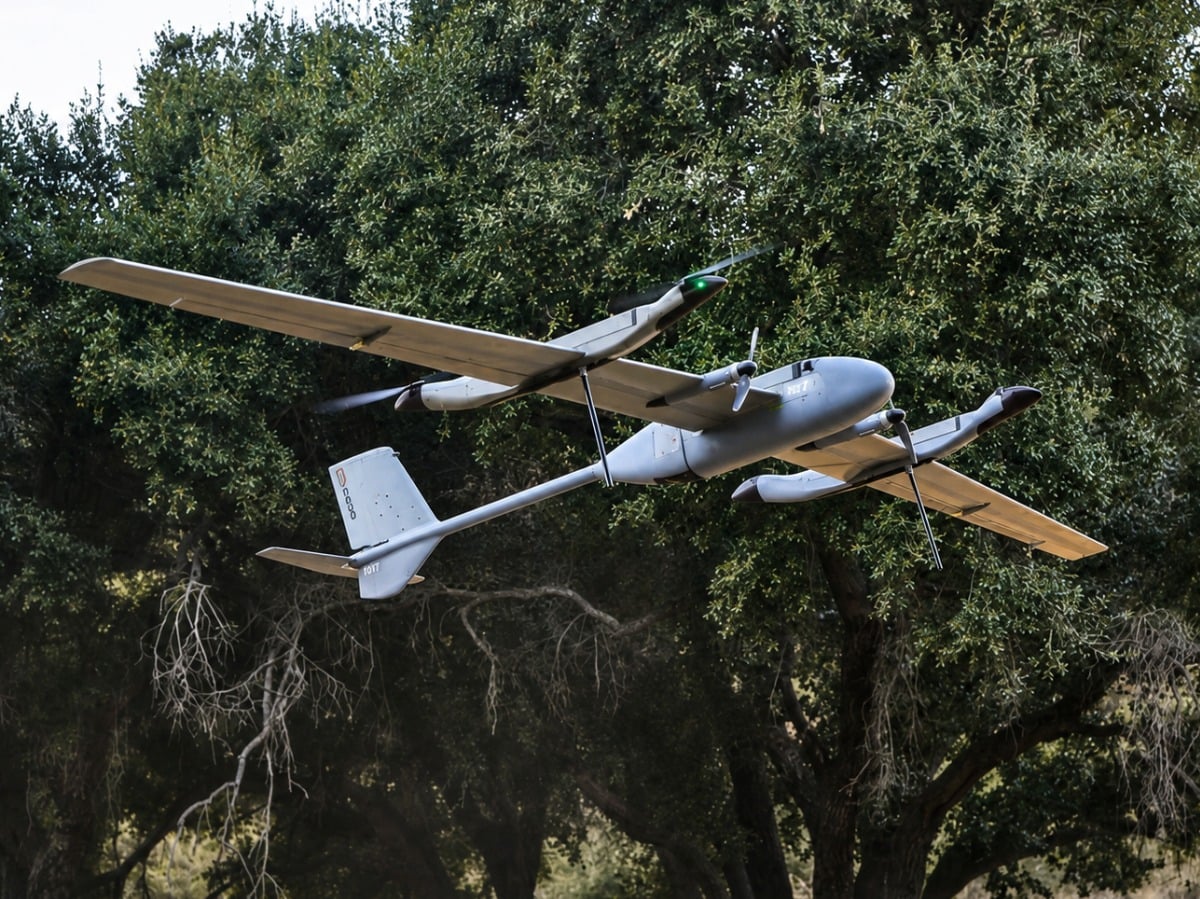
- The U.S. Army awarded AeroVironment a $117 million contract on June 3, 2026, to deliver 82 P550 unmanned aircraft systems for battalion reconnaissance.
- The P550 is an electric vertical takeoff drone with over five hours endurance, 6.8 kg (15 lb) payload capacity, and AI-assisted autonomous operations.
The U.S. Army awarded California-based AeroVironment a $117 million contract on June 3, 2026, to deliver 82 of the company’s P550 unmanned aircraft systems, giving ground commanders an organic reconnaissance and targeting capability that requires no runway, no catapult, and no launch crew beyond the soldiers already in the unit.
AeroVironment (AV) is one of the most established names in American military drone development, with a portfolio ranging from the hand-launched Raven reconnaissance drone carried by individual infantrymen to larger tactical systems used across multiple services. The P550 represents the company’s push into a more capable tier of battlefield unmanned aircraft, one that bridges the gap between the small backpack drones already common in infantry units and the larger, more complex systems that require dedicated operators and support infrastructure.
The contract, administered by Army Contracting Command at Redstone Arsenal in Alabama, covers procurement and delivery of the full 82-system order with an estimated completion date of July 23, 2026, a notably compressed timeline that reflects the Army’s urgency in getting autonomous reconnaissance capability into battalion-level hands. Ten bids were solicited and received before AeroVironment was selected, suggesting a competitive field that the P550’s combination of endurance, payload flexibility, and autonomous capability was judged to have won on its merits.
The aircraft uses electric vertical takeoff and landing, a propulsion configuration that allows it to lift off and land straight up and down under its own power, eliminating the need for runways, pneumatic catapults, or the bungee-cord launch systems that have complicated drone operations in tight or urban terrain. A battalion operating in a city, a dense forest, or a forward position with no clear ground can still put a P550 in the air within minutes of unpacking it, which is precisely the operational flexibility the Army has been seeking as it prepares for potential conflicts in environments far more complex than the open desert terrain that shaped a generation of American military thinking.
Once airborne, the P550 sustains flight for more than five hours on all-battery power, carrying up to 6.8 kg (15 lb) of sensors and mission equipment. That endurance figure is significant because it means a single aircraft can maintain persistent surveillance over a target area through an entire operational period without returning to swap batteries, keeping commanders continuously informed rather than leaving gaps in coverage during the critical intervals when threats tend to move. The aircraft measures 5.2 meters by 2.7 meters by 0.6 meters (17 ft by 9 ft by 2 ft) in flight configuration and folds down to a 1.8 meter by 0.6 meter by 0.6 meter (6 ft by 2 ft by 2 ft) packout that fits in standard military transport containers, with a gross takeoff weight of 25 kg (55 lb).
The modular open systems architecture built into the P550 addresses one of the persistent frustrations of military drone procurement: the tendency for purpose-built systems to become obsolete the moment a new sensor or datalink standard emerges. By designing the aircraft to accept third-party payloads, datalinks, mission planning software, and ground control systems without requiring significant redesign work, AeroVironment is offering the Army a platform that can evolve alongside the threat rather than requiring a new contract every time operational requirements shift. Payloads and batteries swap in the field in under five minutes with no tools required, a detail that matters enormously to a rifle company with no maintenance personnel and a mission that cannot wait.
The AI autonomy layer embedded in the P550 pushes the system meaningfully beyond the remote-controlled aircraft that defined the first generation of tactical military drones. Built-in algorithms allow the aircraft to execute complex flight profiles autonomously, transition smoothly between vertical hover and forward flight, and assist operators with object detection and classification, reducing the cognitive burden on soldiers who may simultaneously be managing a ground tactical situation while trying to make sense of aerial sensor feeds. In GPS-denied or electronically contested environments, where adversaries have demonstrated the ability to jam or spoof drone navigation systems, the autonomous capability provides a degree of resilience that a purely operator-dependent system cannot match.
The drone that can take off from anywhere, fly all day, and think for itself has been a goal of military planners for decades. For 82 Army battalions, it just became a purchase order.