

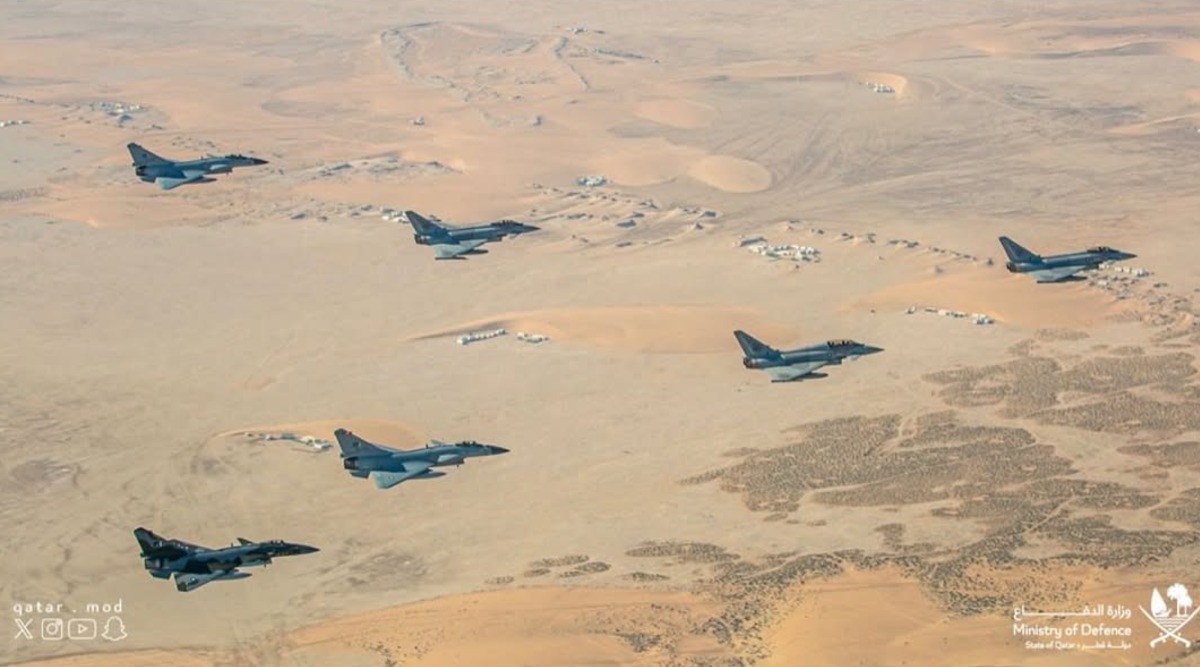
- China's CCTV confirmed Pakistan's J-10CE jets won all nine simulated engagements against Qatar's Eurofighter Typhoons in a 2024 exercise.
- Pakistani media identified the drill as the Zilzal-II joint air exercise held in Qatar in January 2024, details CCTV did not disclose.
Pakistan’s Chinese-made J-10CE fighter jets went undefeated against Qatar’s Eurofighter Typhoons in nine simulated air combat engagements during a joint exercise in 2024, with China’s state broadcaster CCTV confirming the result last week without identifying the specific drill or the countries involved, according to an analysis by Harrison Kass published by The National Interest.
Pakistani media filled in the details CCTV left out, reporting that the engagements took place during the “Zilzal-II” joint air exercise held in Qatar in January 2024. The drill pitted Pakistan Air Force J-10CE jets against Eurofighter Typhoons operated by the Qatar Emiri Air Force, one of the most capable air arms in the Middle East, equipped with some of Europe’s most advanced combat aircraft. The 9-0 score has since circulated widely across Chinese and Pakistani media, framed as evidence that a Chinese-designed fighter can dominate a top-tier Western platform.
The J-10CE, known as the Vigorous Dragon, is the export variant of China’s J-10 family of multirole fighters, built by Chengdu Aircraft Corporation. It features a canard-delta wing configuration, an active electronically scanned array radar, an electronic warfare suite, and compatibility with the PL-15E beyond-visual-range missile, a weapon with a stated range exceeding 200 km (124 miles). China has positioned the J-10CE as an affordable, capable alternative to Western fighters for countries that cannot access or afford American F-16s or European Typhoons. Pakistan has been one of its primary customers, acquiring the type to modernize its fleet alongside older American and French platforms.
The Eurofighter Typhoon, by contrast, was conceived as a dedicated air superiority fighter before evolving into a multirole platform. Built by a European consortium involving the United Kingdom, Germany, Spain, and Italy, the Typhoon is powered by two Eurojet EJ200 afterburning turbofan engines, carries an advanced CAPTOR-E AESA radar, and can reach a top speed of approximately 2,495 km/h (1,550 mph), or Mach 2.3. Qatar’s Typhoons are among the most modern variants in service anywhere. On paper, the Typhoon holds measurable advantages over the J-10CE across most performance categories, including thrust, payload, radar capability, and crucially, missile armament.

That last point is where Kass’s analysis in The National Interest cuts to the core of what the 9-0 score does and does not mean. The Typhoon’s most significant air combat advantage in unrestricted engagements comes from its compatibility with the Meteor missile, a weapon with no close equivalent in current Chinese or Pakistani inventories. Unlike conventional rocket-powered air-to-air missiles that lose energy as they coast toward their targets, the Meteor uses ramjet propulsion to sustain speed throughout its flight, creating what engineers call a very large “no escape zone,” the volume of airspace from which a targeted aircraft cannot maneuver away before the missile arrives. In a real-world beyond-visual-range engagement, Typhoon pilots would typically seek to exploit that reach before a J-10CE pilot could even bring his own weapons to bear.
Military exercises, however, are not real-world engagements. They are controlled environments built around specific training objectives, and the rules that govern them often bear little resemblance to the conditions of actual combat. The full rules of engagement for Zilzal-II have not been made public. As Kass noted, common exercise restrictions include visual-range-only combat requirements, predetermined starting positions, and limitations on which weapons or tactics each side may employ. If the Zilzal-II engagements were structured around close-range maneuvering rather than beyond-visual-range missile duels, the Typhoon would have been prevented from using its most decisive advantages, and a 9-0 score would reflect the exercise design as much as the aircraft’s actual capabilities.
Real aerial combat in the modern era rarely resembles the close-turning dogfights that the term “air combat” still conjures in popular imagination. The vast majority of modern air-to-air engagements, and virtually all engagements between peer or near-peer opponents, take place at ranges where the pilots never visually identify each other. The sequence is radar detection, target identification, missile launch, and kill assessment, with electronic warfare, data links, and ground-based radar networks shaping the outcome as much as the aircraft’s speed or maneuverability. A score achieved in a close-range exercise environment translates poorly, if at all, into conclusions about which aircraft would prevail in that kind of fight.

China has invested heavily in positioning its defense exports as legitimate competitors to Western systems rather than inexpensive derivatives of Soviet designs. The narrative that a Chinese fighter swept a premium European platform 9-0 in exercises serves that positioning directly, creating a headline that travels fast through defense media and reaches the procurement offices of countries considering their next fighter purchase. Pakistan, for its part, has strong incentive to advertise the capabilities of a platform it flies and champions. Kass observed in his The National Interest analysis that the score is certain to become a selling point for Chinese exports, regardless of what the exercise conditions actually measured.
What remains unconfirmed is the ruleset that governed the Zilzal-II engagements, the specific variants of each aircraft involved, whether the Typhoons carried Meteor missiles during the exercise, and whether CCTV’s confirmation of the 9-0 result reflects the complete picture of the exercise outcomes or a selected subset of engagements. None of those questions diminish the fact that the engagements happened and that Pakistan’s J-10CEs performed well within whatever framework the drill established.