


- A Romanian F-16 assigned to NATO's Baltic Air Policing mission shot down a suspected Ukrainian drone over Lake Võrtsjärv in southern Estonia on May 19.
- Ukrainian Defense Minister Mykhailo Fedorov apologized to Estonian Defense Minister Hanno Pevkur after Estonia confirmed the drone likely originated from Ukraine and was headed toward Russian targets.
A Romanian Air Force F-16 patrolling Baltic skies under NATO’s air policing mission shot down a suspected Ukrainian drone over southern Estonia on May 19, marking the first time NATO fighters have actively intercepted and destroyed a drone over the Baltic states rather than simply scrambling to track one.
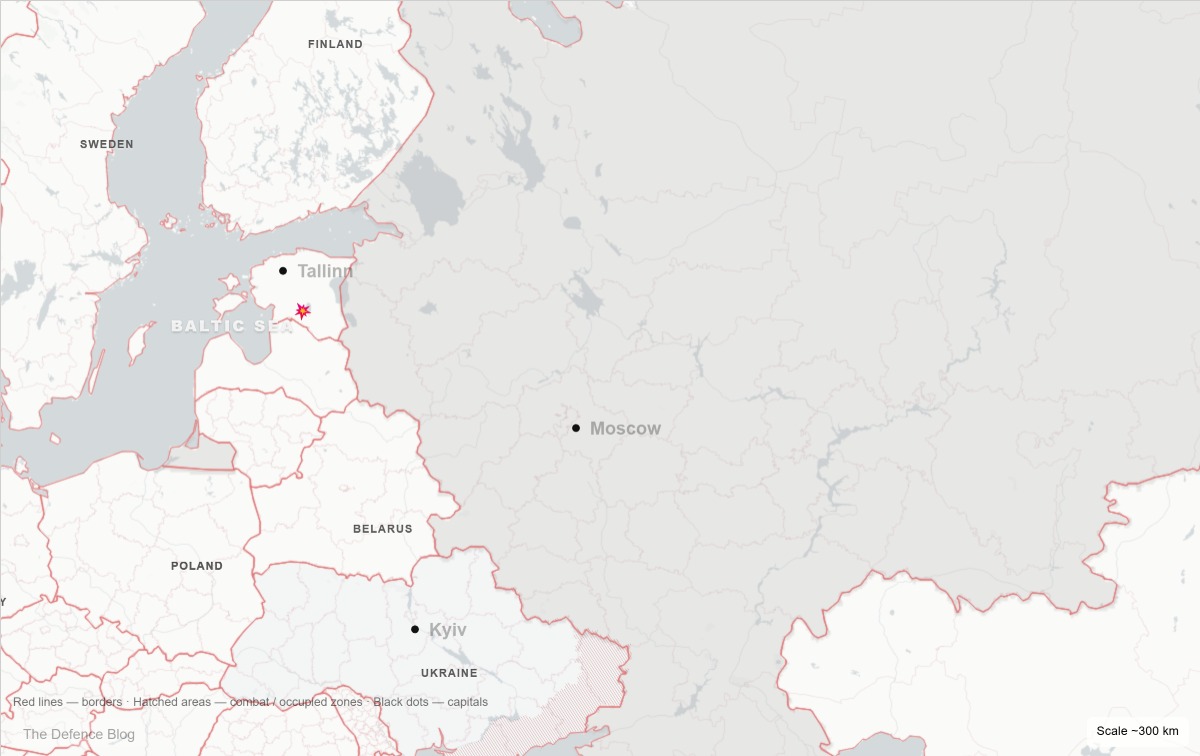
The incident unfolded around midday, with the drone brought down between Lake Võrtsjärv and the town of Põltsamaa in central Estonia, its wreckage falling in a marshy area near Kablaküla village, according to Estonian Defense Minister Hanno Pevkur.
The drone had been tracked before it ever crossed into Estonia, with Latvia providing the initial alert after the aircraft transited Latvian airspace to the south. Latvian military authorities had already declared air threat warnings in five border municipalities and scrambled NATO air policing assets before the drone continued northward into Estonian territory. Latvia reported on May 17 that an unmanned vehicle had entered its airspace near the Russian border, prompting warnings in five border municipalities and the activation of air-defense units and NATO Baltic Air Policing aircraft before the drone eventually left Latvian territory, according to Wikipedia’s running account of the 2026 Baltic drone incursions. Two days later, a new drone followed a similar route and did not leave on its own.
Pevkur confirmed to media that Estonia’s own radar systems picked up the drone after receiving initial data from Latvian colleagues, and that standard NATO air defense procedures were then activated. “Baltic Air Policing fighter jets were also in the air and, in this case, Romanian F-16s shot down the drone,” he said, adding that the wreckage had landed in a marshy area and that search operations were continuing. The reason Romanian jets responded rather than Portuguese fighters, who are currently based at Ämari Air Base in Estonia as part of the current rotation, came down to geography and timing: the Romanian detachment operates from Šiauliai Air Base in Lithuania alongside French Rafales, and Pevkur said the Romanians were simply closest to the incident when it occurred. “We protect Baltic airspace jointly, and whoever is closest at that moment reacts,” he said.
Estonia’s Foreign Minister Margus Tsahkna said the incident demonstrated that NATO air policing was working as designed. “This clearly shows that NATO air policing works and that allies jointly protect our security,” he said, thanking Romania and other NATO allies for their swift response. Tsahkna added that Ukraine had the right to strike Russian military targets to reduce Moscow’s ability to continue its war, but said Estonia had not allowed its airspace to be used for attacks on Russia, and that such incidents were linked to Russian jamming.
Pevkur described the drone as likely of Ukrainian origin, aimed at targets in Russia, and confirmed he had spoken directly with Ukrainian Defense Minister Mykhailo Fedorov following the incident. According to Pevkur, Fedorov apologized. “We once again confirmed with the Ukrainian defense minister that only our allies have permission to use our airspace. Ukraine did not request such permission. The Ukrainian defense minister apologized,” Pevkur said, per the Estonian news outlet Delfi. He also warned that Russian propaganda would likely attempt to exploit the incident for its own purposes, a concern that reflects the political sensitivity surrounding every airspace violation in the region regardless of who is responsible.
The Baltic Air Policing mission, which has run continuously since Estonia, Latvia, and Lithuania joined NATO in 2004, exists precisely because the three countries have no fighter aircraft of their own. The mission operates as a Quick Reaction Alert from two main bases, Šiauliai Air Base in Lithuania and Ämari Air Base in Estonia, with allied nations rotating four-month deployments of typically four fighter jets and between 50 and 100 support personnel, according to NATO’s Baltic Air Policing program documentation. What began as a relatively routine peacetime mission has been transformed by Russia’s war in Ukraine into something considerably more active, with Baltic airspace now regularly affected by drone activity linked to the conflict several hundred kilometers to the south and east.
Russia’s jamming infrastructure, including the Tobol system and related platforms, is assessed to degrade GPS, Galileo, and GLONASS navigation signals across wide areas, disrupting not only military drones but civilian aviation and maritime navigation. Lithuania has recorded a 22-fold increase in GPS spoofing incidents over the past year, and Estonia reports that 85 percent of its civil flights have experienced signal interference, according to reporting by ComplexDiscovery. When a drone loses navigation lock, it does not stop flying. It continues on whatever heading physics allows, which is how a weapon aimed at a Russian port ends up drifting into NATO territory. Lithuanian military specialist Vaidotas Malinionis assessed that Russia is deliberately using stray drones as a political tool against NATO by interfering with Ukrainian drone navigation through jamming to provoke these incidents, aiming to generate insecurity and apply pressure on neighboring countries, according to Wikipedia’s account of the Baltic drone incidents.
Whatever Russia’s intent in jamming the navigation of Ukrainian drones over the Baltic region, the May 19 incident has now produced a new precedent: NATO fighters have actively engaged and destroyed a drone over allied territory in peacetime, a step no Baltic Air Policing mission had taken in over two decades of operation.