


- A Russian intercontinental ballistic missile test at the Yasny range failed shortly after launch, exploding at an altitude of 200–400 meters.
- Footage showed a purple toxic cloud at the crash site, consistent with nitrogen tetroxide and UDMH propellants used in Soviet-era heavy missiles.
Russia has suffered a failed Intercontinental Ballistic Missile (ICBM) test after a launch at the Yasny range in the Orenburg region ended in an explosion only seconds after liftoff.
The missile rose roughly 200–400 meters before detonating in midair and crashing back to the ground, leaving behind a visible purple toxic cloud.
The incident occurred at the Yasny launch site, a location that hosts both a cosmodrome and a base for Russia’s Strategic Missile Forces. It is one of the few facilities in the country capable of launching long-range missiles, including intercontinental ballistic missiles equipped with nuclear warheads.
Defense outlet Defense Express reported that the color of the cloud is characteristic of highly toxic propellants used in certain Soviet-designed missile systems. The report said, “Such a color is inherent only to missiles that use rather toxic fuel — nitrogen tetroxide and unsymmetrical dimethylhydrazine, better known as ‘amyl’ and ‘heptyl’.”


These hypergolic chemicals are common in heavy liquid-fuel ICBMs such as the R-36M2 “Voevoda,” widely known in the West as the “Satan,” and in newer systems like the RS-28 “Sarmat,” which Russia has promoted as its next-generation strategic missile.
The exact missile type involved in the failed test has not been confirmed. Analysts at Defense Express noted that the failure profile resembles past accidents involving the Sarmat missile, stating that “this may have been a test of the Sarmat missile.”
The publication recalled that on September 21, 2024, a previous Sarmat test “exploded in the silo at the Plesetsk cosmodrome,” destroying its launch infrastructure.
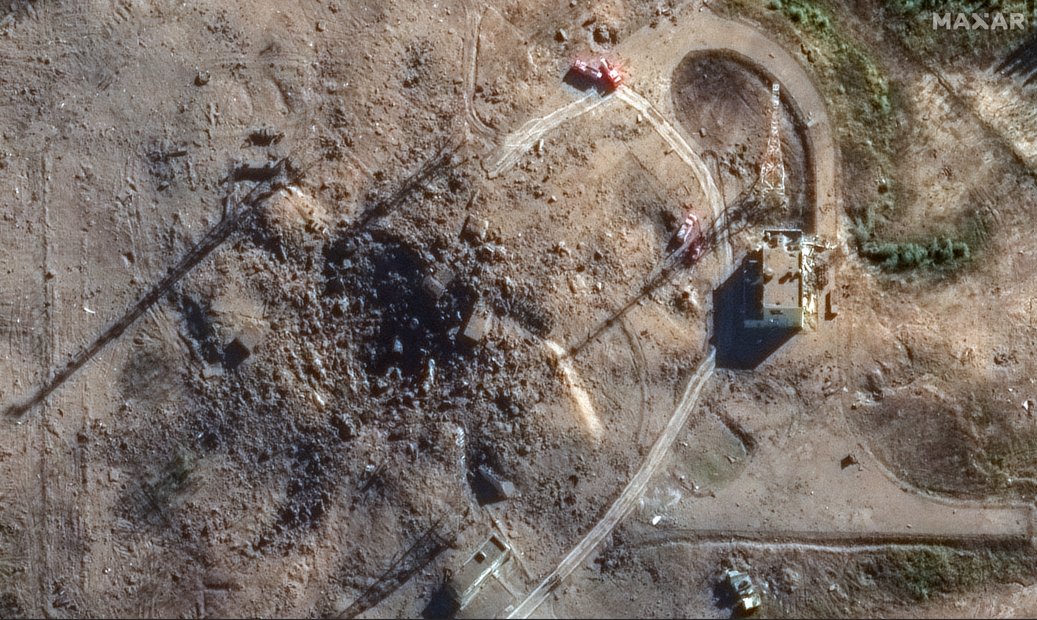
Other regional sources have suggested the failed test could involve the R-36M2 “Voevoda,” which has remained in limited service but is overdue for life-extension trials.
Russian military officials have refused to comment on the incident, despite the circulation of eyewitness videos and reports from nearby residents who saw and recorded the failed launch and the aftermath.
The sighting of purple smoke is particularly concerning, as the hypergolic propellants involved pose extreme danger to humans and the environment. As Defense Express noted, “heptyl has strong toxic and mutagenic effects and is deadly in high concentrations.” The compounds can contaminate soil, water, and air, with lingering effects long after a crash.
The failed test comes at a time when Russia has intensified strategic messaging around its nuclear deterrent and has announced multiple long-range missile modernization efforts. The Kremlin has repeatedly promoted systems like Sarmat as future pillars of its nuclear triad, yet public failures cast doubt on timelines and operational readiness.
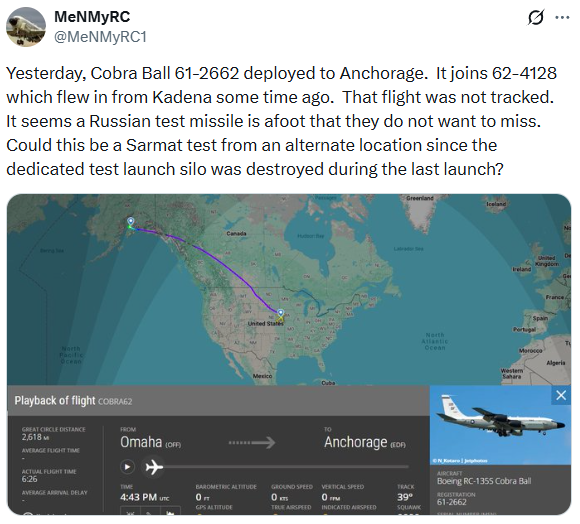
Moreover, a U.S. Air Force RC-135S Cobra Ball aircraft—tail number 61-2662—recently deployed to Anchorage.
The aircraft joined another Cobra Ball, 62-4128, which arrived earlier from Kadena Air Base. The movement was highlighted by aviation observers who noted that “it seems a Russian test missile is afoot that they do not want to miss,” suggesting that the United States may be positioning specialized intelligence aircraft to monitor long-range missile activity.