


- Two U.S. Air Force B-52H bombers conducted a patrol roughly 80 km off the coast of Venezuela, tracked in real time by open-source flight monitors.
- The flight follows a recent low-profile border-area mission by a U.S. Air Force C-146A Wolfhound used by special operations forces.
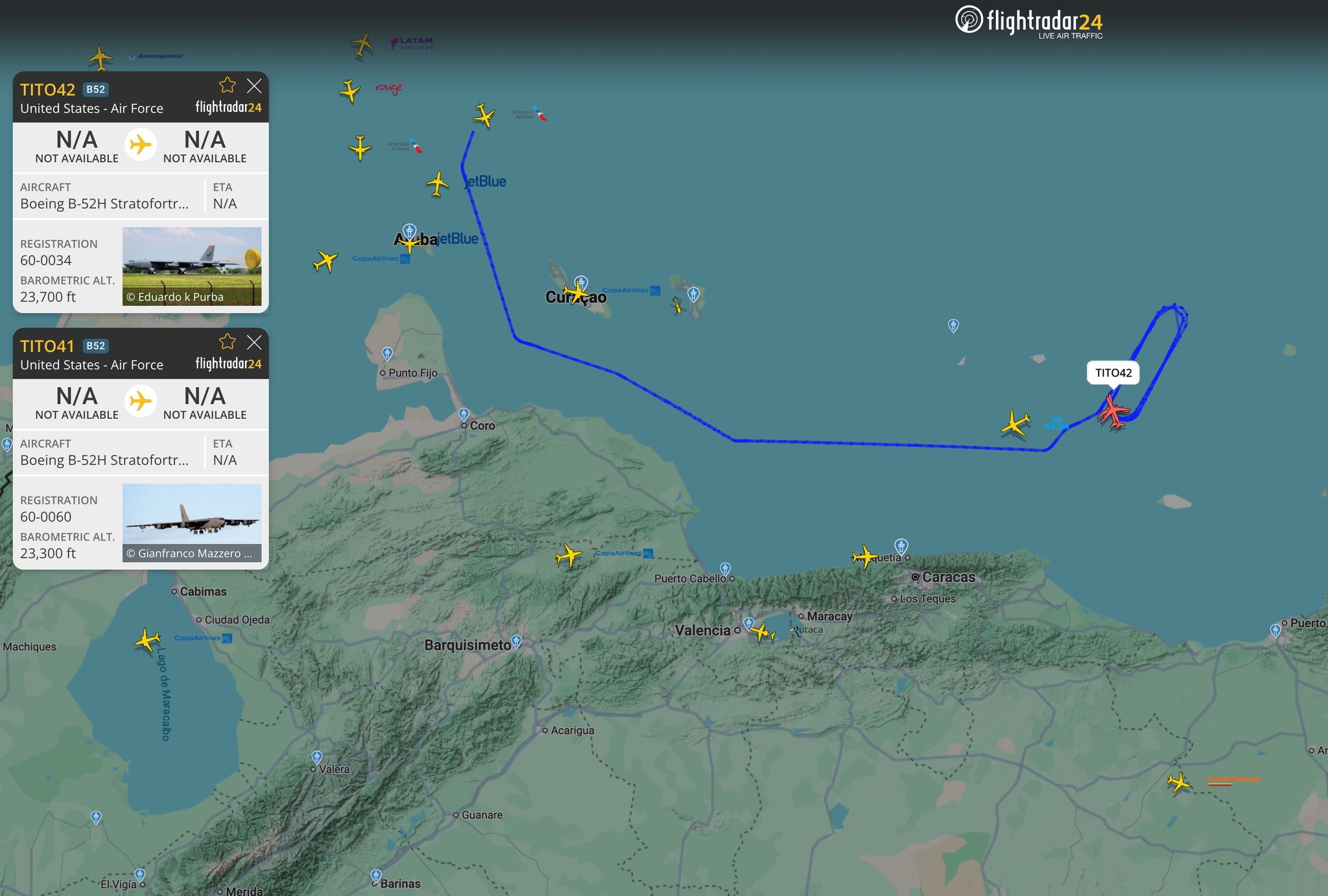
Two United States Air Force B-52H Stratofortress bombers carried out another long-range patrol along the coast of Venezuela this week, maintaining a pattern of sustained American bomber activity in the southern Caribbean.
The flight, tracked in real time by open-source aviation observers, took place at a distance of roughly 80 kilometers from Venezuelan airspace.
The aircraft were visible on Flightradar24 under the callsigns TIT041 and TIT042. According to the tracking display, both aircraft were B-52H Stratofortress bombers, with registrations 60-0040 and 60-0046. The flight paths showed extended orbits over international waters north of the Venezuelan coastline.
Flightradar24, which first highlighted the movement on its public feed, stated: “Topping our most tracked flights list now are a pair of US Air Force B-52s orbiting off the coast of Venezuela.” The platform also noted that “In recent weeks the United States has sent B-52s and B-1s to the southern Caribbean on multiple flights.”
The increased presence of U.S. strategic bombers in the region has coincided with heightened diplomatic friction involving Venezuela, regional maritime disputes, and growing intelligence concerns tied to foreign military cooperation in South America.
The B-52H Stratofortress, operated by Air Force Global Strike Command, is a long-range, nuclear-capable bomber platform designed to project power over extended distances without needing to enter contested airspace. The aircraft can carry both conventional and nuclear weapons and is routinely used in strategic signaling missions designed to reassure partners or deter adversaries.
The patrol follows a separate incident earlier this week in which a U.S. Air Force C-146A Wolfhound — a light transport aircraft used by Air Force Special Operations Command — made a discreet flight close to the Venezuela-Colombia border. That flight drew attention from open-source analysts who track U.S. special operations aviation activity worldwide. The aircraft, designed to operate in austere conditions with minimal visibility, is routinely used for personnel movement and support operations requiring low profile execution.
While there is no indication that the patrol involved any direct interaction with Venezuelan forces, the consistent bomber presence underscores a broader U.S. posture shift in the region. In recent months, American strategic aviation assets, intelligence platforms, and special operations aircraft have appeared frequently in and around the Caribbean basin.
The government of Venezuela has previously criticized U.S. military flights near its borders, calling them acts of provocation. Washington has framed similar bomber missions globally as routine operational readiness activities meant to reassure allies and maintain the credibility of U.S. strategic deterrence.