


- Russian outlet Rybar called for supplying Venezuela with Russian FPV attack drones to prepare for potential U.S. military operations in the region.
- State Duma lawmaker Alexey Zhuravlev said Russia provides Venezuela with a full range of weapons and may deliver the new Oreshnik missile system.
Russian military propagandists and lawmakers are calling for Moscow to supply Venezuela with large numbers of attack drones.
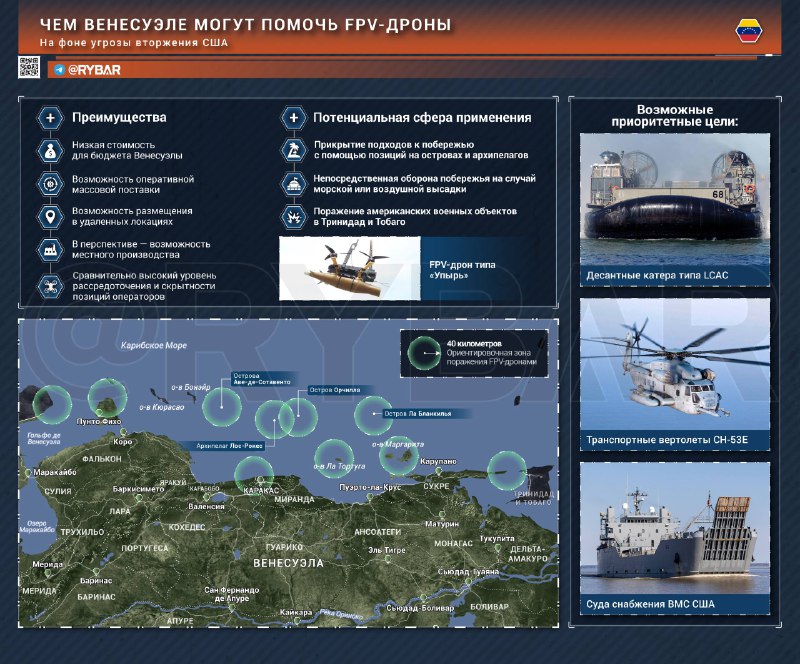
The proposal appeared in Rybar, one of Russia’s largest and most influential pro-military outlets, which urged the transfer of “a mass of Russian FPV drones with equipment” to strengthen Venezuela’s defense and repel “a potential strike.”
Rybar’s article claimed that “this would make it possible, at relatively low cost, to cover the coast from a potential U.S. landing, especially if positions are placed on islands and archipelagos.” It argued that drones with an operational range of around 40 kilometers could “greatly complicate the use of U.S. landing craft and supply ships,” adding that “for operators, they are a fat target.”
The post further stated that even if U.S. ships reached the shore, “they would remain vulnerable — between Caracas and the sea lies a three-kilometer-high mountain range, from which drones could ‘rain down’ on U.S. LCACs made of burning light alloys.” It added that the same approach could be used against “helicopter landing pads if the U.S. sets them up to supply its forces by air,” effectively crippling American logistics during any amphibious operation.
Rybar insisted FPV drones were an ideal choice for Venezuela “for rational military and economic reasons.” The article listed advantages such as concealment, mobility, and low cost, claiming “operators can easily camouflage their positions, unlike coastal missile systems,” and that “FPV units can be deployed to the most remote islands by helicopter or boat.” It said drones were “produced by the thousands” and “can all fit in a cargo aircraft.” Each system, the post said, “costs about $1,000 — roughly the price of an assault rifle.”
In parallel, First Deputy Chairman of the State Duma Defense Committee Alexey Zhuravlev told Russian media that Moscow is already supplying Venezuela with weapons and did not rule out the transfer of advanced systems. “I see no obstacles to supplying our friendly country with new developments such as the Oreshnik [RS-26] complex,” he said. Zhuravlev described Russia as Venezuela’s “key military-technical partner,” claiming Moscow provides “almost the entire range of weapons — from small arms to aviation.” He added that the volume and type of deliveries are secret, warning that “the Americans may be in for a surprise.”
Zhuravlev also said that Russian Su-30MK2 fighters form the backbone of Venezuela’s Air Force and that Moscow has supplied the country with Pantsir-S1 and Buk-M2E air defense systems.
This open advocacy of arming Venezuela with strike drones underscores Russia’s intention to expand its strategic footprint in Latin America, potentially testing U.S. resolve in the Western Hemisphere.
While FPV drones cannot replace advanced air defenses or naval assets, their mass use could disrupt coastal operations, challenge logistics routes, and provide low-cost deterrence. For U.S. forces and policymakers, the message is clear: adversaries are learning to exploit commercial technology to offset American advantages. The potential spread of these systems in the Caribbean highlights a growing trend — one where inexpensive drones become tools of state-level influence, capable of altering local power dynamics with little investment but considerable strategic impact.