

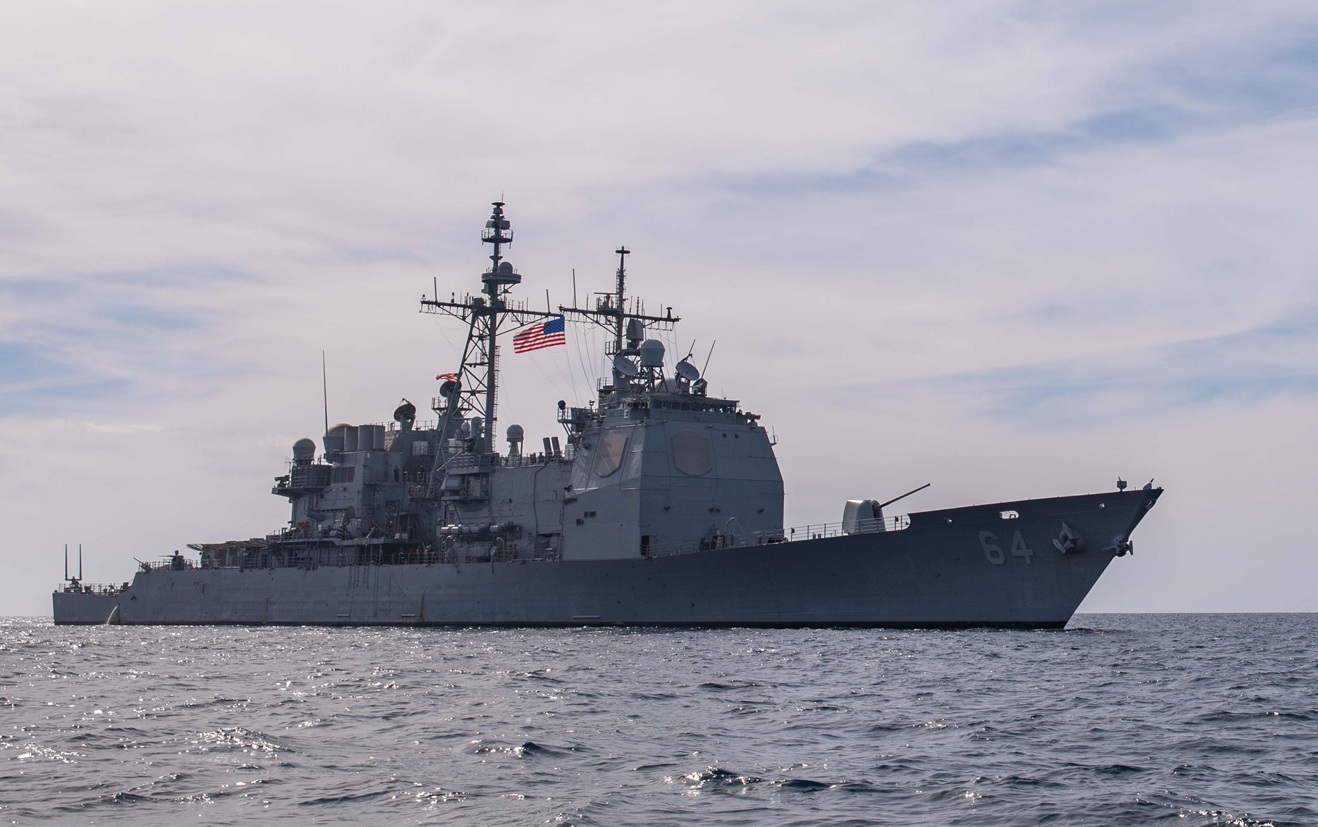
- The U.S. Navy deployed USS Gettysburg (CG 64) to the southern Caribbean under SOUTHCOM’s counter-narcotics task force.
- The Gettysburg joins USS Lake Erie, adding long-range strike and air-defense capability to the flotilla.
The United States Navy has reinforced its presence in the southern Caribbean, deploying the USS Gettysburg (CG 64), a Ticonderoga-class guided-missile cruiser, on an unscheduled mission near Venezuelan waters.
The move adds to growing U.S. military activity in the region amid ongoing narcotics and security operations.
According to The War Zone, a U.S. Navy official confirmed that the Gettysburg has joined naval forces assigned to U.S. Southern Command (SOUTHCOM) for counter–narco-terrorism operations. The ship becomes the second Ticonderoga-class cruiser to participate in the mission, operating alongside the USS Lake Erie (CG 70).
Both warships bring advanced combat systems and layered air-defense capability to the flotilla now operating in the Caribbean. Each Ticonderoga-class cruiser is equipped with the Aegis Combat System, long-range Standard Missiles, and Tomahawk land-attack missiles, providing the task force with wide-area surveillance and precision-strike reach.
The Navy has not disclosed the duration or specific scope of the deployment, though officials described it as an unscheduled reinforcement meant to support ongoing SOUTHCOM maritime operations. The Gettysburg’s presence adds what defense observers call “a great deal of additional firepower and command capability” to the task group.
The USS Gettysburg, commissioned in 1991, has previously served in multiple strike groups and is one of the most capable surface combatants in the U.S. fleet. Its arrival follows an increased U.S. naval posture in the southern approaches to the Caribbean, an area that has seen heightened attention due to regional instability and reports of weapons and narcotics trafficking.
The deployment comes as diplomatic friction continues between Washington and Caracas. Venezuelan officials have repeatedly accused the United States of conducting what they describe as provocative operations near its maritime borders, while U.S. defense officials maintain that the naval missions fall under legitimate counter-trafficking and regional security mandates.
From an operational standpoint, the addition of the Gettysburg and Lake Erie enhances SOUTHCOM’s ability to maintain persistent maritime surveillance, integrate with allied assets, and project deterrence across sea lanes critical to hemispheric security.
Beyond counter-narcotics activity, such deployments reinforce U.S. naval readiness close to the South American mainland — an area where geopolitical tensions, economic instability, and great-power competition increasingly intersect.
The Navy’s renewed activity around Venezuela demonstrates how regional operations can serve dual purposes: disrupting illicit trafficking while reinforcing deterrence near adversarial states.