


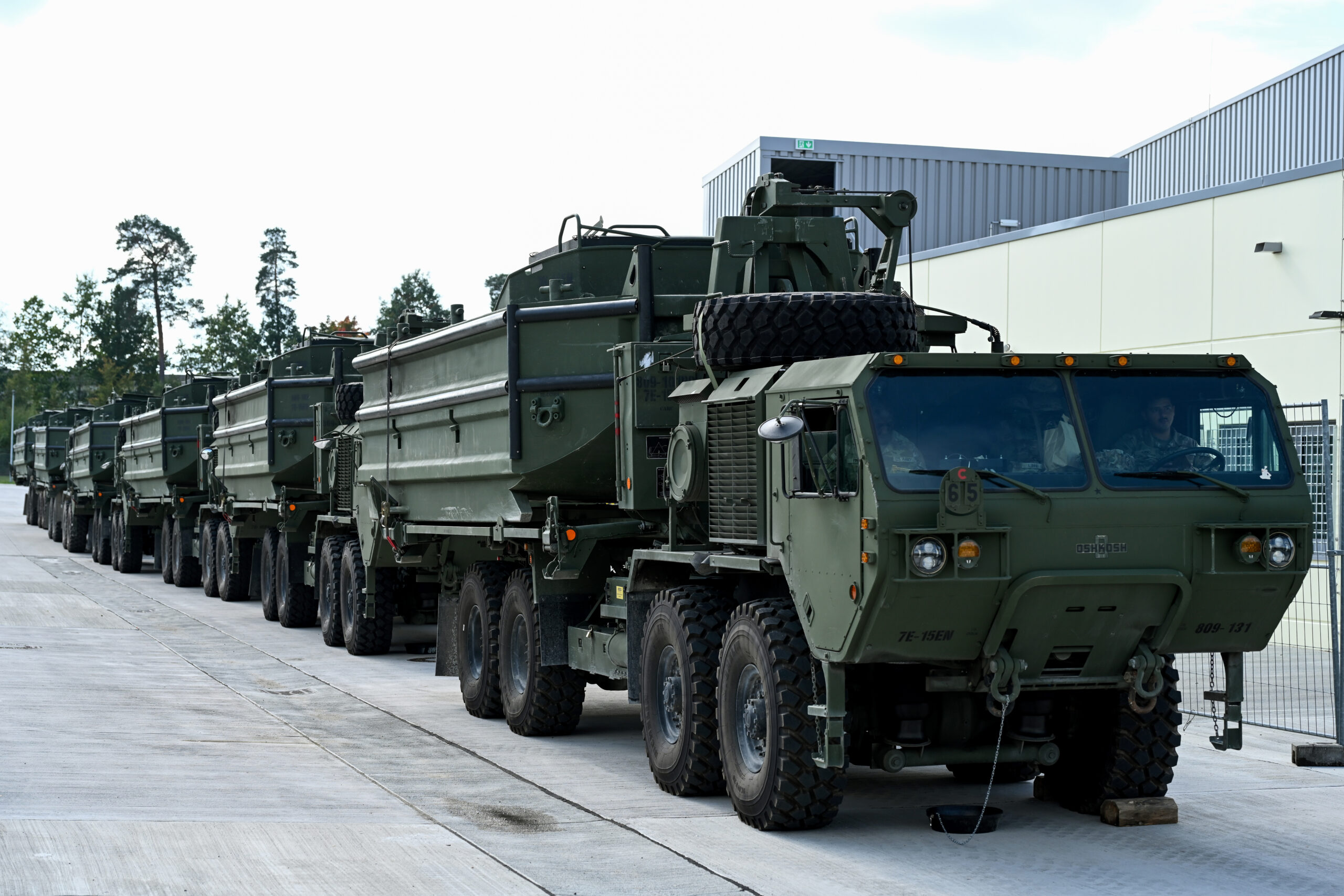
U.S. Army engineers with the 809th Multi-Role Bridge Company (MRBC), 15th Engineer Battalion, 7th Engineer Brigade, conducted a major river-crossing exercise at the 7th Army Training Command’s Grafenwoehr Training Area in Germany, testing the unit’s ability to deploy quickly and support mobility operations across Europe’s challenging terrain.
The 809th MRBC deployed to a designated training area and demonstrated its ability to rapidly establish, assemble, and recover bridging systems under operational conditions.
The unit is the only permanently assigned Multi-Role Bridge Company within U.S. Army Europe and Africa, providing personnel and specialized equipment to transport, assemble, disassemble, retrieve, and maintain both standard and nonstandard U.S. Army bridging systems. These systems support wet and dry gap crossings, enabling heavy vehicles and mechanized units to maintain momentum during offensive and defensive operations.
Rapid river-crossing capability is a core element of modern military operations, particularly in Europe, where rivers and waterways present natural obstacles to large-scale maneuvers. The exercise in Grafenwoehr emphasized the importance of bridging units in ensuring freedom of movement for combat forces and sustaining operational tempo in dynamic battlefield conditions.
The U.S. Army has increased its focus on mobility engineering and rapid bridging capabilities in recent years, recognizing their critical role in high-intensity conflict scenarios. Effective gap-crossing operations enable forces to outmaneuver adversaries, sustain supply lines, and project combat power deep into contested territory.
For the 809th MRBC, such training ensures the unit can respond quickly to operational requirements anywhere in Europe. Its engineers are trained to operate under demanding conditions, assembling floating or fixed bridges within hours to support armored formations, logistics convoys, and rapid reaction forces.
The emphasis on river-crossing readiness also reflects lessons drawn from recent conflicts, where failure to establish secure crossings has led to heavy losses. During Russia’s invasion of Ukraine, armored columns suffered catastrophic casualties while attempting to cross rivers under fire — often due to poor planning, inadequate bridging capabilities, and chaotic execution.
Those experiences underscore the strategic value of specialized engineer units capable of rapid, coordinated gap-crossing operations. By refining these capabilities, U.S. and NATO forces aim to avoid similar vulnerabilities in future conflicts and ensure that mobility does not become a limiting factor in combat operations.