


The U.S. Army is training with a new class of tactical drone capable of performing both surveillance and strike missions, as part of its push to accelerate small unmanned aircraft systems integration across frontline units.
According to imagery from Fort Hood, Texas, soldiers from the 1st Cavalry Division conducted drone operations on September 17, 2025, using the C100 quadcopter produced by Performance Drone Works (PDW).
The drone training is part of the division’s ongoing “Pegasus Charge” initiative, aimed at modernizing force structure and improving battlefield responsiveness.
The C100 is a battery-powered, heavy-lift quadcopter with modular payload capabilities. The aircraft, designed by Performance Drone Works, is man-portable and can be launched in under two minutes. It supports multiple missions including persistent ISR (intelligence, surveillance and reconnaissance), cargo delivery, and precision strike.
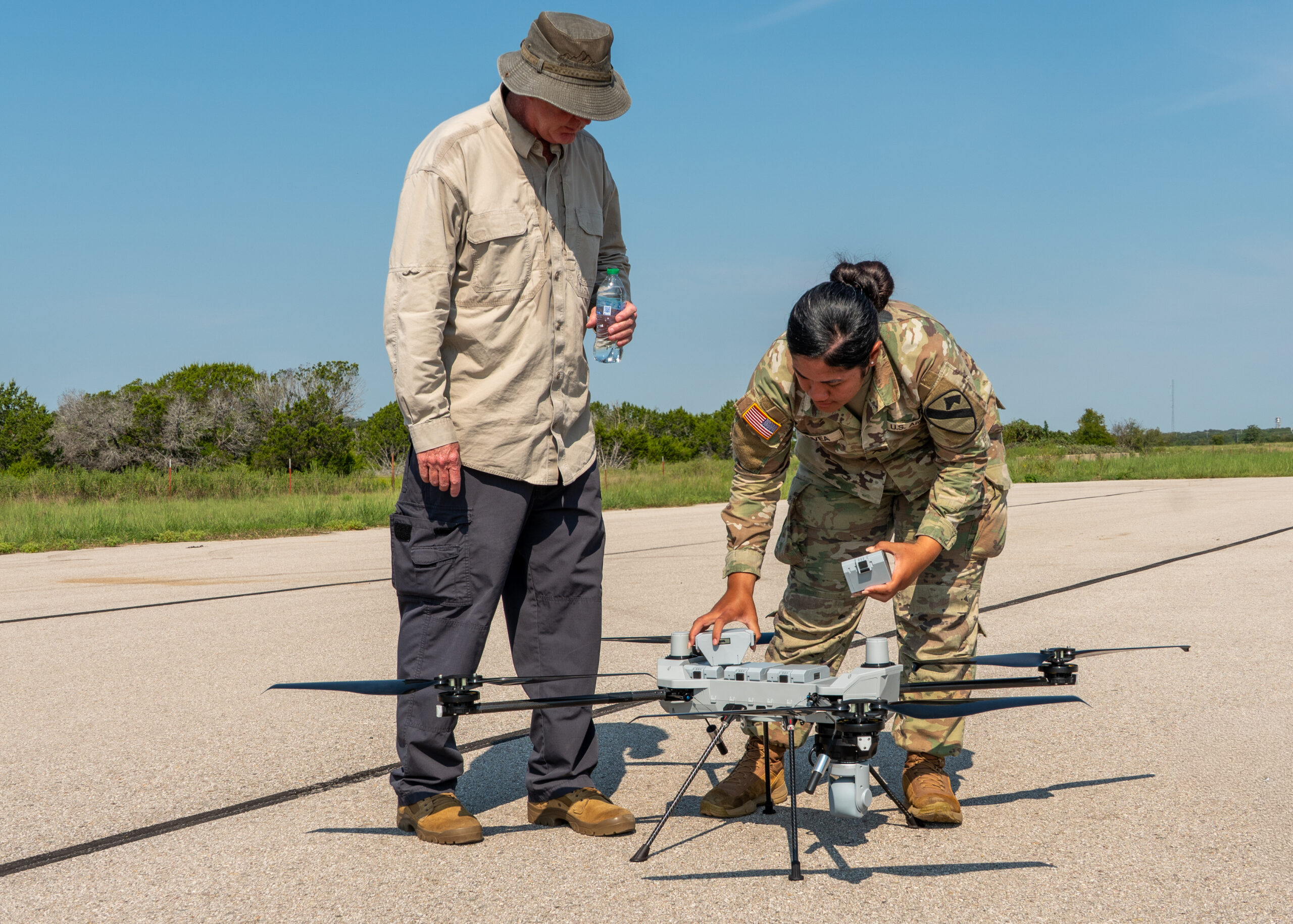
The drone is fitted with a factory-installed payload release system and a munition mounting point, allowing it to operate as a loitering strike platform in contested environments. The aircraft holds a world endurance record in its class, capable of remaining airborne for up to 74 minutes when equipped with a Trillium EO/IR sensor.
The system’s architecture includes DIU Blue UAS-compliant flight controls and secure AES-256 encrypted data links via Doodle Labs’ Helix Mesh Rider Radio. According to the manufacturer, the drone’s modular open design enables rapid integration of new hardware and propulsion upgrades.
The C100 gives soldiers a reliable, scalable platform with short setup time, operational flexibility, and strong performance in austere environments.
The Army’s broader push to acquire and deploy small tactical drones gained momentum in June 2023, when the service formally approved the requirement for company-level SUAS. In the same year, Performance Drone Works and Anduril were selected to supply initial systems to frontline units. The total contract award for the initial tranche was valued at $14.42 million.
Also, PDW recently received a $20.9 million award from the U.S. Army to supply additional C100 drones and Multi-Mission Payloads (MMPs) in support of the TiC initiative. This is the third such contract for the C100 under the Army’s Company Direct Requirement for Medium Range Reconnaissance (MRR). The TiC program aims to move emerging commercial systems rapidly from prototype to operational fielding.
The first two contracts under the TiC effort resulted in C100 systems being deployed to seven Army PM UAS units. The new batch will equip units within the 18th Airborne Corps and U.S. Army Special Operations Command (USASOC), expanding the scope and operational relevance of the system.
The Army says the initiative is part of a larger effort to deliver new capability quickly and directly into the hands of soldiers, emphasizing modularity and rapid deployment in austere environments.
The drone featured during the Fort Hood operation is also capable of operating with independent first-person view navigation, allowing operators to maneuver using a dedicated forward flight camera, even when payload sensors are inactive.

Military planners have noted the increasing relevance of unmanned systems capable of both reconnaissance and kinetic action in irregular warfare and near-peer conflict zones. The dual-use potential of platforms like the C100 is viewed as a way to reduce risk to personnel while expanding options for tactical commanders on the ground.