


Shield AI has integrated its Hivemind autonomy system onto the MQ-20 Avenger drone in just twelve weeks, demonstrating full mission capability through live flight tests.
According to the company, the rapid deployment was made possible by leveraging modular open architecture and close collaboration with General Atomics Aeronautical Systems.
In the official blog, Abigail Francis, Technical Program Manager at Shield AI, wrote, “Starting the day before Thanksgiving 2024, my team and I found ourselves locked in a sprint—racing holidays and red tape—to prove what happens when the right software, partners, and urgency align.”
The integration effort began in late November 2024. Shield AI’s team used the Autonomy Government Reference Architecture (A-GRA) as a baseline to connect Hivemind to the MQ-20 without the benefit of a vehicle dynamics simulator, which was unavailable due to government restrictions.
Despite this, Francis wrote, “Within just one day in the GA lab, we successfully integrated onto the MQ-20 Avenger and refined our solution using the actual dynamics simulator.”
Shield AI says its Hivemind autonomy stack is platform-agnostic and engineered to execute complex missions in GPS- and communication-denied environments. During two live flight demonstrations, Hivemind successfully controlled the Avenger drone in both single-agent and multi-agent scenarios.
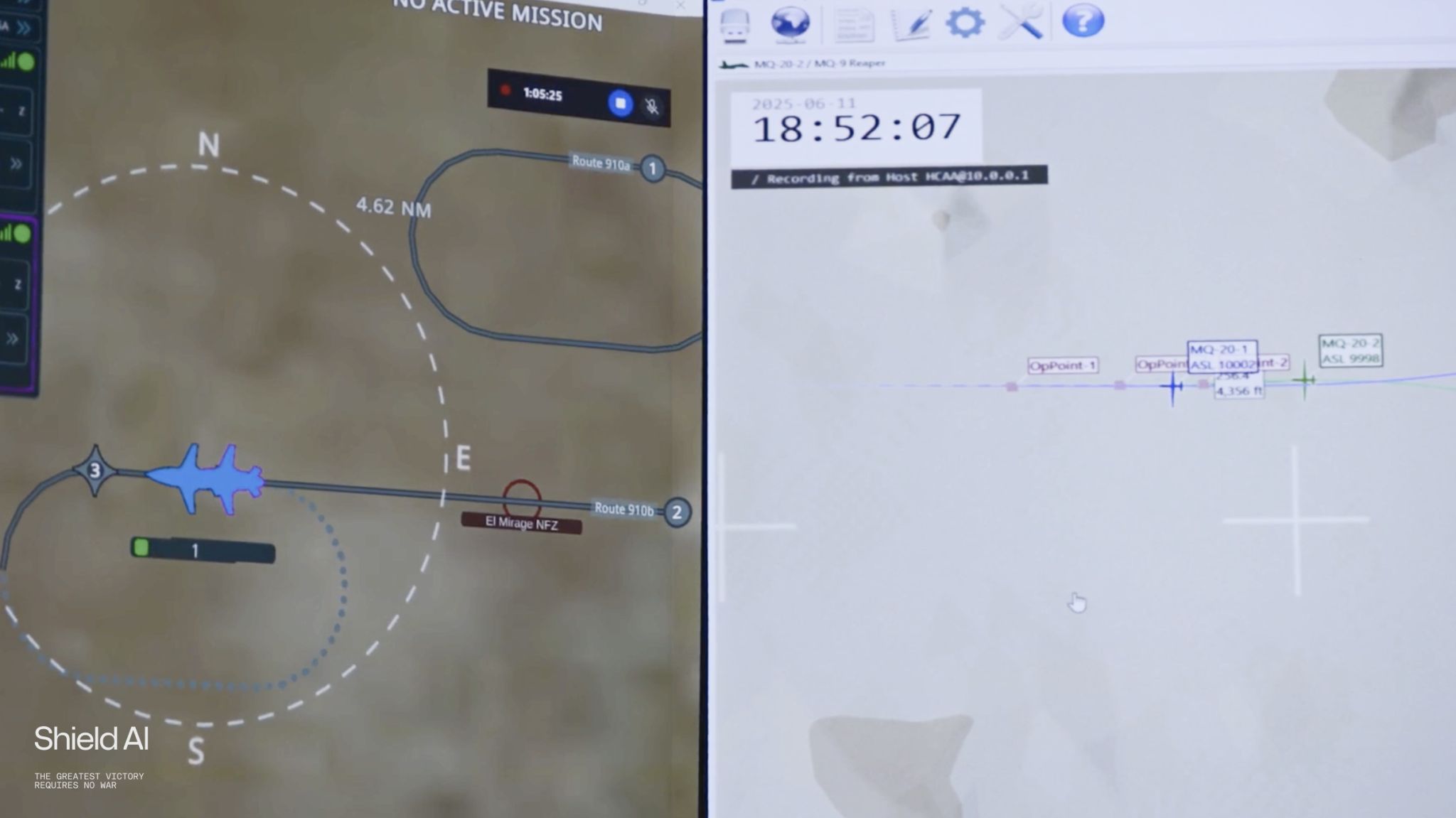
The first test took place in February 2025 at Orange Flag 25-1. According to the company, the system demonstrated command and control (C2) functionality, including waypoint-based navigation, heading/speed/altitude control, and dynamic geozone avoidance.
The second test moved into collaborative autonomy. A live MQ-20 flew in formation with its digital twin in a live-virtual-constructive (LVC) scenario, performing a fully autonomous 180-degree offset combat air patrol. Francis wrote, “This was the leap from ‘can we fly safely’ to ‘can we fight as a team.’”
Hivemind coordinated agent behaviors using geometry-based decision logic to maintain trail formations and adjust navigation in real time to avoid no-fly zones. The company said it proved aggregation is not only possible, but safe and scalable.
Engineering Manager Alysha Singh noted, “A large factor in our success was making the autonomy interface to the platform simple and the internal parameters of the algorithms highly configurable. This enabled the team to quickly tune and iterate based on platform performance in the lab.”
The integration effort involved a small core team working under compressed timelines. Their simulation-driven approach allowed for rapid testing in software-in-the-loop (SIL) and hardware-in-the-loop (HIL) environments to validate safety functions before flight.
Francis wrote, “We solved problems shoulder to shoulder, approaching every challenge as a single, integrated team.”
One key innovation was the ability to toggle between autonomy stacks mid-mission, which allowed the teams to validate Hivemind during MQ-20 flights without disrupting GA’s separate test program.
Shield AI stated that General Atomics was impressed by the lab integration and invited the company to demonstrate its capability at the Orange Flag event. According to the company, the LVC test built confidence among pilots and engineers, with each iteration reinforcing that AI-driven aggregation can be safely deployed.
As the defense community seeks faster ways to integrate autonomy at scale, Shield AI’s MQ-20 effort presents a case study in what is possible. The company says the results show that autonomy can be fielded in months—not years—if the right software, partners, and infrastructure are in place.
Looking ahead, Francis wrote, “This journey is far from over. If there is one lesson we can all share, it is this: bold timelines are achievable when you build the right technology, choose the right partners, and work as one team.”
Shield AI has said that providing an advanced simulator from the outset would further accelerate integration timelines. But even without that, the MQ-20 effort demonstrates that AI autonomy can transition from lab to field-ready within weeks, not months or years.
The MQ-20 Avenger, manufactured by General Atomics and operated by the U.S. Air Force, is designed for combat ISR missions and survivable unmanned strike roles. Shield AI’s successful integration of Hivemind onto this platform may point toward a new era in drone warfare—one where AI coordination becomes standard practice rather than experimental trial.
The flight tests, conducted under A-GRA compliance, further reinforce the feasibility of plug-and-play autonomy across a variety of U.S. platforms.
According to Shield AI, their experience with the MQ-20 provides a repeatable path forward for rapid integration onto other manned or unmanned systems.