


Soldiers with the U.S. Army Reserve’s 469th Combat Engineer Company (Infantry) and 402nd Combat Engineer Company carried out a large-scale detonation on August 3 at Fort McCoy’s North Post impact area, demonstrating one of the military’s most powerful breaching tools.
In an interview with Greg Mason of the Fort McCoy Multimedia-Visual Information Office just before the blast, Staff Sgt. Nathan Schulke explained the operation.
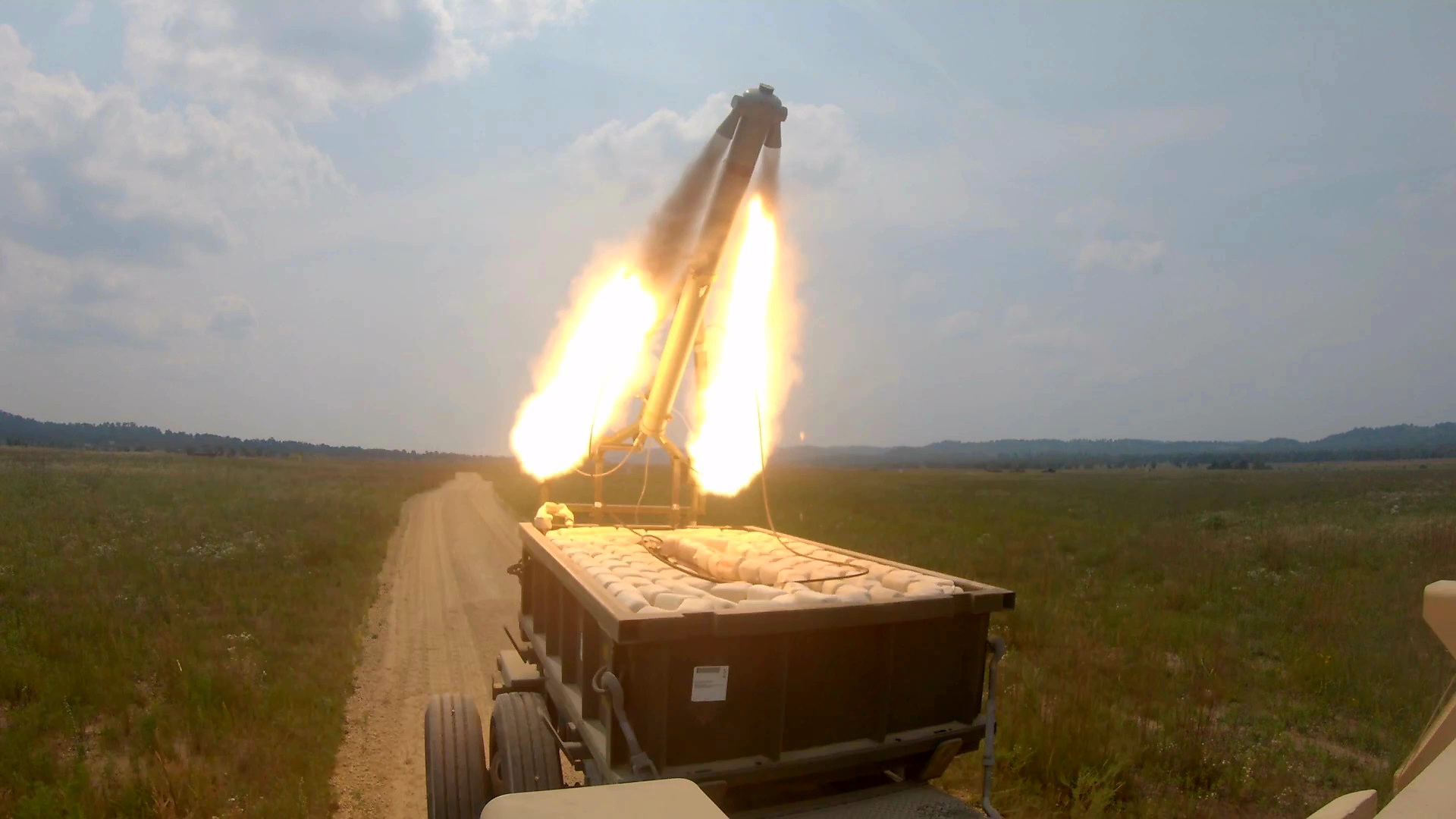
“Today we’ll be firing off a MICLIC, or a Mine Clearing Line Charge,” Schulke said. “This is a breaching tool that the Army and the Marine Corps use to breach minefields. Basically, it’s going to be firing a rocket followed by a line of over 2,000 pounds of explosives, and that will clear a path through the minefield. It’s a pretty big deal because firing a live rocket and a live charge is rarely seen in a training environment.”
The MICLIC, as outlined in a U.S. Army fact sheet, is “a system of systems consisting of a rocket-propelled explosive line charge fired from a MK155 launcher mounted on a M200A1 trailer.”
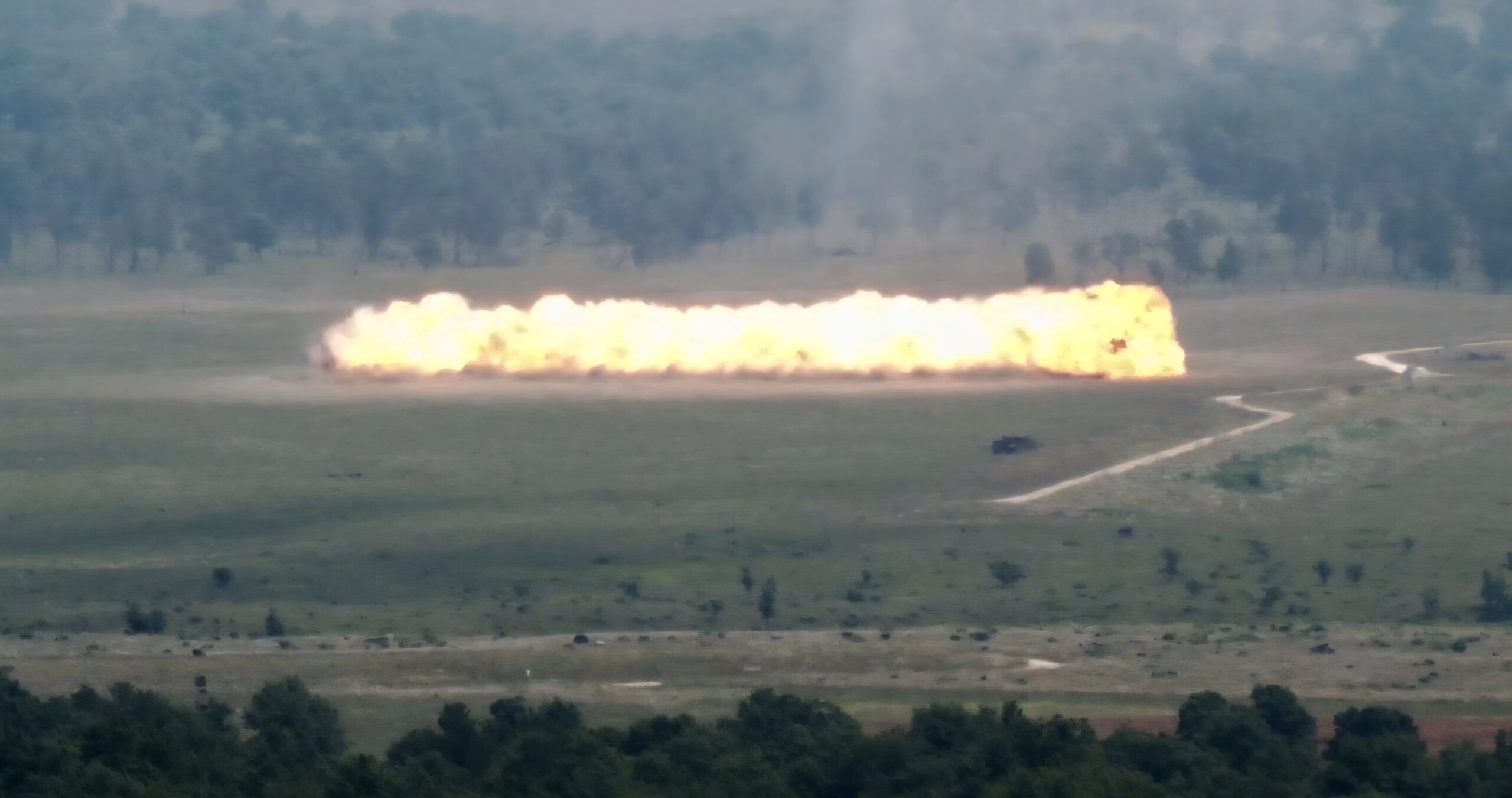
The M58 demolition charge, measuring 350 feet long and made up of 700 C4 block charges, is propelled over the minefield by a MK 22 5-inch rocket motor. Upon detonation, it clears a vehicle-wide lane 100 meters in length. The system can also be fired from the M1150 Assault Breacher Vehicle.
The pre-planned detonation at Fort McCoy went exactly as intended, with the explosion resonating far beyond the installation’s perimeter.
The 469th Combat Engineer Company has a history of advanced breaching training at Fort McCoy. In 2021, the unit was featured in a report by Cheryl Phillips of the 88th Readiness Division Public Affairs Office for conducting live-fire explosive breaching at the post’s dedicated range. Master Sgt. Bradley Schmoll, the unit’s first sergeant, described the breaching capability as a “niche” skill the engineers could employ in urban combat. That training involved constructing several types of charges, each designed for different tactical effects, and using them in coordinated entry operations.
In urban breaching, the report noted, a typical assault stack involves four to six personnel, including combat engineers and the assault force, positioned behind a Kevlar blast blanket. Once a breach is achieved — such as opening a door — the assault force moves in immediately. As described in the 2021 training, the detonator operator counts down from five before initiating the charge.
This year’s detonation was part of two weeks of annual training at Fort McCoy for both the 469th and 402nd Engineer Companies. The MICLIC event served as one of the central highlights of their schedule, providing an opportunity for Soldiers to execute a complex and rarely performed live-fire operation under realistic conditions.
Fort McCoy, a key training site for reserve and active-duty forces, regularly supports engineering and demolitions training designed to keep units proficient in breaching and obstacle-clearing techniques essential for combat operations.
In this case, the combination of heavy explosives, live rocketry, and coordinated engineer expertise offered participating Soldiers valuable experience in a critical combat support role — one that, as Schulke noted, is seldom replicated in peacetime training environments.