


A new prototype aircraft spotted at Hongdu Aviation Industry Group’s facilities in Nanchang has fueled speculation that China is developing a naval variant of an advanced jet trainer modeled after the U.S.-built T-7A Red Hawk.
Images and recently published design patents from China’s National Intellectual Property Administration indicate that the new jet, while externally resembling Boeing’s T-7, features twin engines, reinforced landing gear, and twin canted vertical stabilizers.
According to a 2023 design patent filing (CN 307977940 S), the aircraft — officially referred to as a “twin-tail jet with side-mounted intakes” — was registered by Hongdu Aviation Industry Group. The technical drawings show a two-seat tandem cockpit, prominent air intakes, and key structural adaptations likely aimed at meeting the demands of naval aviation, including arrested landings and catapult launches.
While the jet retains a general silhouette similar to the Red Hawk, including cropped delta wings and blended fuselage contours, it departs in several critical areas. The patent drawings and photos reveal two engine nacelles and a twin-nose wheel undercarriage — both indicators of a platform potentially intended for China’s growing fleet of aircraft carriers.

The emergence of this prototype follows China’s wider push to modernize its naval aviation forces, which currently rely on the JL-9 and L-15 trainers. While the L-15 — also produced by Hongdu — has been exported to several countries and used domestically, it lacks the full capability needed to operate from carriers. This new aircraft may be intended to fill that gap by offering a dedicated carrier-capable trainer jet for the People’s Liberation Army Navy (PLAN).
Industry watchers note that the design’s ruggedized gear, arrestor hook housing, and high-thrust twin-engine layout strongly suggest a deck-landing role.
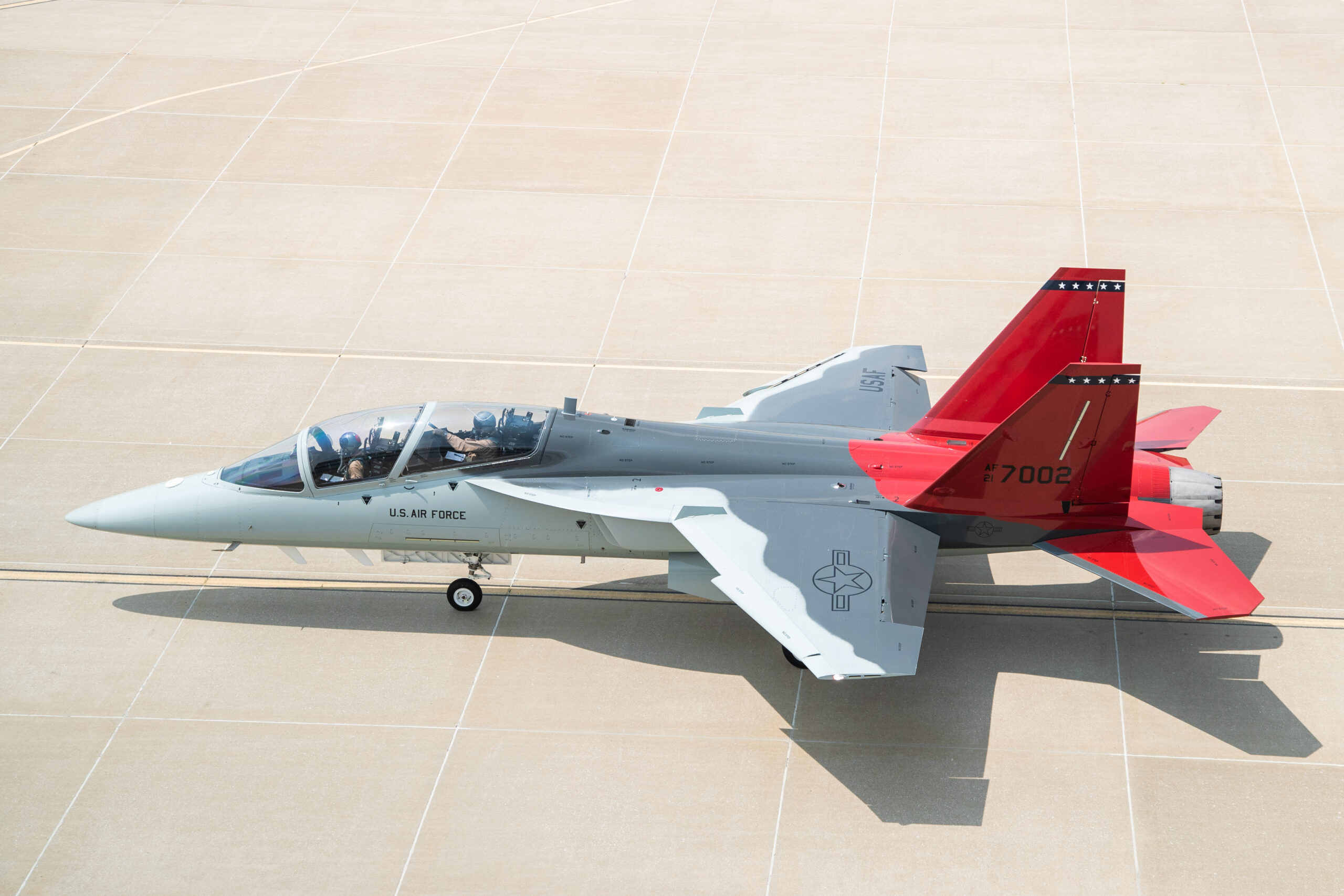
The U.S. Air Force’s T-7A Red Hawk, jointly developed by Boeing and Saab, entered production in recent years as a next-generation trainer designed to replace the aging T-38 fleet. The Chinese design clearly borrows from the T-7’s aerodynamics, but analysts emphasize that its two-engine configuration likely reflects a broader PLAN preference for redundancy and survivability in maritime environments.