


The war in Ukraine has exposed vulnerabilities in traditional armored formations and is forcing European militaries to reconsider how tanks and infantry fighting vehicles (IFVs) will survive on future battlefields. British defense analyst Nicholas Drummond believes these challenges demand urgent attention and adaptation.
In an exclusive response to Defence Blog, Drummond outlined how the widespread use of drones, precision munitions, and evolving combat doctrines are disrupting long-held assumptions about armored warfare.
“The million dollar question is to what extent is the war in Ukraine predictive of future conflict?” Drummond wrote. He observed that while drones have been in military service since the 1980s, their increased sophistication and reduced costs have transformed them into decisive tools on the modern battlefield.
“UAS used for surveillance tasks have lifted the fog of war. UAS used for strike tasks have inflicted a significant number of casualties. Some people say drones have ‘democratised air power,’ meaning that land force units of all types now have an unprecedented capacity to strike enemy targets from the air.”
This capability, he warned, has made armored maneuver more dangerous than ever. “Concentrations of armoured vehicles are rapidly identified, targeted, and destroyed, making it difficult to manoeuvre effectively. The ubiquity of UAS in Ukraine has contributed to an attritional stalemate with both sides now facing each other across a long line of trenches, just like WW1. The problem is that no one has yet developed an inexpensive and effective counter for small aerial targets. Armies need to invest in air defence systems on an unimagined scale. Until these are rolled out widely across NATO, any attempts to conduct combined arms manoeuvre will be futile.”
Despite the focus on drones, Drummond emphasized the continued relevance of artillery. “Some people have suggested that drones will replace artillery, but this is not correct. It should be noted that 155 mm shells fly from A to B regardless of weather, day or night, winter or summer. Standard 155 shells cannot be jammed and are difficult to intercept.” He highlighted that a battery of 155 mm guns could decisively halt an armored assault, suggesting the two systems—drones and artillery—complement each other rather than replace one another.

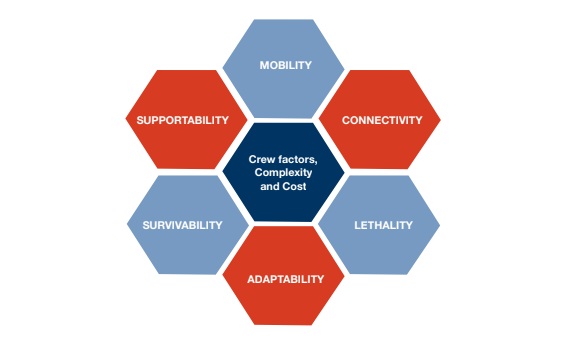
Drummond pointed to a shift in vehicle design priorities beyond the traditional “iron triangle” of firepower, protection, and mobility. “As European defence firms respond to their customers’ needs for new armoured vehicles, the three traditional components remain relevant to system design. But three new elements have become important. These are: (4) connectivity, how vehicle sensors and weapons are networked together to create responsive and efficient kill chains; (5) adaptability, how vehicles can be reconfigured to perform different roles across different mission types; and, (6) sustainability, the logistical burden imposed by a vehicle and the ease with which it can be supported, upgraded, and repaired.”
This six-sided framework forms what he calls the “Armoured Honeycomb.” It underscores how trade-offs in design now extend beyond traditional considerations to include crew factors, complexity, and cost.
In considering future force structures, Drummond identified two complementary types of formations. “Expeditionary and manoeuvre force types complement each other. Expeditionary forces deploy quickly, but have less combat power and resilience. Manoeuvre forces have more combat power and resilience, but deploy more slowly. By having a mix of medium and heavy forces, an army will have more tactical and strategic options.”
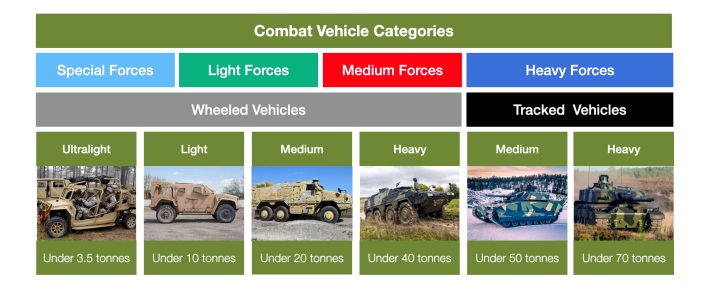
Drummond classifies today’s vehicles into six core types: MBTs, IFVs, 8x8s, 6x6s, protected 4x4s, and ultralight 4x4s. He warns that MBTs face growing economic and operational constraints. “We have reached a point where main battle tanks now cost close to €20 million each, but can be destroyed by a €3,000 drone.”
Yet he argues tanks are not obsolete. “To say that the tank is dead is to ignore the utility and survivability that all armoured vehicles still provide.”
Instead, IFVs are rising in importance. “In many ways, the IFV has become more important than the MBT. It is a mothership… but also a highly flexible combat system.”
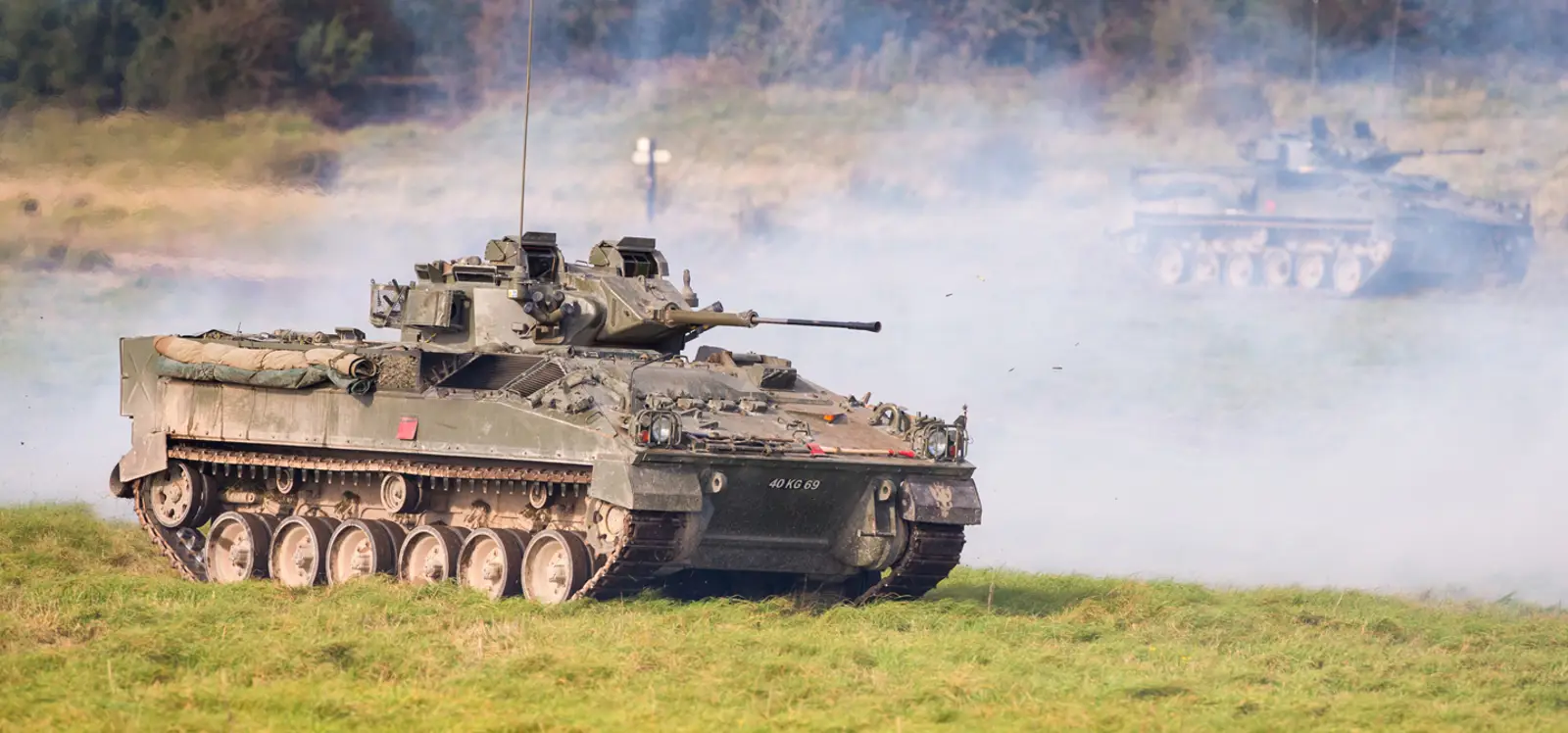
Modern IFVs with airburst munitions will also take on air defense tasks. “We should expect IFV cannons to perform an organic air defence role as well as providing direct fire support.”
On medium-weight vehicles, he notes: “Their primary task is to deliver dismounted infantry mass… This type of vehicle is extremely flexible, providing utility across low, medium, and high intensity conflicts.”
Light 4×4 vehicles, such as the Oshkosh JLTV, are already serving UAS crews in Ukraine. “Vehicles deploy to a location, are camouflaged, and then used to control UAS from under armour… They offer ‘a lot of bang for the buck.’”
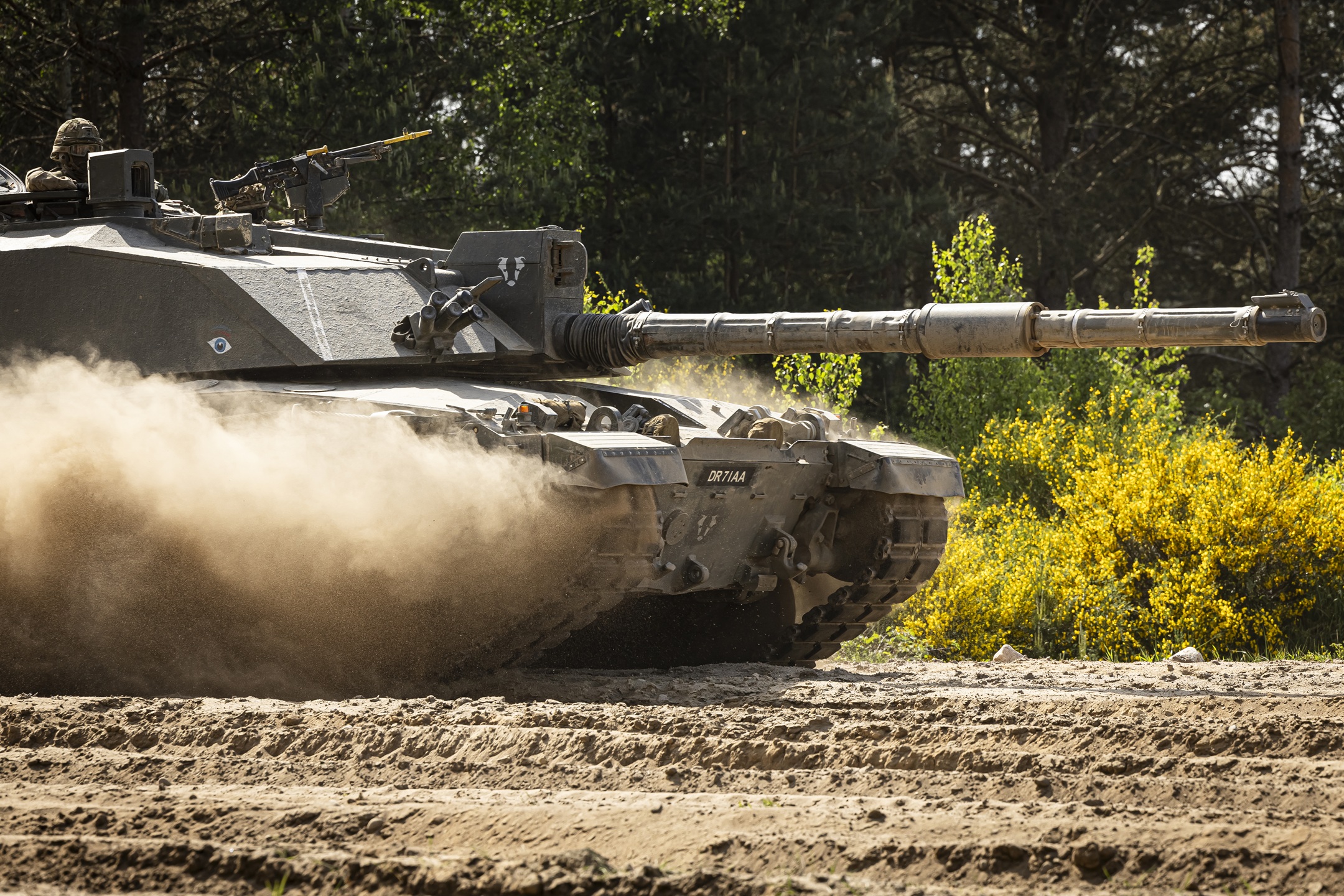
The British Army’s modernization plans reflect this duality, but they come with significant challenges. “A problem for the UK is that it only plans to upgrade 148 of the previous Challenger 2 fleet of 227 tanks. This number was fixed before Russia invaded Ukraine. A total of 148 Challenger 3 MBTs allows two regular and one reserve tank regiment to be generated. Many British Army officers believe that four regular and two reserve tank regiments are now needed.”
Drummond also addressed the British Army’s adoption of Boxer vehicles and the troubled Ajax program. “Moving to the Mechanised Infantry Vehicle programme, Boxer was the preferred 8×8 option with 623 vehicles ordered. Initially, Boxer was intended to provide a medium weight capability for the British Army in dedicated Strike brigades, analogous to US Army Stryker Brigade Combat Teams. After the Warrior upgrade programme cancellation, Boxer was re-envisaged as an IFV substitute.”
Drummond concluded with a sober reflection on Europe’s strategic calculus. “We are moving towards a brave new world of radical military technology, but we are still in a period of transition where legacy capabilities are needed to de-risk innovative new ones as they mature.”
“While the war in Ukraine certainly provides clues about how future conflicts will be fought, a war between NATO and Russia or NATO and China would be very different in character,” he noted. “Since Europe, unlike Ukraine, possesses nuclear weapons, there is a much greater risk of escalation leading to a nuclear exchange.”
According to him, any unprovoked aggression would lead to an immediate conventional response designed to frustrate an assault and buy negotiating time before a nuclear response became necessary.
“To strengthen our negotiating position, we would seek to deliver an emphatic conventional response that would avoid the need to use nuclear weapons. The important point to make here is that
without sufficient conventional mass, nuclear weapons become the first and only option. For this reason, Europe is trying to establish a “Porcupine Defence,” through which sufficient conventional
mass is established so that unprovoked aggression becomes very costly.”
Germany and Poland are leading efforts to rebuild their land forces, Drummond noted. “Germany and Poland are building the largest armies in Europe to provide a significant deterrent effect. In doing so, they are recreating traditional heavy armour forces that existed during the Cold War. Their armies will be similar in size, structure, and capabilities to those possessed by Russia at the beginning of its invasion of Ukraine.”
The British Army wants 3rd (UK) Division to become all-tracked with Challenger 3 and Ajax. Ares would be repurposed as a heavy APC to replace Warrior. Meanwhile, Boxer would go to an all-wheeled 1st (UK) Division. If true, this is EXCELLENT news. All credit to whoever had the… pic.twitter.com/KLFAZ6IA34
— Nicholas Drummond (@nicholadrummond) June 30, 2025
Drummond described the current period as a delicate transition. “We are moving towards a brave new world of radical military technology, but we are still in a period of transition where legacy capabilities are needed to de-risk innovative new ones as they mature. In other words, the restoration of heavy armour capabilities is a hedge against an investment in new technologies that fails to deliver expected returns.”
This strategy, he explained, is producing a “new duality” in force structures. “Legacy heavy armoured platforms are complemented by new light and medium ones. Driving this change is the fact that highly sophisticated heavy armour platforms are difficult to replace once lost. Instead, simpler, low-cost armoured vehicles that can be produced quickly have become a more viable option.”
Drummond cited modular designs such as the M1126 Stryker and ARTEC Boxer as benchmark capabilities. “Vehicles like the M1126 Stryker and the ARTEC Boxer are benchmark capabilities because they provide an optimum balance of the armoured hexagon’s six elements. What really sets them apart is their modularity.”
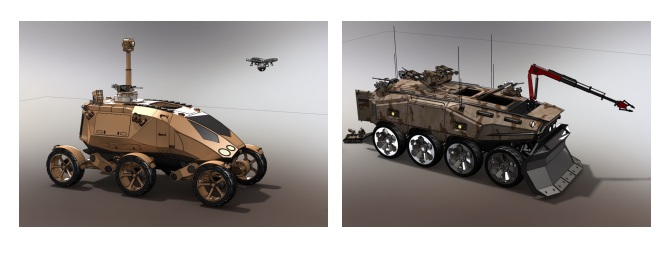
“A common base platform that provides the necessary levels of protection and mobility allows an extensive family of vehicles to be created. Modularity simplifies acquisition, operational use, training, and support. It enables incremental upgrades to be implemented easily while reducing long-term ownership costs.”
He also highlighted drivetrain innovation. “Electric motors are likely to be used more widely… Various manufacturers have developed hybrid electric drivetrains… This delivers increased range and allows the drivetrain to be packaged more efficiently.”
Above all, Drummond called for pragmatism. “In restoring conventional mass, are Germany, Poland, and other European nations, including the UK, recreating armies that would be quickly destroyed should Russia widen its strategic goals and attack NATO? The answer is we do not know. But, if we don’t have conventional mass, then nuclear war becomes unavoidable.”