


The U.S. Army is testing advanced radar technology to counter low-flying drones, as Soldiers from the 3rd Squadron, 2nd Cavalry Regiment mounted an EchoShield cognitive radar system on a Stryker vehicle during a recent exercise at the Hohenfels Training Area in Germany.
The live test took place on June 20, 2025, as part of Project Flytrap, a multinational training initiative aimed at improving counter-unmanned aircraft system (C-UAS) capabilities.
The radar-equipped Stryker successfully detected drone activity and provided real-time location data directly to ground troops’ end-user devices, enhancing situational awareness in complex airspace environments.
According to radar manufacturer Echodyne, EchoShield is a medium-range, software-defined pulse-Doppler radar operating in the Ku-band. It is designed specifically for detecting small, erratic airborne threats such as drones, which often fly below traditional radar coverage and operate in crowded electromagnetic environments.
The company describes EchoShield as a 4D cognitive radar capable of tracking hundreds of objects simultaneously, offering angular accuracy better than 0.5 degrees in both azimuth and elevation. This level of precision allows it to direct optical sensors and countermeasure platforms toward fast-moving threats with minimal delay.
EchoShield addresses those challenges with tailored waveforms and agile beam scheduling. During Project Flytrap, the radar operated in its C-UAS Mission Set mode, which emphasizes short-range drone detection, particularly in areas near the ground or along the horizon where drones are most likely to appear.
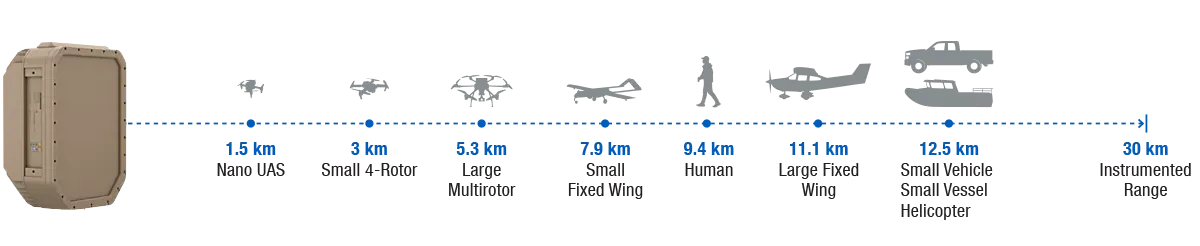
The system also includes a Dismount Mission Set for ground surveillance, with a detection range of over 8 kilometers for human targets and more than 11 kilometers for vehicles. Other mission configurations are available for broader airspace surveillance, on-the-move targeting, and coastal monitoring.
One of the core features of EchoShield is its software-driven flexibility. Users can rapidly switch between mission profiles using pre-set configurations designed to meet specific operational needs. Each mode modifies radar behavior in real-time, ensuring the most effective use of radar energy and data processing.
By integrating radar systems like EchoShield onto mobile platforms such as the Stryker, the U.S. Army is developing a more agile and responsive method for detecting and tracking aerial threats during maneuver operations. Real-time data transfer to Soldiers in the field allows for rapid reaction and tighter coordination with kinetic or electronic response systems.